


Freelancers in North Carolina may owe federal self-employment tax at a rate of 15.3% for 2025, according to the Internal Revenue Service, in addition to applicable income taxes. To understand how to pay taxes as a freelancer in NC, start with two thresholds: the IRS generally requires estimated payments if you expect to owe at least $1,000 in federal taxes, and North Carolina requires them if you expect to owe at least $1,000 in state taxes for 2026.
It’s understandable to find tax rules confusing when no tax is withheld from your client payments. Start by separating self-employment tax, which funds Social Security and Medicare, from federal and North Carolina income tax. Your business profit and eligible deductions help determine what you owe.
This guide explains how self-employment tax works, which federal and North Carolina taxes may apply, and how estimated payments fit into the year. It also covers income records and tax planning, so you can make informed decisions about how to pay taxes as a freelancer in NC.
Key Takeaways
- Separate self-employment tax from federal and North Carolina income tax to understand the different parts of your tax bill.
- Track legitimate business expenses because deductions can affect the income used to calculate your taxes.
- Estimate your tax liability throughout the year to plan for payment deadlines and reduce the risk of underpayment penalties.
- North Carolina’s income tax rate and filing requirements shape what freelancers owe in addition to federal taxes.
- Higher earnings may bring an additional Medicare tax, so your income level matters when planning ahead.
Do I pay quarterly estimated taxes in North Carolina?
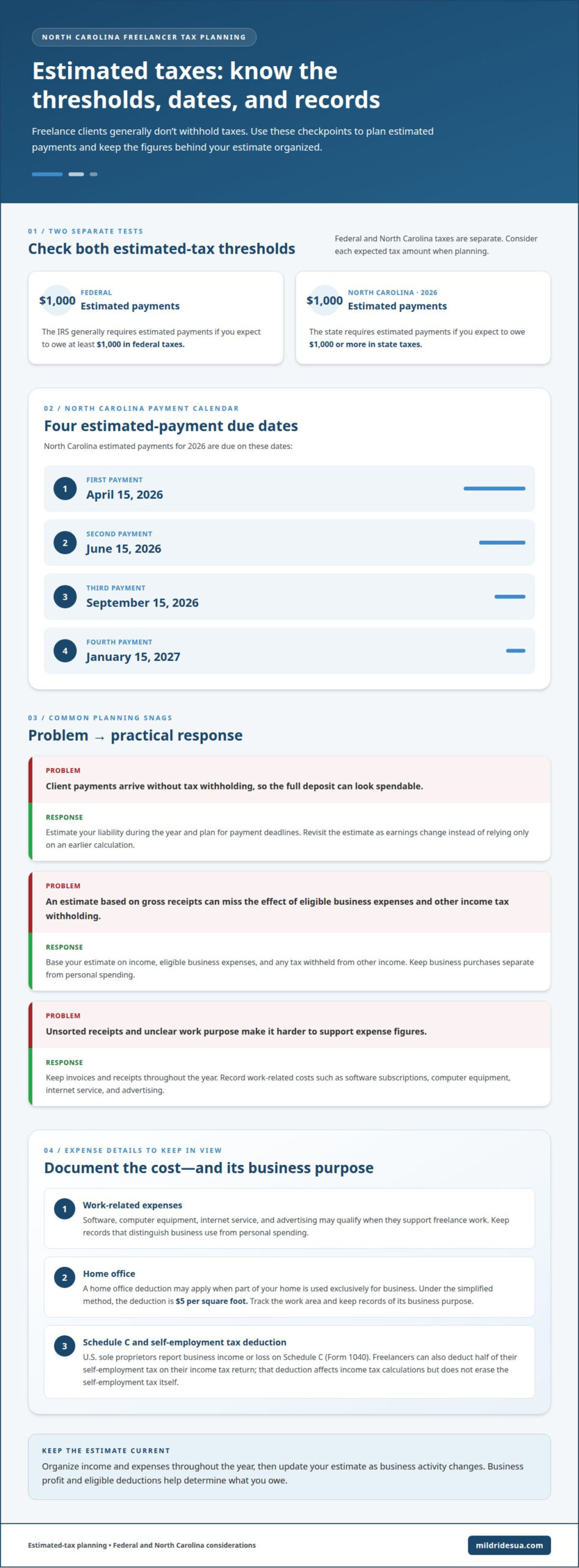
Freelancers may need estimated tax payments because clients generally don’t withhold taxes from freelance income. For 2026, the North Carolina Department of Revenue requires estimated payments if an individual expects to owe $1,000 or more in state taxes. The IRS requires federal estimated payments when a freelancer expects to owe at least $1,000 in taxes. Consider both thresholds when planning payments.
North Carolina estimated payments for 2026 are due April 15, June 15, and September 15, 2026, and January 15, 2027. Your estimate should account for income, eligible business expenses, and any tax withheld from other income. As earnings change, revisit the calculation so payments reflect your current business activity, rather than relying only on an earlier estimate.
Business expenses can reduce the profit used to calculate income and self-employment taxes. Keep invoices and receipts for costs related to freelance work, such as software subscriptions, computer equipment, internet service, and advertising. Separate business purchases from personal spending, and organize records throughout the year. Bookkeeping can help prepare your income and expenses for Schedule C.
A home office deduction may apply when part of your home is used exclusively for business. The simplified method allows a deduction of $5 per square foot. Track the area used for work and keep records showing its business purpose. The method and the expenses available to you affect how the deduction is calculated.
Software, technology, and advertising costs may qualify as business expenses when they support your freelance work. A designer’s design software or a consultant’s business advertisement, for example, may be relevant costs to record. Don’t claim personal technology use as entirely business spending. Clear records help distinguish work-related costs from personal expenses.
Freelancers can also deduct half of their self-employment tax on their income tax return. This deduction affects income tax calculations, but it doesn’t erase the self-employment tax itself. U.S. sole proprietors report business income or loss on Schedule C (Form 1040), according to the Internal Revenue Service. Eligible expenses and this deduction serve different purposes in the calculation.
Do freelancers in North Carolina need to collect sales tax? It depends on what they sell: North Carolina sales tax on physical goods is 4.75%, plus local tax of 2% to 2.75%. A freelancer’s service or product type determines whether sales tax collection applies.
To register a freelance business with the North Carolina Department of Revenue, set up the state tax accounts that apply to your activities. The accounts you need depend on what your business does, including whether you sell goods subject to sales tax.
North Carolina income tax rate
North Carolina’s individual income tax rate can change over time. This flat rate applies to taxable income, not automatically to every dollar of freelance receipts. Your taxable amount depends on business profit, allowable deductions, filing status, and other income. A freelancer also needs to account for federal income tax and self-employment tax separately.
North Carolina’s individual income tax rate can change over time, so check the current rate when estimating your state tax. That change affects state income tax calculations, but it doesn’t determine your full tax bill. Federal rates range from 10% to 37%, and the applicable rate depends on taxable income and filing status. North Carolina residents file state income using Form D-400.
Start by adding up business revenue, then subtract eligible expenses to determine net profit. Net profit is not necessarily the same as taxable income, because other income, deductions, and filing status can affect the final calculation. Keep income and expenses organized by tax year to support the figures on your return.
For 2026, North Carolina’s standard deduction is $12,750 for single filers, $19,125 for heads of household, and $25,500 for married couples filing jointly. The federal standard deduction for single filers is $16,100 for 2026. These state and federal deductions are separate, and filing status affects which amount applies. Consider them alongside itemized deductions and business expenses.
Illustrative combined federal and North Carolina tax estimates show how profit changes the planning picture. A single self-employed filer with $40,000 of profit is estimated to owe $9,077. At $60,000 of profit, the estimate is $14,932; at $80,000, it is $21,804. A single filer with $120,000 of profit is estimated to owe $37,230. These estimates are examples, not a substitute for calculating your own taxable income and tax liability.
Set aside part of each payment rather than treating all freelance earnings as spendable income. A planning guideline is 25-30% of profit for taxes. Your estimate should reflect business expenses, other employed income, filing status, and applicable deductions. Recalculate as earnings change, then use the updated estimate to guide quarterly payments.
For a clearer estimate, organize profit, filing status, and deductions before preparing your return. A freelance tax projection can help connect those details to a forward-looking payment plan.
Federal self-employment tax rates
Freelancers may owe both federal income tax and self-employment tax on business earnings. These are separate obligations, and distinguishing them is central to understanding how to pay taxes as a freelancer in NC.
Who Pays Self-Employment Taxes
Self-employment tax generally applies to people earning income through freelance work or a sole proprietorship. The Internal Revenue Service requires an annual federal tax return if net self-employment earnings are $400 or more. This filing threshold helps freelancers identify when business income triggers a federal return, including when they also earn wages from employment.
Freelancers with both wage income and independent earnings may have tax withheld from wages, but not from client payments. Track each income stream separately to see what has already been paid and what remains due. For example, a consultant with a part-time job should distinguish withheld wage taxes from freelance earnings when planning federal taxes.
What Self-Employment Tax Covers
Self-employment tax funds Social Security and Medicare contributions. For W-2 employees, Social Security tax is 6.2% and Medicare tax is 1.45%, with employers paying the other half of each. Self-employed workers cover both shares through this separate employment tax calculation.
The U.S. federal self-employment tax rate is 15.3%, according to the Internal Revenue Service. This federal rate doesn’t change based on whether a freelancer lives in North Carolina or another state. State income tax remains a separate calculation, so a North Carolina freelancer should plan for the federal and state obligations independently.
Calculating Self-Employment Tax
Freelancers calculate self-employment tax using net earnings, not gross receipts. The calculation method applies the tax to 92.35% of net earnings. Self-employed individuals use Schedule SE (Form 1040) to calculate self-employment tax, according to the Internal Revenue Service. This process turns business profit into the earnings figure used for the tax calculation.
Subtract eligible business expenses from freelance revenue to determine net profit. Then use the applicable calculation method and Schedule SE to calculate self-employment tax. Software can organize income and receipts, but accurate results depend on accurate entries. Understanding these steps is a practical starting point for how to pay taxes as a freelancer in NC.
Self-employed individuals can deduct half of their self-employment tax when calculating income tax. This deduction can affect how income tax is calculated, while the self-employment tax calculation is considered separately. Keep the deduction separate from the tax calculation to understand how each amount affects your return.
Quarterly estimated tax payments
Estimated payments help freelancers pay federal and North Carolina taxes during the year. The amount depends on expected taxable profit, applicable deductions, and taxes already withheld or paid.
Quarterly Estimated Tax Requirements
Freelancers who expect to owe $1,000 or more in taxes must make quarterly estimated payments, according to the Internal Revenue Service. North Carolina requires estimated tax payments if an individual expects to owe $1,000 or more in state taxes, according to the North Carolina Department of Revenue. These are separate federal and state tests, so assess each obligation independently.
A freelancer without paycheck withholding may need to plan for both federal and state taxes. Include self-employment earnings and income from other work when estimating your total tax. If business income changes, update the estimate rather than relying on an outdated calculation.
Combining Federal and State Tax Estimates
A combined estimate brings federal income tax, self-employment tax, and North Carolina income tax into one planning view. Calculate each separately first, because a deduction or payment affecting one tax may not affect another in the same way.
Begin with expected freelance profit after eligible expenses, such as a qualifying home office deduction. Add other taxable income and account for withholding or payments already made. Track federal and state amounts separately so a payment for one is not mistaken for credit toward the other.
North Carolina Estimated Tax Payments
North Carolina estimated payments cover state income tax expected from earnings without sufficient withholding. The amount depends on projected income, filing status, deductions, and payments already credited. Keep a record of each payment, including its tax year and state designation.
If your income rises after a large project, revisit your North Carolina estimate. A home office deduction may affect taxable profit, but it does not replace calculating your state tax liability. Reassess the estimate as revenue and expenses change.
Estimated Tax Payment Dates
For 2026, North Carolina estimated payments are due April 15, June 15, and September 15, 2026, and January 15, 2027. The schedule divides payments across the tax year, but freelance income may arrive unevenly. Keep each deadline visible in bookkeeping records.
A North Carolina taxpayer can skip the January estimated payment if they file and pay in full by January 31. Align that choice with the final tax calculation, not simply the calendar. Recording payment dates and amounts helps reconcile estimates with the filed return.
How do you calculate estimated taxes as a freelancer in North Carolina? Project income and eligible expenses, calculate federal and state liabilities separately, then account for withholding and payments already made. The IRS Form 1040-ES can help calculate federal estimated payments.
Late or insufficient estimated payments may result in a penalty. North Carolina taxpayers can avoid underpayment interest by paying at least 90% of current-year tax or 100% of prior-year tax, whichever is less.
Additional Medicare tax thresholds
Freelance income can affect more than ordinary income tax and self-employment tax. For 2025, an additional Medicare tax applies at 0.9% to income above a threshold that depends on filing status. A North Carolina freelancer should consider this federal tax separately from state income tax and standard Medicare contributions.
The applicable 2025 thresholds are:
- Single taxpayers: income above $200,000.
- Married couples filing jointly: income above $250,000.
- Married taxpayers filing separately: income above $125,000.
These thresholds are not interchangeable. For example, a married freelancer filing separately uses the $125,000 threshold, not the joint-filing amount. Filing status therefore matters when estimating whether income crosses the applicable limit. The additional rate applies to the income above that threshold, rather than changing North Carolina’s individual income tax rate.
Freelance earnings are only one part of your annual tax picture. Wages, freelance profit, deductions, and filing status can all affect your overall estimate. Organize income records by source, then compare the relevant income with the threshold for your filing status. This can help you determine whether to include additional Medicare tax in your projection.
Keep this calculation distinct from regular self-employment tax. The regular tax includes Social Security and Medicare contributions, while the additional Medicare tax is a separate 0.9% charge above the applicable 2025 threshold. A deduction that affects taxable income may not change every tax calculation in the same way, so avoid treating one estimate as a substitute for another.
For instance, a single freelancer with income below $200,000 doesn’t cross the listed 2025 threshold. A married couple filing jointly compares its income with $250,000 instead. If income exceeds the relevant amount, calculate the additional tax on the excess, then include it in the federal estimate. North Carolina residence doesn’t change which filing-status threshold applies.
As income changes during the year, update your annual projection and keep records of wages and independent business earnings. A maintained estimate can help distinguish regular Medicare contributions from additional Medicare tax, while keeping federal planning separate from North Carolina income tax. This distinction is useful when freelance revenue or employment income changes.
Review your freelancer tax plan to account for filing status, income sources, and the applicable Medicare threshold.
Mildrid Esua, CPA, PLLC: Back Taxes & IRS Tax Relief
Mildrid Esua, CPA, PLLC helps freelancers address back taxes, unfiled returns, tax liens, and IRS matters through tax resolution and IRS representation. For individuals and businesses in Greensboro, Burlington, Winston-Salem, and nearby North Carolina communities, tax planning and preparation can bring current filing decisions and outstanding tax issues into a clearer strategy.
When freelance records need structure, bookkeeping can help organize business income and expenses. An accountant and tax advisor for small businesses can also support informed decisions about ongoing tax responsibilities. The next step depends on whether you need help resolving past-due obligations, preparing returns, or planning future payments.
Contact Mildrid Esua, CPA, PLLC to discuss your tax situation and the support that fits your needs.
Build a Tax Routine That Supports Your Next Move
Freelance work can shift as projects, clients, and business priorities change, so your tax routine should adapt too. Set a regular time to review income records, organize expenses, and update your plans when your work changes. This forward-looking habit makes tax decisions part of managing your business, rather than a task postponed until filing season.
Understanding how to pay taxes as a freelancer in NC gives you a stronger foundation for decisions throughout the year. If a return is overdue, records are difficult to organize, or you need to connect tax obligations with business plans, experienced support can help clarify a practical next step. Mildrid Esua, CPA, PLLC can discuss your situation and relevant support.
Contact Mildrid Esua, CPA, PLLC to discuss your tax needs and plan your next step. With an organized approach, you can keep your attention on building your freelance business with greater clarity.
Frequently Asked Questions
What is Self-Employment Tax?
Self-employment tax is a federal contribution toward Social Security and Medicare, based on self-employment earnings. It is separate from federal income tax, so a freelancer’s return may involve both calculations. Someone with freelance income and a part-time job, for example, needs to distinguish wages, where tax may be withheld, from business earnings. That separation makes records and tax estimates more useful.
How much tax do 1099 workers pay in North Carolina?
There isn’t one combined rate for every 1099 worker. The federal self-employment tax rate is 15.3%, and the North Carolina individual income tax rate is 3.99% for 2026. Federal income tax also depends on taxable income and filing status, while business deductions affect the income used in calculations. Treat these as separate tax components, not percentages to simply add onto every dollar received.
Should you form an LLC or S corp in North Carolina?
Choose a business structure based on liability, administration, and tax planning needs, not just its name. By default, a single-member LLC is taxed federally as a sole proprietorship, so forming one does not by itself change federal income tax. An S corporation election changes the tax framework and adds payroll considerations. Review expected profit, administrative responsibilities, and long-term plans before deciding which structure fits.
What tax write-offs can I claim?
Freelance write-offs generally need a clear business purpose and supporting records. Potential categories include software, advertising, business travel, and qualifying home office expenses. The simplified home office method uses $5 per square foot, and the workspace must be used exclusively for business. Keep invoices and receipts organized by category. Personal expenses don’t become business deductions simply because you sometimes use them while working.
When must North Carolina freelancers make federal estimated tax payments?
Freelancers who expect to owe $1,000 or more in taxes must make quarterly estimated payments, according to the Internal Revenue Service. Estimate the federal amount using projected business profit, other income, deductions, and tax already withheld. For a freelancer whose income changes during the year, revise the projection after major shifts in client work instead of carrying forward an outdated estimate.
How do freelancers pay North Carolina state estimated income taxes?
Freelancers calculate the expected state income tax, then make estimated payments to the North Carolina Department of Revenue. The state requires estimated tax payments if an individual expects to owe $1,000 or more in state taxes. Keep state payments separate from federal payments in your records, including the tax year and amount. This makes it easier to reconcile estimates against the North Carolina return.
What are the quarterly estimated tax payment deadlines for 2026?
North Carolina’s estimated tax payment deadlines for 2026 are April 15, June 15, and September 15, 2026, followed by January 15, 2027. Record each date alongside the payment amount and tax year. Freelance income can arrive unevenly, so update estimates when projects or expenses shift. A January payment can be skipped if you file and pay in full by January 31.
What North Carolina tax deductions can freelancers claim?
North Carolina freelancers can consider the state standard deduction that matches their filing status: $12,750 for single filers, $19,125 for heads of household, or $25,500 for married couples filing jointly in 2026. Business expenses are handled separately from the personal standard deduction. Self-employed individuals must file an annual federal tax return if their net self-employment earnings are $400 or more.




Leave a Reply
Your email is safe with us.