

The lowest CPA fee isn’t always the clearest measure of value. In Greensboro, the cost depends on the work involved, such as preparing an individual or business return, addressing complex tax details, or providing bookkeeping and accounting support. To understand how much a CPA costs in Greensboro, compare the scope of work and pricing model, not just the initial fee.
It’s reasonable to want a predictable cost before you entrust someone with your taxes or business records. A CPA may charge by the hour or set a fee for a defined service, and the final price depends on the case and is provided after a quote request. Complexity, the records involved, and the type of support needed all shape the work.
This guide explains common CPA pricing models, hourly fees, and factors that can affect costs. You’ll also learn how to assess what’s included, so you can choose support that fits your tax and accounting needs.
Key Takeaways
- Compare flat-fee and hourly arrangements by the work each includes, not just the quoted amount.
- Return complexity, recordkeeping needs, and the level of accounting support can all shape the overall cost.
- Before choosing a CPA, clarify the scope of work and which services are included in the fee.
- Lower-cost or free tax preparation may suit straightforward situations, while more involved tax needs can call for broader professional support.
- Understanding your needs first can help you choose support that fits your tax situation and business goals.
CPA pricing models
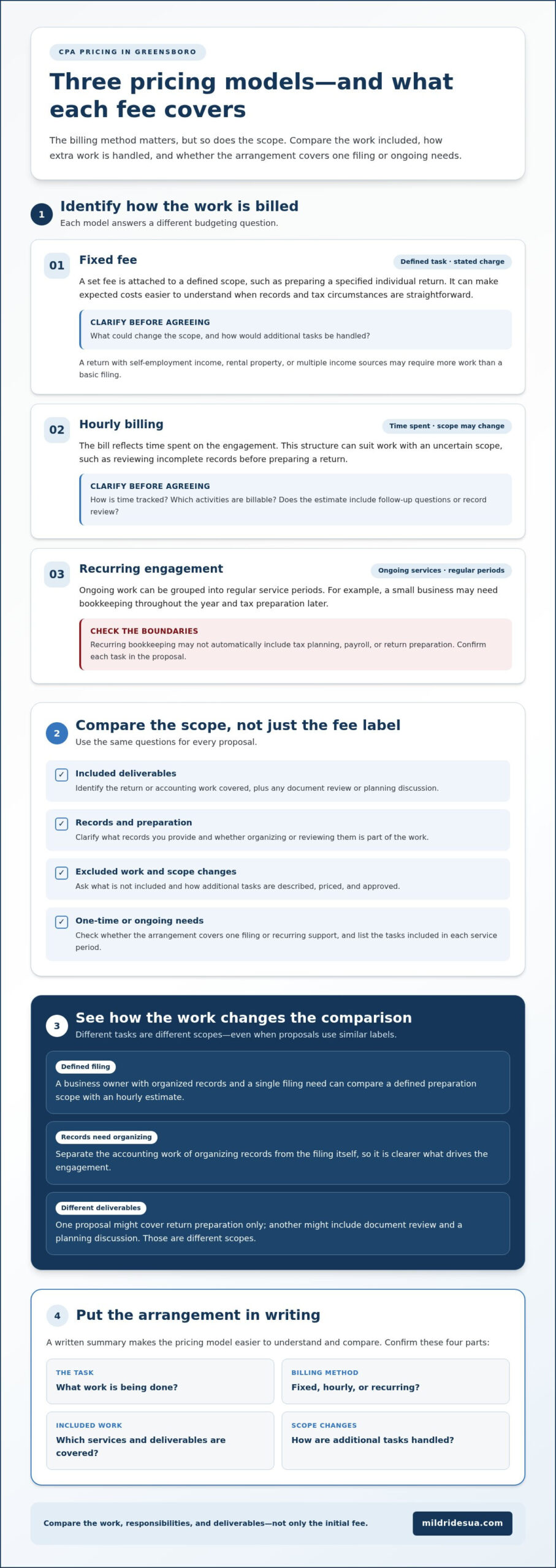
To understand how much a CPA costs in Greensboro, first identify how the work will be billed. The fee may be tied to a defined task, time spent, or ongoing support. Each model raises a different budgeting question: What work is included? How could additional work affect the total? Does the arrangement cover one filing or ongoing needs?
A fixed fee assigns a stated charge to a defined scope, such as preparing an individual return. This can make the expected cost easier to understand when records and tax circumstances are straightforward. The scope matters: a return involving self-employment income, rental property, or multiple income sources may require more work than a basic filing. Ask what could change the scope and how additional tasks are handled.
An hourly arrangement ties the bill to the time spent on the engagement. This structure can suit work with an uncertain scope, such as reviewing incomplete records before preparing a return. The total reflects the work required, not just the original task description. Ask how time is tracked, which activities are billable, and whether the estimate includes follow-up questions or record review.
A recurring arrangement can group ongoing accounting work into regular service periods. For example, a small business may need bookkeeping throughout the year and tax preparation later. Check that each task is clearly described in the proposal. Recurring bookkeeping may not automatically include tax planning, payroll, or return preparation. Written boundaries help clarify which services the fee covers.
- Fixed fee: A defined task has a set scope, such as preparing a specified return.
- Hourly billing: Charges reflect time spent on work whose scope may change.
- Recurring engagement: Ongoing services are arranged for a regular period, with included tasks defined.
Compare proposals by matching the work, not just the fee labels. One might cover return preparation only, while another includes document review and a planning discussion. Those are different scopes, even if both are described as tax preparation. Ask for the included deliverables, excluded work, billing method, and process for approving additional tasks.
For example, a Greensboro business owner with organized records and a single filing need can compare a defined preparation scope with an hourly estimate. If the records need organizing, distinguish that accounting work from filing. This makes it easier to see what drives the engagement and decide whether one-time or ongoing support fits.
Before agreeing, summarize the arrangement in writing: the task, billing method, included work, and how scope changes are handled. Clear terms turn a pricing model into a useful planning tool and help you compare services based on the work your tax situation requires.
Choosing a CPA
Compare written quotes for the same tax situation, requested work, and expected deliverables. To verify a North Carolina CPA license, search the CPA’s name using the North Carolina State Board of CPA Examiners’ license verification tool and confirm the listing matches the person you’re considering.
Describe your filing and support needs consistently to each CPA. For example, explain whether you have wage income, self-employment income, rental property, or business records. A quote for a simple individual return isn’t directly comparable with one covering business income and bookkeeping. Sharing the same information makes the comparison more meaningful.
Next, review what each proposal covers. A useful written scope identifies the return or accounting work, the records you need to provide, and the deliverables you’ll receive. It should also explain how additional work is handled if the records reveal another issue. Clear boundaries help distinguish a lower initial quote from a broader service package.
- Scope: Match the tax forms, income sources, and accounting tasks included.
- Records: Note whether you organize documents or the CPA performs additional review.
- Communication: Identify how you’ll share information and receive questions or updates.
- Follow-up: Confirm whether post-filing questions or tax notices fall within the engagement.
- Billing: Compare the stated fee structure and how added work is approved.
Fit matters beyond the quote. An individual with one employer and organized records may need a different working relationship from a small business owner tracking income, expenses, and payroll. Choose a CPA whose experience aligns with the return or accounting support you need. Ask how the work will proceed, what information is needed first, and who will communicate with you.
Communication is part of the service. Consider whether the CPA explains unfamiliar terms clearly and outlines next steps after reviewing your situation. For instance, a business owner with incomplete monthly records may need to organize them before return preparation begins. That conversation clarifies responsibilities and the sequence of work.
License verification and a written engagement scope serve different purposes. The North Carolina State Board of CPA Examiners’ lookup helps verify the license listing, while the engagement document explains the work and billing arrangement. Review both before proceeding. Compare proposals based on the same needs, responsibilities, and deliverables, rather than choosing solely by the lowest quoted amount.
Factors affecting CPA fees
A CPA’s workload depends on the records, income sources, and decisions involved. A return with one wage statement differs from one combining self-employment income, rental property, and business activity. Each additional source may need separate review, reconciliation, and tax treatment. The more information that needs organizing and checking, the broader the preparation work.
Business structure also shapes the engagement. A sole proprietor, single-member LLC, and partnership can have different records and filing responsibilities. A partnership return, for example, may require details about business income and each partner’s share. Multiple owners, separate business activities, or changes during the year can add review steps. Clearly explain your entity structure and ownership when describing your needs.
Record quality can affect the work required before preparation. Organized statements, categorized expenses, and complete income records help a CPA review the facts efficiently. Missing receipts, unreconciled accounts, and transactions mixing personal and business use need clarification. A business owner without consistent books may need accounting work before a return can be prepared accurately. Bookkeeping or accounting for some self-employed individuals, property owners, and businesses is separate from the listed tax preparation fees.
- Income complexity: Self-employment, rental, and business income can require additional classification and review.
- Entity structure: An LLC with multiple members may involve more coordination than a straightforward individual filing.
- Record condition: Complete, categorized records reduce the need to resolve gaps or reconcile transactions.
- Additional services: Bookkeeping, accounting, or audit support may sit outside tax return preparation.
Timing and prior-year issues can also affect the scope. An unfiled return may require reconstructing income and expenses from records across several periods. A tax notice may require reviewing prior filings and correspondence, not just preparing the current return. Tell the CPA which years or notices are involved so the proposed work reflects the actual task.
Scope changes matter, too. A quote for preparing a return may not cover bookkeeping cleanup, amended filings, or responses to later questions. Ask which deliverables are included and how newly identified work will be approved. Listed tax preparation fees do not include audit support. This distinction helps you compare proposals without assuming every tax-related task is bundled together.
Your price depends on the return’s complexity, record condition, entity structure, and support requested. Before accepting a quote, provide a clear summary of your income sources, business activities, records, and prior-year concerns. Specific details help align the proposed scope with the work your situation requires.
Hourly CPA fees
The total depends on the time required for the specific work, so the hourly rate alone doesn’t reveal the full cost. Reviewing organized records may take less effort than researching unclear transactions or resolving missing information.
Hourly billing can suit work whose scope is difficult to define at the outset. A CPA may need to review records, identify questions, and determine what further work a tax matter requires. Each additional task can add billable time. Ask which activities count, how time is tracked, and how you’ll be told if the work expands.
For example, a small business owner may request help understanding expenses before preparing a return. The CPA may review transaction records, clarify classifications, and discuss next steps. These activities are separate from return preparation. A written engagement should show whether hourly work covers only the review or also later preparation and follow-up.
Use the rate as one part of a cost comparison, not the only deciding factor. A lower hourly rate may involve more hours for a particular scope, while a higher rate may cover specialized work. Without an estimate of effort and included tasks, comparing rates alone won’t show which proposal better fits your needs.
- Define the task: Describe the specific review, planning, or preparation you need.
- Request a time estimate: Ask what work the estimate covers and what could change it.
- Clarify billing increments: Confirm how time is recorded for calls, document review, and research.
- Set an approval point: Agree how the CPA will communicate before doing work beyond the original scope.
Records affect the time required. A business that provides categorized income and expense details gives the CPA a clearer starting point. Mixed personal and business transactions, missing statements, or unanswered questions can require additional review. Organize documents before work begins and label unusual items so the CPA can focus on what needs clarification.
Hourly billing also makes communication practices relevant. Ask whether brief questions, meetings, and follow-up reviews are billed, and how updates will be shared. If you expect several conversations, clarify their purpose and scope early. This helps distinguish substantive professional work from the separate deliverables included in a tax or accounting engagement.
Before accepting an hourly arrangement, request a written outline of the task, rate, estimated effort, and process for additional work. Compare the estimate with a defined-fee proposal only after aligning their tasks and exclusions. That way, you can budget around the expected work rather than the rate alone.
Are there low-cost or free tax preparation options in Greensboro?
Free or low-cost preparation can suit a straightforward return, while business income or unresolved tax issues may call for broader help. In Greensboro, compare the type of return each option handles, its eligibility rules, and the support included. A low advertised cost matters less if your situation falls outside the service’s scope.
Start by identifying your filing needs. A person with wage income and organized documents has a different task from someone reporting self-employment income, rental activity, or business transactions. Write down your income sources, filing status, and unusual tax documents. That summary helps you assess whether a basic preparation option fits your return.
Free filing tools and assisted preparation are different approaches. A self-preparation tool asks you to enter information and make decisions yourself. An assisted option involves someone helping prepare or review your information. Before choosing, read the eligibility criteria and determine whether the service covers your income types and filing needs.
- Eligibility: Compare the stated income, return, and assistance requirements with your circumstances.
- Scope: Identify which forms and income sources the option supports.
- Extra charges: Review whether added forms or additional assistance change the cost.
- Support: Determine whether help covers data entry, tax questions, or review of your completed return.
For example, a taxpayer with a side business should check whether an option supports self-employment income. A property owner should see how rental income and expenses are handled. Don’t assume that a service designed for a simple wage-based return also covers these situations. The return’s details determine whether the available support matches the work required.
Gather documents before you begin. Sort income statements, expense records, and prior-year tax information by category. If you’re using a self-preparation tool, keep a record of how you classified unusual items. If instructions are unclear, pause before submitting. Rushed answers can create follow-up work and make an apparently simple filing less straightforward.
Free or low-cost preparation focuses on filing, while a CPA may also help with broader tax and accounting questions. If your records need organizing, your business structure raises questions, or you have unfiled returns, consider whether a basic filing option covers those needs. Tax preparation, bookkeeping, and tax resolution are distinct services, so compare the support offered with the issue you need addressed.
Before selecting an option in Greensboro, use a simple decision process: list your income sources, match them to the service’s eligibility criteria, review what assistance includes, and identify any additional work you need. A straightforward return may fit a basic preparation option. More involved circumstances call for careful consideration of the full scope before you decide.
Mildrid Esua, CPA, PLLC: Tax Planning & Tax Preparation,Bookkeeping IRS Representation small business accounting Tax resolution unfiled tax, tax lien , payroll servies
Mildrid Esua, CPA, PLLC supports individuals and small businesses with tax preparation, planning, bookkeeping, and accounting. If you need more than return filing, the firm also provides IRS representation and tax resolution for unfiled returns, back taxes, and tax liens.
Small business owners can work with the firm for accounting and tax advisory support, including payroll services. Individuals facing unresolved tax matters can get focused help addressing those issues alongside their broader tax responsibilities. Start by clarifying the work you need, whether that means preparing a return, organizing books, or resolving a tax concern.
To discuss your tax or accounting needs, contact Mildrid Esua, CPA, PLLC.
Make Your Next Tax Decision With Clarity
Understanding how much a CPA costs in Greensboro is only part of making a sound decision. Consider how tax support fits your broader financial plans, not just the return you need today. Organized records, clear priorities, and a defined scope can help you manage tax obligations and plan ahead.
Before moving forward, note the questions or concerns you want addressed. They might involve preparing for an upcoming filing, maintaining business records, or resolving an outstanding tax matter. A focused conversation can help identify the right starting point and clarify what work your situation calls for.
For guidance tailored to your circumstances, connect with Mildrid Esua, CPA, PLLC. A considered next step can bring greater direction to your tax decisions and support a steadier path forward.
Frequently Asked Questions
How Much Does a CPA Cost?
CPA costs depend on the work, with preparation fees varying by return type and complexity. These figures cover tax preparation, not audit support.
What is the average cost of a CPA in Greensboro, NC?
There isn’t one average that represents every Greensboro CPA engagement because individual and business returns involve different work. A multi-member LLC or more involved business return may require additional work beyond a basic filing.
What are typical hourly rates for CPAs in Greensboro?
This rate can apply to work billed by time rather than a set return-preparation fee. For example, reviewing unclear transaction records may take more work than answering a focused tax question. Consider the task and estimated hours together, since the hourly rate alone doesn’t show the total engagement cost.
How much does a CPA charge for individual tax preparation in Greensboro?
Complexity can arise from factors such as self-employment income or rental activity, which require additional information to report and review. These figures are for preparation; they don’t include audit support or any bookkeeping or accounting work that may be needed.
How much does a CPA charge to prepare business taxes in Greensboro?
These categories aren’t interchangeable, so identify your business structure and filing needs before comparing a quoted scope.
Do Greensboro CPAs offer flat-fee or hourly pricing?
Both flat-fee and hourly pricing models are used for CPA work. A flat fee can apply to a defined service, such as preparing a specified return; hourly billing reflects time spent on work with a less certain scope. For example, an initial records review may be billed hourly, while return preparation has a defined fee. Compare what each arrangement includes, not just its billing label.
What factors affect CPA fees in Greensboro, such as tax complexity or business size?
Fees depend on the return’s complexity, business structure, records, and requested work. A sole proprietor with organized records presents a different preparation task from a multi-member LLC with incomplete books. Additional bookkeeping or accounting may be needed for self-employed people, property owners, or businesses, and is not included in the listed tax preparation fees. Audit support is also excluded from those preparation figures.




Leave a Reply
Your email is safe with us.