


When transactions are incomplete or difficult to interpret, it can be hard to see how your business is performing. Managing paperwork can also pull attention from customers and daily operations. For small businesses in Greensboro, reliable book keeping services organize routine financial activity into a clearer picture of income, expenses, and business trends.
Bookkeeping is more than data entry or a task to tackle before filing taxes. Up-to-date records help you make informed decisions throughout the year and give tax preparation a more organized starting point. This guide explains what bookkeeping typically covers, how it connects with payroll, accounting, and tax work, and which records and decisions remain your responsibility. It also outlines how to prepare for ongoing bookkeeping and build a practical routine.
Key Takeaways
- Understand how bookkeeping records and organizes transactions, while accounting and tax advisory work interpret the financial picture.
- See how gathering source documents, recording transactions, and reconciling accounts helps keep records dependable.
- Compare book keeping services by scope, communication, reporting, and how they connect with payroll and tax preparation.
- Prepare by identifying your accounts, financial records, payroll processes, and reporting priorities.
- Learn how Mildrid Esua, CPA, PLLC brings bookkeeping together with small-business accounting, payroll, and tax preparation.
What Do Bookkeeping Services Include for a Small Business?
Bookkeeping maintains an organized record of a business’s financial activity. It involves recording and categorizing transactions, then comparing the records with account statements. Accounting builds on this foundation by interpreting the information and supporting broader decisions. Tax advisory work focuses on tax planning. The overview of Bookkeeping introduces the basic role and methods involved.
For a small business, dependable records make it easier to understand where money comes from and where it goes. The scope of book keeping services can reflect transaction volume, business needs, and processes already in place.
For an introduction to the accounting fundamentals behind these tasks, watch this video:
Which recurring tasks can bookkeeping cover?
Recurring bookkeeping tasks can include recording income and expenses, assigning transactions to useful categories, and reconciling accounts. A customer payment, for instance, is recorded as sales income, while a supplier invoice is categorized as an expense. Reconciliation compares the business’s records with bank and card statements to identify missing, duplicated, or mismatched transactions.
Receipts and invoices can be organized with the financial records. Depending on the engagement, reports may also summarize activity for review. Together, these records and reports give the owner and accounting professional a consistent financial picture.
Consider a Greensboro shop that receives customer payments, buys inventory, and pays monthly expenses. Bookkeeping organizes those transactions by type and checks account balances against statements. The owner can then review a clearer summary of sales and spending.
How is bookkeeping different from accounting and tax preparation?
Bookkeeping keeps financial records current and organized as business activity happens. Accounting interprets those records to assess performance, identify patterns, and support business decisions. Tax preparation uses financial information to prepare tax filings. These functions connect routine recordkeeping with planning and filing work.
Mildrid Esua, CPA, PLLC provides bookkeeping alongside small-business accounting and tax preparation, with payroll support for businesses in the Greensboro and High Point area.
How Does a Bookkeeping Process Keep Business Records Reliable?
Reliable records come from a repeatable process, not a last-minute effort to sort through months of activity. Consistent book keeping services connect source documents to recorded transactions, making financial information easier to review. The Corporate Finance Institute’s guide to What is Bookkeeping? also outlines the day-to-day recordkeeping foundation behind this work.
What happens to transactions and supporting records?
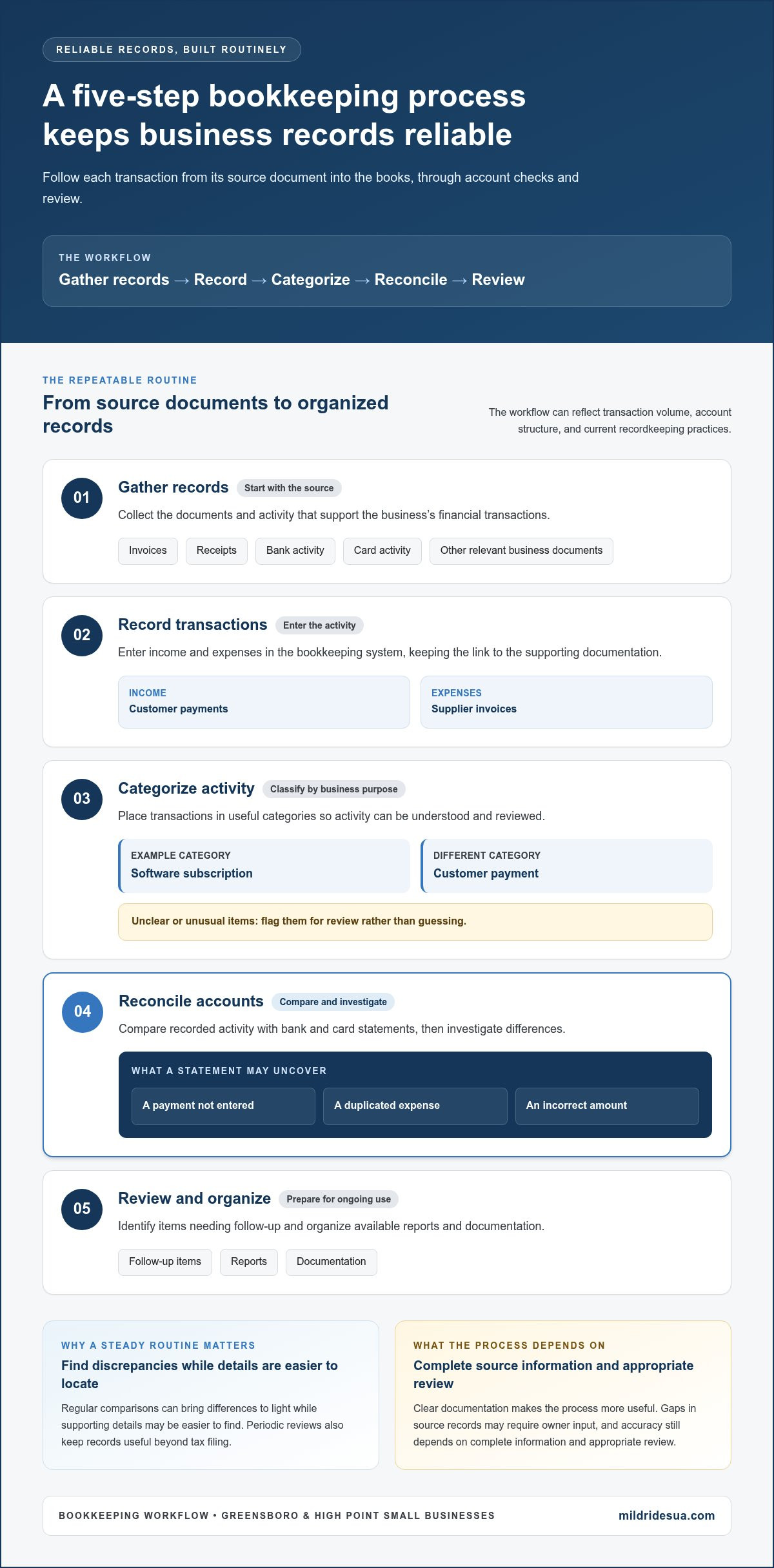
A practical workflow follows each transaction from its source into the books and through review. The details should reflect how the business earns income, pays expenses, and manages its accounts.
- 1. Gather records. Collect invoices, receipts, bank and card activity, and other relevant business documents.
- 2. Record transactions. Enter income and expenses in the bookkeeping system and retain the link to supporting documentation.
- 3. Categorize activity. Classify transactions by business purpose. A software subscription and a customer payment, for example, belong in different categories. Flag unclear or unusual items for review rather than guessing.
- 4. Reconcile accounts. Compare recorded activity with bank and card statements, then investigate differences.
- 5. Review and organize. Identify items needing follow-up and organize available reports and documentation for ongoing use.
The routine can reflect the business’s transaction volume, account structure, and current recordkeeping practices. Clear documentation makes the process more useful, while gaps in source records may require owner input.
Why do reconciliations and regular reviews matter?
Reconciliation compares the transactions recorded in the books with an account statement to identify and resolve differences. A bank statement may reveal a payment that has not been entered, a duplicated expense, or an incorrect amount. Regular comparisons bring discrepancies to light while supporting details may be easier to find.
Periodic reviews also keep records useful beyond tax filing. Waiting until tax preparation to rebuild the books can make it harder to find missing receipts, explain unfamiliar transactions, or separate business activity across accounts. A steady routine supports organized records and gives owners a clearer basis for monitoring operations. Accuracy still depends on complete source information and appropriate review.
For ongoing support, explore monthly bookkeeping for small businesses. Mildrid Esua, CPA, PLLC connects bookkeeping with broader small-business accounting support. Learn about the firm’s accounting support.
What Should Greensboro and High Point Owners Look for in Bookkeeping Services?
The right bookkeeping arrangement should match the way your business operates. A Greensboro service business with a few accounts may need straightforward transaction tracking. A High Point business managing payroll, frequent customer payments, or several types of expenses may need a broader workflow. The goal is consistent records that help you understand operations and prepare for tax work without adding unnecessary complexity.
Which bookkeeping features matter as a business grows?
Compare what the service covers, how questions are handled, what information you receive, and how bookkeeping connects with tax preparation. Clarify who provides records, follows up on unclear transactions, and organizes information for review. Revisit the scope as transaction volume, payroll needs, or business complexity changes.
| Area | What to consider |
|---|---|
| Service scope | Does the workflow fit your transaction volume, accounts, and payroll needs? |
| Communication | Is there a clear process for sharing records and resolving questions about transactions? |
| Reporting | Will you receive financial information in a format and rhythm that supports your review? |
| Tax connection | Are records organized to support tax preparation and coordination with accounting work? |
A small business may be able to manage bookkeeping internally, especially when activity is limited. But if collecting receipts, checking statements, and sorting transactions repeatedly interrupts customer service or operations, the administrative work can outweigh the apparent simplicity. A consistent process also helps prevent records from becoming fragmented as the business changes.
How can organized books support North Carolina tax preparation?
Organized income, expense, account, and payroll records give the tax preparer a clearer starting point for reviewing information related to filings with the IRS or the North Carolina Department of Revenue. Good records do not replace tax preparation or determine the outcome. They make relevant business information easier to review and follow up on.
For example, an owner who organizes business expenses and supporting documents throughout the year may have less to reconstruct when preparing filing materials. The bookkeeping workflow should reflect actual transactions and preserve records for review. For a broader view of how preparation and planning fit together, read strategic tax planning for NC entrepreneurs.
As your business grows, revisiting the workflow can keep recordkeeping aligned with changing operations and support informed decisions.
How Can You Prepare Your Business for a Bookkeeping Engagement?
A thoughtful start helps bookkeeping reflect how your business operates. You do not need to make every record perfect first. Gather what is available, note what is missing, and outline how money moves through the business. This gives the process a practical foundation and helps identify tasks that need ongoing attention.
Which records and details should owners organize first?
Start with information that shows where transactions happen and how they are tracked. You may want to gather:
- Recent bank and credit card statements, along with a list of business accounts.
- Customer invoices, supplier bills, receipts, and existing financial records.
- A description of current bookkeeping habits, including how records are collected and stored.
- An outline of payroll processes, if the business has employees.
- Your reporting priorities, such as the financial information you want to review regularly.
- A short list of missing documents, unfamiliar transactions, or items that need clarification.
Systems vary by business. A solo operator may track activity differently from a growing company with payroll and several accounts. Notes about your current process help shape book keeping services around actual needs rather than assumptions about how every business operates.
How should owners stay involved after bookkeeping begins?
Set a workable routine for sharing records and raising questions. Decide where to provide invoices and receipts, how to communicate payroll information, and how often to discuss reports. Consistent communication gives the bookkeeper context for unusual transactions and helps prevent open questions from lingering.
Continue reviewing financial reports and speak up when activity looks unfamiliar. Bookkeeping organizes information, but it does not replace your judgment about business decisions or your awareness of daily operations. Your perspective can explain a transaction’s purpose and help keep records aligned with the business.
Preparing thoughtfully can also support the connection between ongoing bookkeeping and tax work. For additional context on planning for North Carolina businesses, explore strategic tax planning for NC entrepreneurs.
For bookkeeping support tailored to your business’s records and processes, explore bookkeeping and small-business accounting support.
How Can Mildrid Esua, CPA, PLLC Support Small-Business Bookkeeping?
Mildrid Esua, CPA, PLLC supports small businesses in Greensboro and High Point with bookkeeping alongside small-business accounting, payroll, and tax preparation. The firm also serves businesses and individuals in Burlington, Kernersville, Jamestown, Oak Ridge, Summerfield, and Winston-Salem. This connected support treats recordkeeping as part of an ongoing financial process, rather than a task to revisit only when tax filings are due.
The scope of book keeping services can reflect a business’s records, transaction activity, and needs. A business with straightforward activity may need a different routine from one managing payroll or more complex financial records. Understanding how bookkeeping fits into your operations helps establish a practical process and clarifies where owner input is needed.
How does connected bookkeeping support tax readiness?
Consistently organized records give tax preparation a clearer foundation. Income, expenses, and supporting documents are easier to review when maintained as part of the bookkeeping process, helping surface questions that need attention during preparation.
Bookkeeping does not determine a tax outcome or replace tax advice. Filing work depends on the business’s facts, available records, and applicable rules. Mildrid Esua, CPA, PLLC provides bookkeeping and tax preparation as related forms of small-business support, connecting ongoing records with tax work while accounting for each business’s needs.
What does an ongoing accounting relationship help owners achieve?
An ongoing relationship can help owners maintain visibility into business activity and keep financial records organized over time. Bookkeeping can sit alongside payroll and broader accounting support, so records reflect important parts of how the business operates. Owners still review the information, provide context, and make decisions. Professional support helps create a more dependable basis for that oversight.
Start by identifying the accounts and records you use, the bookkeeping or payroll tasks that take the most time, and the information you want to review. Explore small-business bookkeeping support and discuss a process that fits your needs.
Build a Clearer Financial Routine for Your Business
Reliable records depend on consistent transaction tracking, organized supporting documents, and regular review. Book keeping services can reflect your business’s activity and processes, helping you maintain useful financial information throughout the year instead of piecing it together when tax work is due.
For small businesses in Greensboro, High Point, Burlington, Kernersville, Jamestown, Oak Ridge, Summerfield, and Winston-Salem, Mildrid Esua, CPA, PLLC provides bookkeeping alongside payroll, tax preparation, and small-business accounting. This connected support helps align ongoing recordkeeping with tax preparation and gives owners a clearer foundation for reviewing business activity. Your records and circumstances remain central, and your oversight continues to matter.
Consider which records are difficult to maintain and what financial information would help you make decisions. Then explore bookkeeping support for your small business with Mildrid Esua, CPA, PLLC. A consistent process can help you spend less time untangling financial administration and more time guiding your business forward.
Frequently Asked Questions
How often should a small business have its books updated?
Books should be updated on a consistent schedule that suits the pace of business activity. A business with frequent transactions may need more frequent updates, while a simpler operation may use a different routine. Regular updates help owners identify questions while transaction details are accessible, rather than reconstructing activity at tax time. Agreeing on a practical cadence also keeps records useful for ongoing review.
Can bookkeeping services help prepare a business for tax season?
Yes. Organized records give a tax preparer a clearer starting point by bringing income, expenses, and supporting documents together for review. Bookkeeping does not replace tax preparation or guarantee a particular tax result. Filing work depends on the business’s circumstances, records, and applicable rules. Mildrid Esua, CPA, PLLC provides bookkeeping alongside tax preparation for small businesses in Greensboro and High Point, connecting ongoing recordkeeping with tax work.
What records should I gather before starting bookkeeping services?
Gather recent business bank and card statements, sales invoices, supplier bills, receipts, and existing financial records. List your business accounts and describe how transactions, documents, and payroll information are tracked. You do not need to resolve every gap first. Identify missing records and unfamiliar transactions so they can be reviewed with the available context. The right starting materials depend on how your business operates.
Are bookkeeping services useful for a very small business?
Bookkeeping services can help a very small business when recordkeeping takes time from customer work or financial information is becoming difficult to follow. Even a solo owner may need to track customer payments, business expenses, and account activity consistently. If transactions are limited and records are manageable, an owner may handle routine tracking independently. The key is maintaining a process that supports clear oversight and organized tax preparation.
How much do bookkeeping services cost?
The cost depends on the scope of work and effort required to maintain the records. Factors may include transaction volume, the number of accounts, payroll activity, the condition of the records, and reporting needs. A business with organized records and straightforward activity may require a different level of service from one with more complex workflows. Mildrid Esua, CPA, PLLC tailors small-business bookkeeping support to the business’s records and needs.
What is the difference between bookkeeping and accounting?
Bookkeeping records and organizes financial transactions, while accounting interprets that information to assess business activity and support decisions. For example, bookkeeping organizes revenue and expenses, while accounting can help an owner understand what those figures indicate. Tax preparation is a related service that uses financial records to prepare filings. Mildrid Esua, CPA, PLLC provides bookkeeping alongside small-business accounting, payroll, and tax preparation.




Leave a Reply
Your email is safe with us.