

An S Corp may not be an alternative to your LLC at all. If you’re comparing S Corp vs LLC taxes, start with this distinction: an LLC is a legal business structure, while S corporation status is a federal tax election an eligible LLC may choose. That difference makes the decision less straightforward than it may first appear.
It’s reasonable to ask whether an S Corp election could reduce self-employment taxes, especially as your business becomes more profitable. But the potential tax treatment comes with responsibilities, including paying yourself reasonable compensation, running payroll, and filing a separate business return. If those obligations outweigh the potential benefit for your business, the election may add work without improving your overall tax position.
This guide compares default LLC taxation with S corporation tax treatment in 2026 and explains what the differences may mean for your business. You’ll find practical records to gather, responsibilities to weigh, and questions to raise with a tax professional. A tailored review can help you assess the trade-offs before choosing a tax path.
Key Takeaways
- Separate the legal structure from the tax choice: an LLC may be eligible to elect S corporation tax treatment.
- Compare income reporting, owner compensation, payroll, and ongoing filing responsibilities when assessing S Corp vs LLC taxes.
- Weigh potential employment-tax effects against added payroll and compliance work. An S Corp election doesn’t guarantee lower total taxes.
- Gather prior returns, bookkeeping records, owner duty details, payroll information, and business projections for a tailored comparison.
- Ask a CPA to review eligibility, projected tax treatment, and operational readiness before deciding whether to pursue an election.
S Corp vs. LLC taxes: understand the difference before comparing
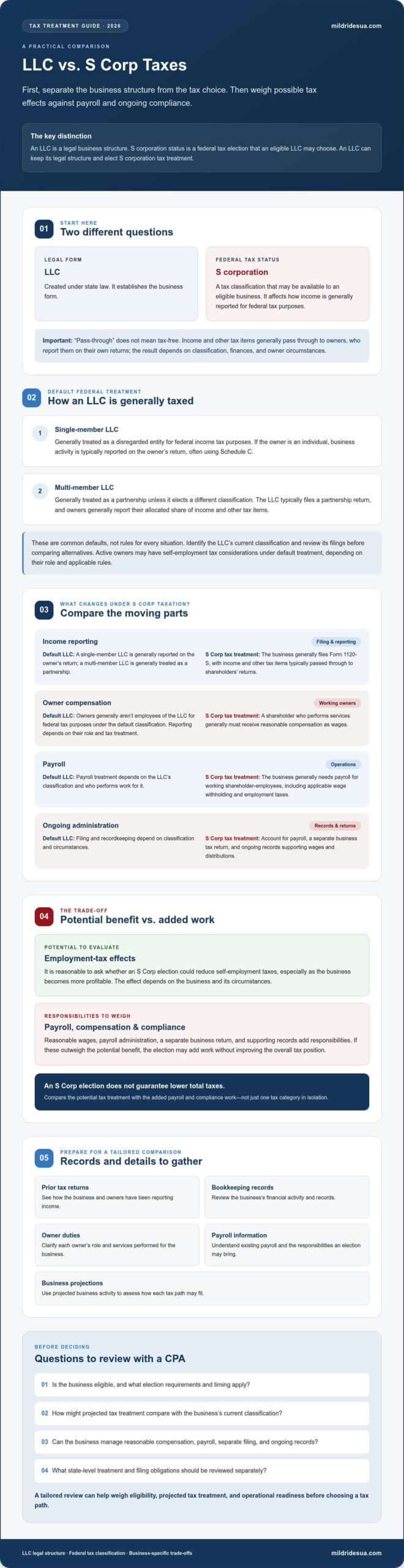
Short answer: An LLC is a business structure formed under state law. S corporation status is a federal tax election available to eligible businesses. An LLC’s federal tax treatment depends on its ownership and any elections it makes, so LLCs aren’t all taxed the same way.
This distinction is the starting point for comparing S Corp vs LLC taxes. “Pass-through taxation” generally means the business passes income, deductions, and other tax items through to its owners, who report them on their own tax returns. It doesn’t mean the income is tax-free. The result depends on the business’s classification, finances, and owners’ circumstances.
Is an S Corp a business entity or a tax status?
An LLC is created under state law; an S corporation is a federal tax status, not a separate state-law entity type. An eligible LLC can keep its legal structure and elect to be taxed as an S corporation. The S corporation tax status is one federal classification that may be available, but eligibility rules and election requirements apply. Confirm whether the business qualifies and when and how to file before changing its tax treatment.
In practical terms, the legal structure and federal tax classification answer different questions. The LLC establishes the business form, while the tax classification determines how the business’s income is generally reported for federal tax purposes. Review state-level treatment and filing obligations separately.
How does an LLC get taxed by default?
For federal tax purposes, the typical default depends on the number of owners:
- Single-member LLC: Generally treated as a disregarded entity for federal income tax purposes. If the owner is an individual, business activity is typically reported on the owner’s return, often using Schedule C.
- Multi-member LLC: Generally treated as a partnership unless it elects a different classification. The LLC typically files a partnership return, and owners generally report their allocated share of income and other tax items.
These are common defaults, not rules for every situation. An LLC may make an eligible election for a different federal tax classification, and special circumstances can affect reporting. Active owners may also have self-employment tax considerations under default treatment, depending on their role and applicable rules.
Before comparing options, identify how your LLC is currently classified and review its filings. This gives you a starting point for understanding which tax treatment applies now and what could change under an election.
How LLC and S Corp tax treatment differs for business income
Tax classification affects how business income is reported and how an owner who works in the business is paid. With an LLC using default federal tax treatment, an active owner’s share of business income may generally be subject to self-employment tax. An S corporation treats a working shareholder as an employee for compensation purposes, which brings payroll into the picture.
| Consideration | LLC using default federal tax treatment | LLC taxed as an S corporation |
|---|---|---|
| Income reporting | A single-member LLC is generally reported on its owner’s return; a multi-member LLC is generally treated as a partnership for federal tax purposes. | The S corporation generally files Form 1120-S, with income and other tax items typically passed through to shareholders’ returns. |
| Owner compensation | Owners generally aren’t employees of the LLC for federal tax purposes under the default classification. Reporting depends on the owner’s role and the LLC’s tax treatment. | A shareholder who performs services for the business generally must receive reasonable compensation as wages. |
| Payroll | Payroll treatment depends on the LLC’s classification and who performs work for it. | The business generally needs payroll for working shareholder-employees, including applicable wage withholding and employment taxes. |
| Ongoing administration | Filing and recordkeeping depend on the LLC’s classification and circumstances. | Owners must account for payroll and a separate business tax return, along with ongoing records supporting wages and distributions. |
How self-employment tax may apply to LLC owners
Income tax and self-employment tax are separate considerations. Income tax applies under the rules for the owner’s taxable income; self-employment tax generally covers Social Security and Medicare taxes on qualifying net earnings from self-employment. Active owners of LLCs using default treatment may owe self-employment tax on business income. The result can depend on the owner’s status, income type, and applicable exceptions, so review the specific facts before estimating the impact.
How S Corp salary and distributions are treated
Reasonable compensation is a central compliance requirement for S corporation shareholders who work in the business. Salary should reflect the services performed, not be set simply to shift earnings into distributions. Wages are subject to payroll taxes. Remaining profits may be distributed and generally receive different employment-tax treatment, but they aren’t automatically tax-free. Income tax, shareholder basis, and other rules still matter. The IRS requirements for S corporations provide federal guidance on these obligations.
Bookkeeping and payroll records are essential to a sound comparison. North Carolina business owners assessing S Corp vs LLC taxes can discuss their circumstances with a CPA familiar with S Corp election guidance, including through small-business tax planning from Mildrid Esua, CPA, PLLC. The firm serves business owners in Greensboro, High Point, Burlington, Kernersville, Jamestown, Oak Ridge, Summerfield, and Winston-Salem.
Does S Corp taxation actually save more than LLC taxation?
No election guarantees a lower total tax bill. S corporation treatment may change how some business income is treated for employment-tax purposes, but weigh that potential benefit against payroll, recordkeeping, and separate filing responsibilities. A useful comparison of S Corp vs LLC taxes considers the business’s full operating picture, not just one tax line.
Potential benefits and trade-offs of an S Corp election
The analysis often turns on the relationship between business profit and reasonable compensation for the owner’s work. A working shareholder must be paid reasonable wages, which are subject to employment taxes. Remaining profit may be distributed under applicable rules, with different employment-tax treatment. The amount left after compensation, the owner’s duties, and the business’s circumstances all affect the comparison.
Consider a hypothetical service business whose owner performs most of the client work. Rather than assume an S Corp election will save money, the owner and tax professional would estimate defensible compensation based on the work performed. They would then compare the resulting employment-tax treatment with the costs and effort of operating under the election. No single profit level or salary formula determines the answer for every business.
For a broader introduction to comparing LLC and S corp structures, readers can consider how tax treatment fits alongside other structural considerations. The right choice still depends on current rules and the business’s individual facts.
What costs and responsibilities belong in the comparison?
Model the responsibilities as carefully as the potential tax effect. An S Corp election generally requires the business to manage payroll, withhold and pay applicable employment taxes, file a separate business return, and maintain records supporting compensation and distributions. It also requires consistent bookkeeping and documentation of the owner’s duties and pay decisions.
Use this practical framework without assuming a result in advance:
- Estimate the potential tax effect: Compare projected business income and reasonable owner compensation under each treatment.
- Map the added administration: Account for payroll processes, tax return preparation, bookkeeping, and recordkeeping.
- Consider owner time: Assess whether the business can reliably manage recurring payroll and compliance tasks.
- Test more than one outlook: Review how the comparison could change if profit, workload, or compensation needs shift.
The value of an election depends on what remains after considering both tax effects and operational demands. A CPA can help build a tailored comparison using your records and projections. Mildrid Esua, CPA, PLLC advises small-business owners on tax planning and S Corp elections, helping them weigh potential benefits against ongoing responsibilities without promising a particular savings outcome.
How to decide between LLC and S Corp taxation for your situation
A sound decision starts with your current tax setup, not a general income threshold or someone else’s experience. Use this framework to organize the facts behind your S Corp vs LLC taxes comparison:
- Identify your current classification. Confirm how the LLC is treated for federal tax purposes and review its recent filings. The state-law entity and federal tax classification are separate questions.
- Review profit and owner compensation. Look at actual and projected business profit, who performs services, and how owners are paid now. Consider whether potential S Corp treatment would require payroll and reasonable compensation.
- Model the tax and operational obligations. Compare projected tax treatment alongside payroll administration, bookkeeping, business return preparation, recordkeeping, and owner time. Evaluate more than one business outlook rather than relying on a single forecast.
- Confirm eligibility and requirements. Check applicable federal rules, election procedures, and timing. Separately verify current North Carolina tax treatment and state filing obligations through authoritative sources.
Questions to answer before making an election
Gather prior business and personal tax returns, current bookkeeping reports, profit projections, payroll details, and a clear description of each owner’s duties. Review ownership, how compensation is determined, and whether your records can support consistent payroll and reporting. The owner’s broader tax position may affect the analysis, so consider the full picture rather than the business return alone.
What should North Carolina business owners verify?
Keep state and federal requirements distinct. North Carolina rules for an LLC’s formation and ongoing filings are separate from federal S corporation election requirements. Confirm current obligations rather than assuming the federal choice changes the state-law entity. Business owners in Greensboro, High Point, Burlington, Kernersville, Jamestown, Oak Ridge, Summerfield, and Winston-Salem can review their circumstances with a CPA who understands the tax-planning questions and the records needed to evaluate them.
For a focused review, bring the documents above and ask how projected income, owner duties, payroll readiness, and filing responsibilities compare under each option. Discuss your business tax planning with Mildrid Esua, CPA, PLLC to assess your circumstances and S Corp election considerations without assuming one tax treatment will suit every business.
Plan an S Corp election or LLC tax strategy with a CPA
A tax election should fit both your financial outlook and the way you run your business. A CPA can review S corporation eligibility, compare projected tax treatment, assess payroll readiness, examine bookkeeping practices, and identify relevant federal and North Carolina filing obligations. That analysis helps you understand the trade-offs rather than focus only on a possible tax benefit.
Mildrid Esua, CPA, PLLC provides small-business tax planning and S Corp election guidance for business owners in Greensboro, High Point, Burlington, Kernersville, Jamestown, Oak Ridge, Summerfield, and Winston-Salem. The guidance is tailored to your circumstances, not a promise that an election will lower your taxes. Bring your records and questions so the discussion can address how the choice may work in practice.
What to bring to an S Corp tax planning discussion
Gather recent business and personal tax returns, if available, along with current bookkeeping reports, ownership information, and payroll records. Note each owner’s responsibilities and how compensation is handled. Write down your business goals, operational concerns, and questions about North Carolina requirements. Clear records help a CPA evaluate your current position and identify what needs further review.
How ongoing accounting supports the decision
Reliable bookkeeping helps you monitor business performance and maintain records that support tax reporting and planning. If S corporation treatment applies, organized payroll records also help track wages and related obligations. For an overview of tax preparation considerations, review the firm’s S Corp tax preparation guide as part of your research.
As you compare S Corp vs LLC taxes, consider whether your records and processes can support the responsibilities that come with the tax treatment you’re considering. A decision based on current information is more useful than relying on a generic income threshold or assumed savings.
Practical next steps: Gather your returns, bookkeeping, ownership and payroll details, and business projections. Confirm current federal and North Carolina rules, then review the implications with a CPA before making an election. North Carolina business owners can discuss their circumstances with Mildrid Esua, CPA, PLLC to make an informed choice that accounts for tax treatment and ongoing administration.
Choose a tax strategy that supports your next stage
The central takeaway from comparing S Corp vs LLC taxes is that an LLC is a legal structure, while S corporation treatment is a tax election that may be available to an eligible business. The election can affect how owner compensation and business income are handled, but it doesn’t guarantee lower total taxes.
Weigh potential employment-tax effects against payroll, bookkeeping, separate filing, and recordkeeping responsibilities. Your current classification, business projections, owner duties, and ability to maintain consistent records all inform the decision. Review federal rules and North Carolina obligations before you act.
Mildrid Esua, CPA, PLLC provides CPA-led tax planning and preparation for small businesses, along with S Corp election and self-employment tax guidance. Bookkeeping and payroll services can also support ongoing business compliance. For an individualized review of your circumstances, discuss your business tax strategy.
Bring your returns, current financial records, and questions about payroll and state requirements. A thoughtful comparison can help you make an informed decision and move forward with greater confidence.
Frequently Asked Questions
Is an LLC or S Corp better for taxes?
Neither is automatically better. The right choice depends on your business’s circumstances and ability to manage its tax and administrative responsibilities. An LLC may use its default federal tax treatment, while an eligible business may elect S corporation treatment. Compare projected income and owner compensation alongside payroll, bookkeeping, and filing obligations. A CPA can model your circumstances instead of relying on a general income threshold or assuming an election will lower your total taxes.
Can an LLC be taxed as an S Corp?
Yes, an eligible LLC can generally elect to be taxed as an S corporation for federal tax purposes while retaining its LLC legal structure. The election doesn’t change the entity into a different state-law form. Eligibility requirements, filing procedures, and timing apply, so confirm them for your ownership and business circumstances. If you’re considering an election for a particular tax year, check the applicable deadline before making plans.
How are LLC profits taxed compared with S Corp profits?
Tax reporting depends on the LLC’s federal classification. A single-member LLC is generally treated as a disregarded entity, while a multi-member LLC is generally treated as a partnership unless it elects otherwise. An S corporation generally passes income and other tax items through to shareholders. Working S corporation shareholders also receive wages for their services. Income tax and employment-tax treatment are distinct, and distributions aren’t automatically tax-free.
Do S Corp owners have to pay themselves a salary?
Generally, an S corporation shareholder who performs services for the business must receive reasonable compensation as wages. The appropriate amount depends on the work performed and the business’s circumstances, not a universal percentage or formula. Wages are subject to payroll rules, so the company needs records to support compensation decisions and payroll reporting. Review owner duties, pay practices, and documentation with a tax professional.
Does choosing S Corp taxation always reduce self-employment tax?
No. S corporation treatment doesn’t guarantee lower total taxes or eliminate payroll taxes. A working shareholder’s reasonable wages are subject to employment taxes, while some remaining distributions may receive different employment-tax treatment under applicable rules. The overall result depends on profit, compensation, owner duties, other circumstances, and the added work of payroll and separate business filings. Compare the full tax and compliance picture before electing.
When should an LLC file an S Corp election?
An eligible LLC generally makes the federal election by filing Form 2553 within the applicable deadline for the tax year it wants the election to take effect. For calendar-year businesses seeking S corporation treatment for 2026, the deadline was March 16, 2026. Since that date has passed, ask a tax professional promptly whether late-election relief may apply. For another tax year, verify current IRS timing and filing requirements before submitting an election.
What should North Carolina business owners consider when comparing LLC and S Corp taxes?
Review federal tax classification separately from North Carolina entity, tax, and filing obligations, and confirm current state requirements with authoritative sources. Compare projected income, owner compensation, payroll readiness, bookkeeping, and filing responsibilities rather than assuming federal treatment determines every state obligation. Business owners in Greensboro, High Point, Burlington, Kernersville, Jamestown, Oak Ridge, Summerfield, and Winston-Salem can bring their records and questions to Mildrid Esua, CPA, PLLC for an individualized review of their tax strategy.




Leave a Reply
Your email is safe with us.