

The cheapest way to form an S corporation in North Carolina may not be the cheapest to maintain. The cost to set up an S Corp in NC starts with the legal entity you create: an LLC or a corporation. In 2026, either state formation filing costs $125, while the IRS charges no fee to file Form 2553 to elect S corporation tax status.
It’s understandable to focus on the initial filing, but ongoing obligations shape the full cost. North Carolina charges LLCs $200 for an annual report, compared with $25 for a paper corporation report or about $18 to $21 online. S corporations also face a minimum $200 state franchise tax. Owners who work in the business need to account for reasonable wages, payroll, bookkeeping, and tax-return preparation.
This guide separates one-time formation expenses from recurring costs, explains why an S corporation is a tax election rather than a separate entity, and compares the LLC and corporation routes. You’ll also see which fees, deadlines, and tax considerations to verify before filing, so you can assess the commitment for your business.
Key Takeaways
- The cost to set up an S Corp in NC depends first on whether you form an LLC or a corporation. S corporation status is a tax election, not a separate entity.
- Separate state formation charges from optional support and ongoing administration so your budget includes more than the initial filing.
- Before making an election, check current IRS Form 2553 instructions, eligibility rules, and timing requirements.
- Build a step-by-step budget that covers entity choice, filing costs, election support, payroll, bookkeeping, and tax preparation.
- Compare DIY formation, filing assistance, and continuing CPA guidance against your ownership structure, income, payroll readiness, and capacity to manage compliance.
What does it cost to set up an S Corp in North Carolina?
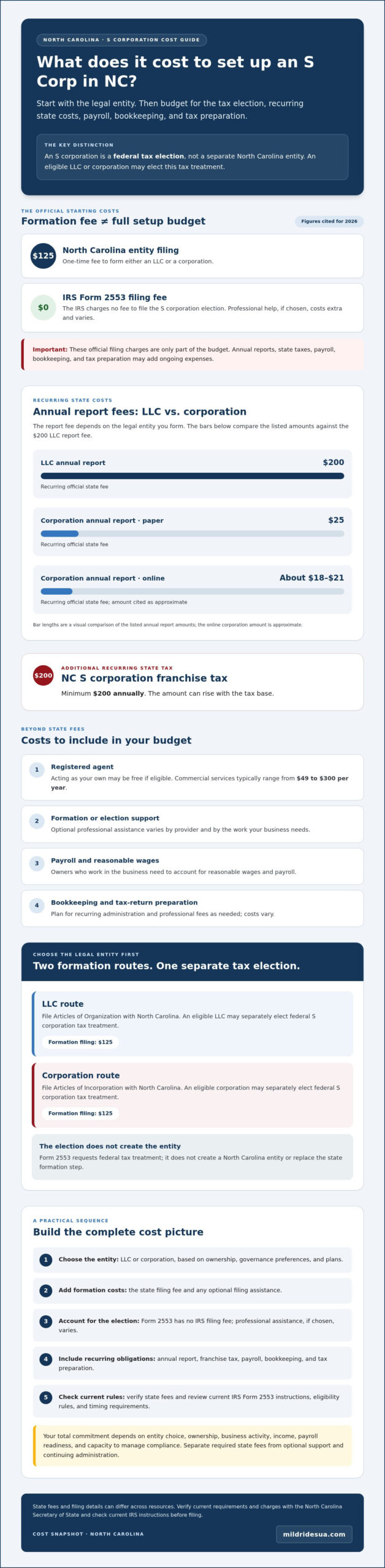
The total cost depends on the entity you form, state filings, tax-election support, and ongoing administration. In 2026, North Carolina charges a one-time $125 filing fee to form an LLC or corporation, and the IRS doesn’t charge a fee to file Form 2553 for S corporation tax treatment. Those official charges are only part of the budget. Annual reports, state taxes, payroll, bookkeeping, and tax preparation can add recurring expenses.
Entity formation creates the legal business under North Carolina law. Tax classification determines how that business is treated for federal tax purposes. An eligible LLC or corporation may elect S corporation treatment, subject to IRS requirements. The S corporation overview provides background on this federal tax classification, but check current IRS instructions for eligibility and filing rules.
This video walks through forming an S corporation in North Carolina. Use current figures when estimating costs, since fees cited in online resources may differ.
Which costs are one-time, and which recur?
Separate initial state charges from recurring compliance and service expenses. The table distinguishes official fees from professional costs, which vary by provider and the work your business needs.
| Cost category | Timing | Current amount or budget note |
|---|---|---|
| LLC or corporation formation filing | One-time official fee | $125 with the North Carolina Secretary of State |
| IRS Form 2553 election | One-time official fee | No IRS filing fee; professional assistance, if chosen, varies |
| Annual report | Recurring official fee | LLC: $200; corporation: $25 paper or about $18 to $21 online |
| North Carolina S corporation franchise tax | Recurring official tax | Minimum $200 annually; the amount can rise with the tax base |
| Registered agent | Recurring, if using a service | Acting as your own may be free if eligible; commercial services typically range from $49 to $300 per year |
| Formation, accounting, payroll, and tax preparation support | As needed or recurring | Professional fees vary; request provider-specific estimates |
Why the S corporation label can confuse setup estimates
The cost to set up an S Corp in NC isn’t one single filing charge. Forming the entity establishes the business; filing Form 2553 requests federal tax treatment and does not create a North Carolina entity. After setup, accounting, payroll, and tax-return needs depend on ownership, business activity, and administrative capacity. A useful estimate separates required state fees from optional professional support, then includes recurring work before you choose a structure.
North Carolina entity formation fees: LLC or corporation?
The state filing is only one part of choosing a route. To assess the cost to set up an S Corp in NC, compare how each legal structure fits your ownership, governance preferences, and plans. Then add its ongoing compliance needs. Both an LLC and a corporation can seek federal S corporation tax treatment if they meet IRS requirements, but the election doesn’t make them the same kind of entity.
The North Carolina Secretary of State is the official source for state forms, filing requirements, and current charges. Its North Carolina entity formation fees information lists a $125 initial filing fee for either LLC Articles of Organization or corporation Articles of Incorporation. Verify that amount directly with the state before filing, along with any processing details that apply to your submission.
Forming an LLC and then choosing S corporation tax treatment
An LLC is created under state law by filing Articles of Organization. If the owners later choose S corporation tax treatment, they make a separate federal election; it doesn’t replace or repeat the state formation step. An LLC may appeal to owners who prefer its management structure, but include recurring compliance costs in your comparison. North Carolina’s annual report fee is $200 for an LLC, subject to verification before filing. For background on how the election relates to self-employment tax, see the S Corp Election for Self-Employment Tax: 2026 Guide.
Forming a corporation and evaluating its costs
A corporation is formed by filing Articles of Incorporation and generally involves formal governance and corporate recordkeeping. Its paperwork and internal practices differ from an LLC’s, so compare the administrative work as well as the initial filing. The state annual report fee is $25 for paper filing or about $18 to $21 electronically. Verify current amounts with the Secretary of State. A lower report charge alone doesn’t make a corporation the right fit for every owner.
Already operating through an LLC or corporation? Review your current entity before budgeting for a new formation filing. Ownership changes, governance preferences, and existing records may affect the appropriate next step. A CPA can help evaluate how the structure, election, payroll readiness, and ongoing tax work fit together. For guidance on formation and S corporation election considerations, explore small-business formation and tax planning.
What does an S corporation election and ongoing compliance add?
Electing S corporation tax treatment doesn’t complete the setup process. It involves federal paperwork and ongoing responsibilities for compensation, payroll, bookkeeping, and tax filings. These affect the cost to set up an S Corp in NC beyond the entity filing. Professional costs depend on the business’s circumstances and provider.
Federal election paperwork and timing
Form 2553 is the IRS form eligible corporations and LLCs generally use to elect S corporation tax treatment. The IRS charges no filing fee, but check current IRS instructions for eligibility, signatures, and filing deadlines. For an election to take effect for the current tax year, the general deadline is within the first two months and 15 days of the tax year. Filing the form doesn’t guarantee acceptance.
IRS election paperwork requests federal tax treatment; it does not create a North Carolina legal entity. The business must be formed separately under state law, and an existing entity should review its status before proceeding. Professional help with an election may be useful, but fees vary by provider. Request a scope and estimate based on your circumstances.
Payroll, bookkeeping, and annual tax work
Ongoing administration is where a simple filing estimate can fall short. An S corporation shareholder who works in the business must receive reasonable compensation for their services, and wages are subject to payroll taxes. Discuss payroll processing and recordkeeping needs with a tax professional rather than assuming distributions replace wages or that the election alone reduces overall costs.
Budget for regular bookkeeping and payroll administration, plus preparation of the federal S corporation return, Form 1120-S. For calendar-year businesses, the 2026 filing deadline is March 16, since March 15 falls on a weekend. Review current IRS instructions for your business’s filing obligations and any applicable extensions. For return-preparation context, consult current Form 1120-S instructions and discuss your filing needs with a tax professional.
North Carolina obligations can continue after the election. The state imposes a minimum $200 annual franchise tax on S corporations, and annual-report requirements depend on whether the entity is organized as an LLC or corporation. Confirm current state rules and deadlines before planning your compliance budget.
A practical estimate accounts for the election process, payroll, bookkeeping, federal return preparation, and state obligations as separate categories. Mildrid Esua, CPA, PLLC advises small businesses on S corporation elections, payroll, bookkeeping, and tax preparation, helping owners assess these connected responsibilities without assuming the election will produce a particular tax outcome.
How can you estimate your North Carolina S Corp setup budget?
A useful estimate is a worksheet, not a single headline figure. The cost to set up an S Corp in NC depends on your entity, the support you need, and the work required to keep the business compliant. Separate mandatory government charges from optional professional and operating expenses, then estimate both the first year and later years.
A practical cost-estimation checklist
Work through these categories in order. Record each amount, who charges it, when it’s due, and whether it’s a one-time or recurring expense.
- Choose the entity. Note whether you’re forming an LLC or corporation, or already have an entity. Your ownership, governance preferences, and existing records can affect the work required.
- Verify state charges. Check current forms, filing fees, and annual-report requirements directly with the North Carolina Secretary of State. Confirm applicable federal election instructions and eligibility with the IRS.
- Assess election support. Decide whether you’ll prepare Form 2553 yourself or seek professional guidance. If requesting a quote, ask whether it covers eligibility review, form preparation, submission, and follow-up.
- Estimate recurring operations. Include payroll setup and administration, bookkeeping, and federal and state tax preparation. Add software or other tools only if your business expects to use them.
- Mark timing and frequency. Label each item as one-time, annual, periodic, or dependent on a business change. This makes renewal and compliance costs easier to anticipate.
Keep official filing charges in a separate column from optional legal, CPA, payroll-service, and software expenses. A professional quote should clearly identify its scope, including which filings, advisory work, and follow-up are included and which items are billed separately.
When a DIY filing may not be the right comparison
Self-preparation may suit an owner with a straightforward situation, confidence handling forms, and time to verify requirements. Consider professional support if ownership is more involved, the entity already exists, or payroll and tax responsibilities raise questions. Neither route guarantees lower total costs or tax savings. Compare the time involved, your familiarity with the process, and the effort it may take to correct errors.
Build three scenarios without guessing at service prices: a low-complexity plan with self-prepared filings and basic recordkeeping; an expected plan that includes the support and recurring work you anticipate; and a complex plan that allows for additional ownership, advisory, or compliance needs. Replace estimates with current state charges and provider-specific quotes before deciding.
For broader context on aligning entity and tax decisions with business goals, review the 2026 Strategic Tax Planning Guide for NC Entrepreneurs. Mildrid Esua, CPA, PLLC provides small-business formation, bookkeeping, payroll, and tax guidance. Discuss your business’s formation and tax planning needs as you refine the budget.
Choose an S Corp setup plan that fits your North Carolina business
The right setup plan depends on more than whether you can complete a form yourself. Compare DIY formation, filing assistance, and continuing CPA support based on your ownership structure, expected income, payroll readiness, and ability to manage records and deadlines. A straightforward business with an owner comfortable handling filings may need a different level of support than an existing entity with multiple owners or questions about compensation.
Before choosing, gather your current entity documents, ownership details, income expectations, payroll plans, and estimates of state fees and recurring work. This information helps you compare the cost to set up an S Corp in NC with the time and compliance responsibilities that follow. Professional guidance can help assess whether the election fits your circumstances, but it can’t guarantee tax savings or a particular outcome.
Questions to ask before hiring formation or tax support
Request a clear written description of the proposed work. Ask what the engagement includes, what it excludes, and what information or tasks remain your responsibility. Confirm whether it covers state entity formation, federal election preparation, payroll setup, bookkeeping, or tax-return preparation. These may be separate services, so don’t assume one engagement includes them all.
Also ask how ongoing compliance responsibilities will be explained and monitored. Clarify whether the provider will help you understand relevant filing deadlines and payroll recordkeeping, or whether you’ll need to track those items yourself. A well-defined scope makes comparisons more useful than looking at a fee without knowing what work it covers.
Plan the next step with a North Carolina tax advisor
Use a personalized review to connect entity choice, election timing, expected income, compensation, and administrative capacity. Mildrid Esua, CPA, PLLC provides business formation support and advises small businesses on S corporation elections, bookkeeping, payroll, and tax preparation. A discussion of these connected needs can help identify questions to resolve before filing, without presuming the election is right for every business.
For additional context on election considerations, read the S Corp Election for Self-Employment Tax: 2026 Guide. Then organize your business details and current fee estimates so your next conversation can focus on the decisions that matter to your situation.
Discuss your S corporation plans with a tax advisor.
Make your next S Corp decision with clarity
The best estimate of the cost to set up an S Corp in NC starts with choosing the right legal entity, then accounting for the election and the work required to maintain it. Keep official filing charges distinct from optional professional support, and check current requirements before committing. The right level of help depends on your ownership, income expectations, payroll readiness, and capacity to manage ongoing records and filings.
A tailored review can help you weigh those factors without assuming S corporation treatment will suit every business or guarantee tax savings. Mildrid Esua, CPA, PLLC offers business formation services and guidance on S corporation elections and self-employment tax planning, helping owners consider setup choices alongside ongoing responsibilities.
Gather your entity details, ownership information, payroll plans, and current fee estimates before discussing your options. Discuss your S corporation plans with a tax advisor and take the next step with a clearer view of what your business needs.
Frequently Asked Questions
How much does it cost to set up an S Corp in North Carolina?
The total depends on whether you form an LLC or corporation and what ongoing support your business needs. In 2026, either state formation filing costs $125, and the IRS charges no fee to file Form 2553. Add recurring expenses such as annual reports, North Carolina’s minimum $200 S corporation franchise tax, payroll, bookkeeping, and tax preparation. The cost to set up an S Corp in NC can’t be estimated accurately without those business-specific details.
Is an S corporation a separate business entity in North Carolina?
No. An S corporation is a federal tax classification, not a separate North Carolina entity type. A business first forms as an LLC or corporation under state law, then may elect S corporation tax treatment if it meets IRS requirements. This distinction matters because state formation filings and entity-level compliance remain separate from the federal election. An S election doesn’t create the legal business or replace its state reporting obligations.
What does it cost to file Form 2553?
The IRS charges no filing fee for Form 2553, the federal election form used to request S corporation tax treatment. If you hire a professional to assess eligibility or prepare and submit the form, that provider’s fees vary. Before engaging help, ask what the quoted work includes, such as reviewing the entity and ownership details, completing the form, and addressing follow-up questions. Check current IRS instructions for filing rules and timing.
Do I need to form an LLC before electing S corporation status?
No. You don’t have to form an LLC specifically. An eligible LLC or corporation may elect S corporation tax treatment, but the legal entity must exist before its owners make the federal election. For example, a North Carolina business may form as an LLC by filing Articles of Organization, or as a corporation by filing Articles of Incorporation. Compare governance, ownership needs, and recurring obligations before choosing a route.
What ongoing costs should a North Carolina S corporation budget for?
Budget for state reporting and taxes, payroll administration, bookkeeping, and tax-return preparation. In 2026, North Carolina’s LLC annual report fee is $200; a corporation’s report costs $25 on paper or about $18 to $21 online. The state also imposes a minimum $200 annual franchise tax on S corporations. Payroll and professional costs vary with business needs, so verify current fees and requirements before setting your budget.
Can an LLC elect S corporation tax treatment in North Carolina?
Yes, an eligible LLC can elect federal S corporation tax treatment by filing Form 2553 with the IRS. The election changes the LLC’s federal tax classification; it doesn’t turn the LLC into a North Carolina corporation or remove its state filing obligations. Eligibility, ownership, and timing requirements apply, so review current IRS instructions before filing. Also account for the LLC’s own annual report and other applicable North Carolina obligations.
Is setting up an S Corp worth the cost for a small business?
It depends on the business’s income, ownership, payroll readiness, and ability to manage additional records and filings. Owners who work in the business must consider reasonable compensation and related payroll taxes, along with ongoing bookkeeping and tax preparation. There’s no universal income threshold or guaranteed tax benefit that makes an S election worthwhile for every company. Small-business owners in Greensboro, High Point, Burlington, Kernersville, Jamestown, Oak Ridge, Summerfield, and Winston-Salem can weigh these factors with a tax advisor before deciding.




Leave a Reply
Your email is safe with us.