

The single biggest mistake taxpayers make after years of non-filing isn’t waiting too long; it’s panic-filing without a calculated strategy. If you’re wrestling with missing historical records, mounting interest, and the constant dread of automated IRS collection actions, you already know how paralyzing this burden can be. Learning how to file 10 years of back taxes isn’t about rushing disorganized paperwork to an automated processing center. It demands proactive financial reconstruction, direct procedural compliance, and a clear understanding of your legal rights.
In this guide, you’ll master the exact step-by-step framework to resolve a decade of unfiled returns, halt aggressive enforcement, and minimize cumulative penalties through available statutory relief. We’ll demystify whether the IRS actually mandates all ten years or merely the last six under its look-back rules, demonstrate how to retrieve lost documentation, and outline structured settlement pathways designed to protect your long-term financial stability.
Key Takeaways
- Understand why IRS Policy Statement 5-133 frequently limits mandatory back filing to the last six years, provided enforcement hasn’t escalated.
- Master the structured roadmap on how to file 10 years of back taxes using official IRS wage and income transcripts to reconstruct missing records.
- Discover why professional CPA representation protects against inflated Substitute for Return (SFR) assessments that generic software cannot remedy.
- Identify statutory penalty relief options and structured payment plans to halt aggressive collection actions while safeguarding your cash flow.
- Establish proactive withholding and estimated payment systems to guarantee permanent compliance and protect your long-term financial stability.
The Reality of 10 Years of Unfiled Taxes: Rules, Risks, and IRS Policy
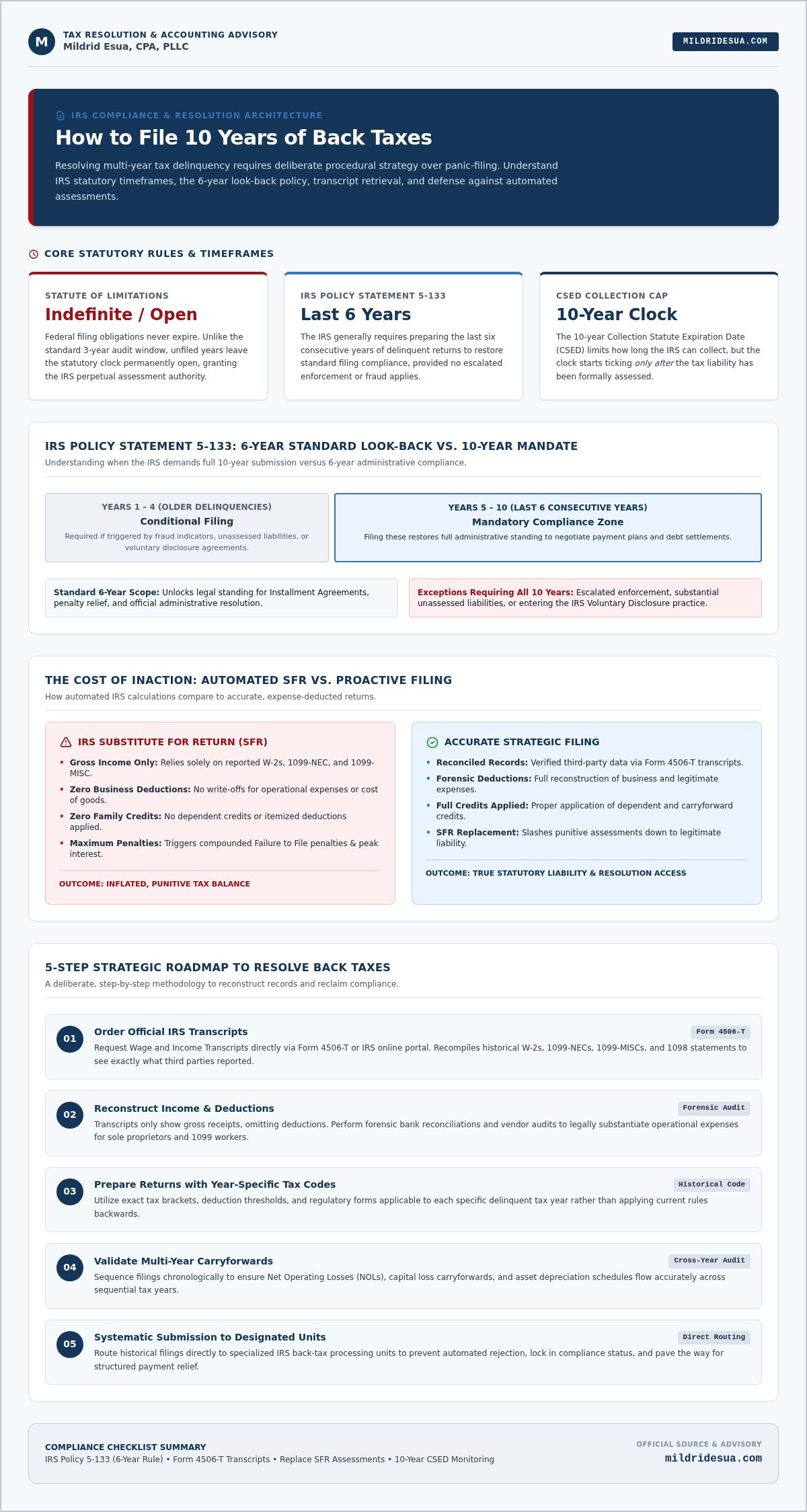
Confronting a full decade of unfiled tax returns feels daunting. Under federal law, the legal obligation to file annual tax returns technically never expires until those returns are formally received by the government. Unlike a typical audit where the IRS faces a strict three-year assessment limit, an unfiled return leaves the statutory clock completely open. The government holds perpetual authority to examine your income and assess taxes, penalties, and interest indefinitely.
Timing your resolution requires precision. The IRS operates under a strict 10-year Collection Statute Expiration Date (CSED), which caps how long the agency can legally collect an assessed tax debt. However, that 10-year collection clock only starts ticking after a tax liability has been officially assessed. Understanding how to file 10 years of back taxes requires knowing the crucial difference between administrative compliance and statutory law.
To better understand the legal timeframes and how tax representation safeguards your rights during enforcement windows, watch this practical breakdown:
IRS Policy Statement 5-133: Do You Really Need All 10 Years?
Most taxpayers assume they must prepare and submit all ten missing returns at once. In reality, IRS Policy Statement 5-133 provides administrative relief by establishing that preparing the past six consecutive years of unfiled returns normally restores a taxpayer to full filing compliance. The agency focuses its standard enforcement resources on this six-year look-back window.
Certain situations trigger exceptions where the agency demands older filings, such as indications of fraud or unassessed tax liabilities. In complex cases, entering an IRS Voluntary Disclosure Agreement or voluntary disclosure practice helps secure structured relief. Achieving verified compliance under the six-year benchmark unlocks your legal standing to negotiate installment agreements or tax debt settlements.
The Hidden Danger: Substitute for Return (SFR) Assessments
If you don’t file, the IRS may eventually calculate your taxes using automated Substitute for Return procedures. The agency constructs an SFR using only the third-party wage and 1099 data reported under your Social Security number; it allows zero itemized deductions, business expenses, or dependent credits. These automated filings result in bloated tax balances, maximum Failure to File penalties, and compounded interest. Knowing how to file 10 years of back taxes correctly enables you to replace these punitive SFR assessments with accurate, expense-deducted returns, slashing your balance to what you legitimately owe.
How to File 10 Years of Back Taxes: A 5-Step Strategic Roadmap
Resolving multi-year tax non-compliance requires a deliberate, step-by-step methodology rather than a rushed scramble. Filing decade-old tax returns blindly often triggers scrutiny or locks in inflated balances. Following a strategic sequence ensures you reclaim control of your financial record while staying fully aligned with federal requirements.
- Order official transcripts directly from the government.
- Reconstruct your historical income and deductible expenses.
- Prepare returns using year-specific tax codes and schedules.
- Validate multi-year carryforwards and depreciation.
- Submit the delinquent filings systematically to the designated IRS processing units.
Step 1 & 2: Pulling Transcripts and Reconstructing Financial Records
You cannot file accurately without knowing what third parties reported to the IRS. Filing Form 4506-T (Request for Transcript of Tax Return) or accessing your IRS online portal lets you pull Wage and Income Transcripts for every delinquent period. These records compile all historical W-2s, 1099-NECs, 1099-MISCs, and 1098 interest statements associated with your tax profile.
Transcripts reveal gross receipts, but they omit your deductions. For sole proprietors and independent contractors, reconstruct business deductions through forensic bank reconciliation and vendor statement audits. Engaging structured monthly bookkeeping for small businesses creates defensible expense trails that withstand automated audits and protect your net income from unfair taxation.
Step 3, 4 & 5: Prior-Year Preparation, Validation, and Strategic Submission
Each delinquent year requires its respective tax forms, standard deduction amounts, and tax brackets. Never apply current tax regulations to income earned five or eight years ago. You must account for dynamic variables, including capital loss carryovers, expiring credits, and depreciation schedules across the ten-year span to prevent compounding mathematical errors.
When you’re ready to submit, packaging matters. If willful non-filing occurred, taxpayers might evaluate the IRS Voluntary Disclosure Practice to mitigate legal jeopardy before mailing. Returns older than three years generally cannot be e-filed by individuals; they must be mailed to specific IRS processing centers using Certified Mail with Return Receipt Requested. When evaluating how to file 10 years of back taxes safely, partnering with Mildrid Esua, CPA, PLLC provides authoritative transcript analysis and nationwide IRS representation to ensure every submission protects your long-term wealth.
DIY Filing vs. Professional CPA Representation: Critical Differences
Many taxpayers initially attempt to resolve delinquent years using consumer tax software. While off-the-shelf software functions adequately for simple, single-year filings, learning how to file 10 years of back taxes exposes severe structural gaps in retail platforms. Sourcing archived tax software discs or outdated digital packages often leads to improper depreciation calculations, missing carryforward losses, and heightened scrutiny from automated IRS audit algorithms.
Software Limitations with Decades of Unfiled Tax Returns
Commercial tax platforms process numbers, but they cannot advocate for your financial interests. Retail tools cannot access internal IRS master files to decipher raw transaction codes, nor can they determine whether unfiled years contain Substitute for Return assessments. These systems cannot strategically evaluate relief options like administrative First-Time Penalty Abatement across multiple periods.
Most importantly, generic software offers zero procedural protection. If the IRS initiates bank levies or wage garnishments during the processing window, software platforms leave you completely exposed to aggressive revenue officers.
The Protective Power of Working with a Licensed CPA
Retaining a licensed Certified Public Accountant changes the dynamic from defensive vulnerability to proactive control. By filing Form 2848 (Power of Attorney), your CPA steps between you and the federal government. The IRS must direct all phone calls, documentation demands, and enforcement interviews directly to your representative, keeping investigators away from your doorstep.
A seasoned CPA doesn’t merely assemble delinquent figures. They apply strategic oversight across every unfiled tax period. For business owners and high-liability taxpayers, pairing transcript analysis with expert tax resolution in North Carolina prevents uncoordinated filings that trigger catastrophic tax bills. Once your historical filings establish formal compliance, your advisor transitions your operations into proactive, strategic tax planning for businesses. This forward-looking stewardship ensures you maintain optimal deductions, control your quarterly liability, and never face back tax crises again.
Resolving the Back Tax Debt: Relief Options and Penalty Abatement
Submitting decade-old returns establishes your legal compliance, but it immediately crystallizes the financial balance due. When back taxes sit unfiled, statutory penalties compound rapidly. The Failure to File penalty accrues at 5% per month up to a maximum of 25%, while the Failure to Pay penalty adds 0.5% per month up to another 25%. Paired with compounding interest, these statutory additions frequently surpass the original tax liability itself.
IRS Penalty Abatement: Eliminating Unnecessary Financial Penalties
Taxpayers learning how to file 10 years of back taxes often don’t realize that statutory penalties are negotiable. Under administrative relief provisions, First-Time Penalty Abatement can remove penalties for the earliest delinquent tax year if you maintained a clean compliance record for the preceding three years.
For subsequent periods, establishing Reasonable Cause provides a powerful defense. If major health crises, severe trauma, or missing records beyond your control caused the filing lapse, the IRS will abate substantial penalties upon receiving documented proof. Systematically dismantling these penalties also eliminates the interest tied to them, significantly shrinking your total debt.
IRS Debt Relief Programs: Fresh Start, Installment Plans, and OIC
Once you reduce penalties, resolving the remaining underlying liability requires a structured plan aligned with your cash flow:
- Streamlined Installment Agreements: Taxpayers with up to $50,000 in combined taxes, interest, and penalties can secure monthly payment terms without submitting invasive financial disclosures.
- Offer in Compromise (OIC): If your total assets and disposable income cannot satisfy the liability within statutory collection windows, an OIC lets you settle the cumulative balance for a fraction of what you owe.
- Currently Not Collectible (CNC) Status: When basic living expenses consume your entire income, the IRS pauses aggressive enforcement, safeguarding your accounts from wage garnishments and levies.
Instead of facing collection notices alone, secure experienced tax resolution services with Mildrid Esua, CPA, PLLC to structure an IRS relief strategy that defends your financial assets.
Reclaiming Compliance: Long-Term Safeguards and Next Steps
Submitting late returns and establishing an IRS resolution plan halts collection threats, but lasting peace of mind requires breaking the cycle of delinquency for good. Learning how to file 10 years of back taxes restores your legal standing; setting up resilient operational safeguards ensures you remain in good standing indefinitely.
Preventing Recurrence: Withholding Adjustments and Quarterly Systems
Multi-year tax debt often begins with small withholding shortfalls or unpredictable self-employment income. For wage earners, recalibrating Form W-4 ensures employer withholdings match your actual annual tax liabilities, preventing unexpected shortfalls when filing season arrives.
For independent contractors, freelancers, and small business owners, disciplined cash management is vital:
- Schedule Estimated Payments: Calculate and remit quarterly estimated tax payments using Form 1040-ES vouchers to prevent interest accumulation throughout the calendar year.
- Separate Financial Accounts: Maintain dedicated business checking and credit accounts. Co-mingling personal and business finances obscures deductible expenses and creates audit exposure.
- Adopt Real-Time Ledgers: Implement structured cloud accounting to monitor revenues, payroll liabilities, and operating expenses monthly instead of piecing together scattered receipts at tax time.
Partner with Mildrid Esua, CPA for Local Tax Resolution
Resolving ten years of unfiled tax returns requires forensic precision, strategic negotiations, and persistent professional oversight. Taxpayers and business owners across Greensboro, High Point, Winston-Salem, Burlington, and Kernersville don’t have to carry this burden alone. Working with an authoritative local advocate turns an intimidating procedural hurdle into a clear, manageable path toward financial health.
Understanding how to file 10 years of back taxes becomes straightforward when an experienced Certified Public Accountant steps in to handle every IRS notice, audit inquiry, and resolution negotiation on your behalf. You can put an end to sleepless nights and collection letters. Schedule your confidential tax consultation with Mildrid Esua, CPA today to halt automated enforcement, resolve historical liabilities, and secure your long-term financial footing.
Reclaim Your Financial Freedom and IRS Peace of Mind
Navigating a decade of delinquent returns doesn’t have to threaten your financial future. When you understand IRS Policy Statement 5-133, use official wage transcripts to dismantle inflated Substitute for Return assessments, and request statutory penalty abatement, you regain total control. Knowing how to file 10 years of back taxes transforms an intimidating compliance crisis into a clear, methodical recovery plan.
You don’t need to face federal revenue officers alone. Mildrid Esua, CPA, PLLC is a licensed North Carolina CPA firm specializing in tax resolution, forensic bookkeeping, and nationwide IRS representation. With extensive experience resolving complex multi-year unfiled returns and negotiating debt relief, our team protects your income while establishing lasting compliance. Take the first step toward permanent relief today. Schedule a confidential consultation with Mildrid Esua, CPA, PLLC and put past tax debt behind you for good.
Frequently Asked Questions
Will I go to jail if I have not filed taxes for 10 years?
Jail time is extremely rare for simply falling behind on your tax filings. The IRS reserves criminal prosecution for willful tax evasion, intentional fraud, or active concealment of offshore accounts. If your failure to file stemmed from financial distress, overwhelming stress, or life disruption, coming forward voluntarily resolves the issue. The IRS prioritizes securing tax compliance and establishing repayment over criminal penalties.
Does the IRS require me to file all 10 unfiled years to get compliant?
Usually no, because IRS Policy Statement 5-133 typically mandates filing only the last six consecutive years to restore an account to good standing. When determining how to file 10 years of back taxes, preparing the most recent six years satisfies compliance requirements in most cases. However, earlier returns may still be required if the IRS filed a Substitute for Return or opened an active collection case.
Can I get refunds for tax returns older than three years?
No, refunds for tax returns older than three years from the original filing deadline are permanently forfeited. Federal statute sets a strict three-year window to claim overpayments. Even though you forfeit older refunds, submitting those delinquent returns remains necessary. Filing establishes your actual income, closes open audit windows, and eliminates potential Substitute for Return assessments.
How do I get my W-2 or 1099 forms from 10 years ago?
You can retrieve historical income data by ordering Wage and Income Transcripts directly from the IRS using Form 4506-T or an online account. Employers often discard decade-old payroll records, but the IRS maintains internal copies of past W-2s and 1099s. For business owners and contractors across Greensboro and Winston-Salem, forensic bookkeeping can reconstruct lost expenses and operational deductions.
What happens if the IRS already filed a Substitute for Return for me?
You can still prepare and submit an original tax return to replace the government’s calculation. An IRS Substitute for Return gives you zero deductions, allowances, or credits, resulting in an artificially inflated debt. Submitting your actual return supersedes the government’s estimate, incorporates your legitimate business and personal deductions, and substantially reduces your balance.
What if I cannot afford to pay the back taxes I owe upon filing?
You should still file immediately, as filing compliance is separate from your ability to pay. The monthly penalty for failing to file is ten times higher than the penalty for late payment. Once the IRS processes your returns, you can resolve the balance through manageable options like Streamlined Installment Agreements, an Offer in Compromise, or Currently Not Collectible status.
Can back tax penalties be removed or reduced by the IRS?
Yes, the IRS routinely reduces or abates assessed penalties through administrative relief programs. First-Time Penalty Abatement can waive late fees on your earliest delinquent year if your record was previously clean. For subsequent tax years, submitting documented evidence of Reasonable Cause, such as serious illness or records destruction, can remove significant failure-to-file and failure-to-pay penalties.




Leave a Reply
Your email is safe with us.