

What if your most significant business expense isn’t your overhead or your inventory, but a 15.3% tax penalty you’re paying simply because of your current legal structure? For many entrepreneurs in Greensboro and High Point, watching nearly sixteen cents of every dollar earned vanish into self-employment taxes feels like an unavoidable cost of doing business. It’s exhausting to feel that your growth is being penalized, especially when you face the added anxiety of navigating complex 2026 tax law updates alone. You deserve a strategy that treats your business as a vehicle for wealth, not just a source of revenue.
By mastering the S Corp tax benefits for small business owners, you can transform your relationship with the IRS from one of reactive compliance to proactive stewardship. This guide reveals how electing S Corp status can drastically reduce your self-employment tax and protect your profits through sophisticated structural planning. We will provide a clear roadmap for tax reduction, explain how to navigate “reasonable salary” requirements with confidence, and show you how a vigilant partnership can secure your financial trajectory for the years ahead.
Key Takeaways
- Identify how the pass-through tax mechanism bypasses the 21% federal corporate tax rate to preserve more liquid capital for your business growth.
- Quantify the impact of S Corp tax benefits for small business owners by reducing the 15.3% self-employment tax burden through a precise salary-to-distribution ratio.
- Master the criteria for “reasonable compensation” to safeguard your earnings from IRS reclassification and maintain compliant, long-term stability.
- Explore advanced deduction opportunities for health insurance and retirement planning that integrate seamlessly with your proactive 2026 tax strategy.
- Follow a methodical roadmap for implementing your S election in North Carolina, ensuring every filing aligns with your broader financial objectives.
What is an S Corp Election and How Does It Protect Your Profits?
Many entrepreneurs mistakenly believe that an S Corp is a distinct legal entity like a Limited Liability Company (LLC) or a corporation. In reality, it’s a specific tax designation granted by the IRS. When you understand What is an S Corporation?, you realize it’s a strategic layer applied to your existing business structure. This election allows your company to bypass the 21% federal corporate income tax that burdens C Corporations. Instead of the business paying taxes at the entity level, profits and losses flow directly to shareholders. This pass-through mechanism is a cornerstone of S Corp tax benefits for small business owners, ensuring your hard-earned revenue isn’t diminished by the “double taxation” trap.
The myth of double taxation often creates unnecessary friction for growing firms. While C Corps are taxed on profits and shareholders are taxed again on dividends, an S Corp eliminates this redundancy. For North Carolina business owners, this structure provides a clear path to capital preservation. Choosing the right structure is the first step in a proactive tax strategy. It’s about moving beyond simple compliance and embracing a philosophy of vigilant stewardship over your financial future.
S Corp vs. LLC: The Critical Differences for 2026
While a standard LLC offers simplicity, it often leaves owners vulnerable to the full weight of self-employment taxes on every dollar earned. Unlike a traditional LLC, an S Corp allows for a sophisticated division of income between salary and distributions. Many Greensboro startups begin as simple LLCs to establish their market presence. However, as revenue scales, the transition to S Corp status becomes a logical step in strategic growth. The break-even point typically occurs when your profit reaches a level where the tax savings significantly outweigh the additional administrative costs of payroll and bookkeeping. It’s a shift from a reactive stance to a proactive methodology designed for long-term stability.
Eligibility Requirements for Small Business Owners
Maintaining S Corp status requires strict adherence to IRS guidelines to protect your tax advantages. Your business must be a domestic entity with no more than 100 shareholders. These shareholders must be “natural persons,” meaning you cannot have other corporations or partnerships owning a stake in your S Corp. Certain trusts and estates are permitted, but the focus remains on individual ownership. To secure these S Corp tax benefits for small business owners for the current year, you must act with precision. The deadline to file Form 2553 for a calendar year entity to be effective for the 2026 tax year is March 16, 2026.
Maximizing Self-Employment Tax Savings Through Structural Strategy
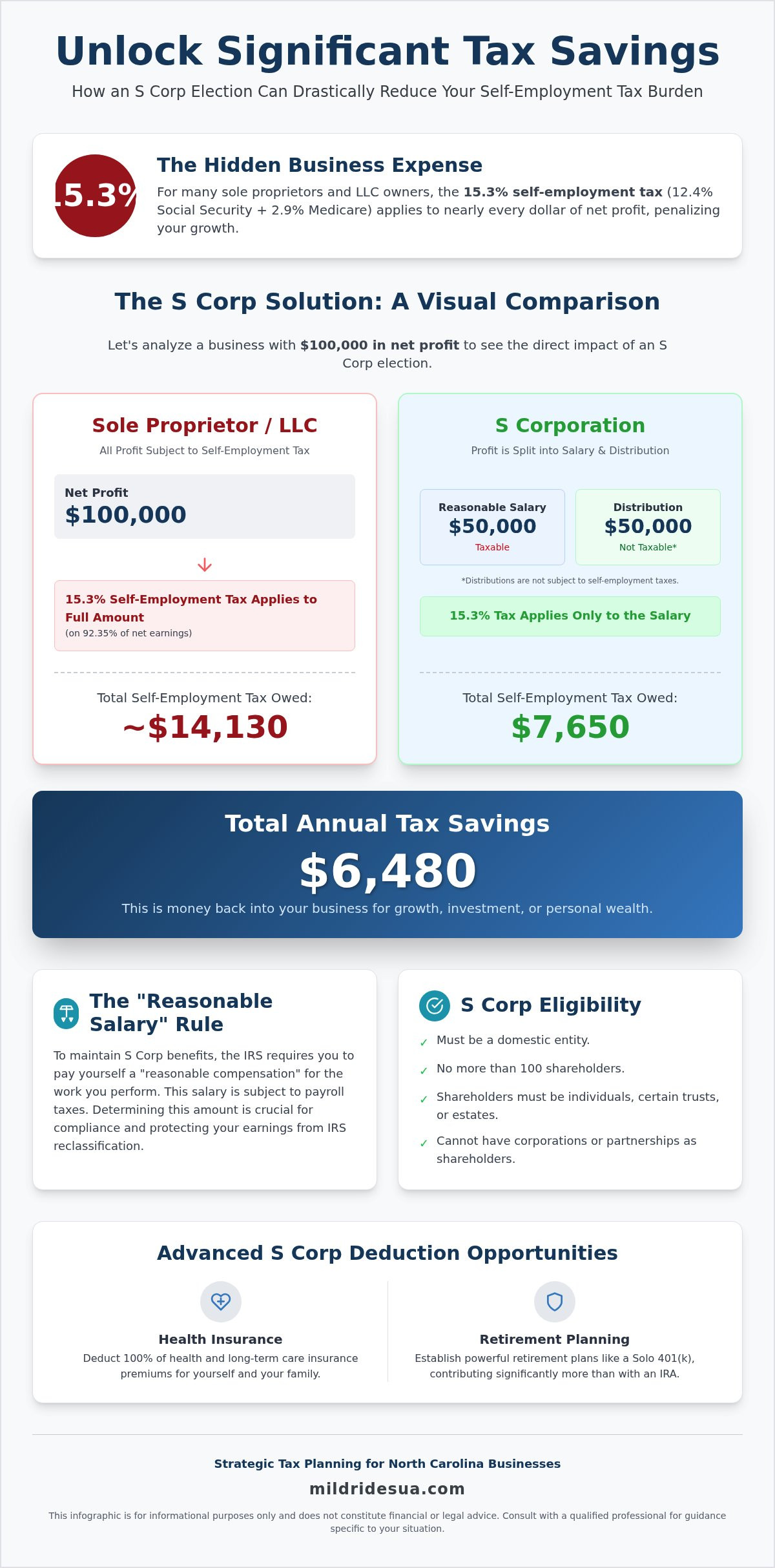
The most persistent drain on a growing firm’s cash flow is often the 15.3% self-employment tax. This figure is not merely a single tax. It’s a combination of the 12.4% Social Security tax and the 2.9% Medicare tax. For a sole proprietor or a standard LLC owner, the IRS applies this 15.3% rate to nearly every dollar of net profit earned up to the 2026 Social Security wage base of $184,500. This creates an environment where your success is met with an increasing tax penalty. Adopting a IRS requirements for S corporations approach allows you to legally circumvent this burden by reclassifying how you receive your income.
The core mechanism of an S Corp involves splitting your earnings into two distinct categories: a W-2 salary and shareholder distributions. Unlike a sole proprietorship, where all income is subject to payroll taxes, an S Corp only applies those taxes to the salary portion. The distributions you receive as an owner are exempt from the 15.3% self-employment tax. This distinction allows you to act as a strategic architect of your own wealth, balancing your draw to optimize personal cash flow while minimizing your total tax liability.
The Math of Profit Preservation
To visualize the impact of S Corp tax benefits for small business owners, consider a typical service business in High Point generating $100,000 in net profit. As a sole proprietor, you would owe approximately $14,130 in self-employment taxes after the standard adjustments. By electing S Corp status and taking a reasonable salary of $50,000, only that half of your income is subject to payroll taxes. The remaining $50,000 is issued as a distribution, which is free from the 15.3% levy. This single structural shift results in over $7,000 in annual tax savings. These preserved funds can be immediately reinvested into business growth, equipment upgrades, or specialized retirement accounts.
Impact on the 199A Qualified Business Income (QBI) Deduction
While reducing your salary increases payroll tax savings, it also creates a complex ripple effect on your Section 199A deduction. The QBI deduction typically allows you to exclude 20% of your qualified business income from federal taxation. Because your W-2 wages are deducted from your business income before the QBI is calculated, a higher salary actually reduces the base of your 20% deduction. Finding the “sweet spot” requires year-round planning to ensure that the payroll tax savings you gain aren’t offset by a diminished QBI benefit. Partnering with a Greensboro tax advisor who understands these nuances is essential for maintaining vigilant stewardship over your bottom line.
Navigating the “Reasonable Salary” Requirement with Vigilant Stewardship
The IRS does not offer a specific percentage or “safe harbor” for determining what you owe yourself as an owner-employee. Instead, they scrutinize “Reasonable Compensation” based on the market value of your labor. If the IRS decides your salary is too low, they may reclassify your distributions as taxable wages, triggering immediate liabilities for unpaid payroll taxes, interest, and penalties. Preserving the S Corp tax benefits for small business owners requires a balanced structure that satisfies these regulatory expectations while still maximizing your net take-home pay.
Many owners are tempted by “Zero Salary” strategies during lean months, but this is a dangerous myth that invites immediate IRS scrutiny. Unlike a reactive firm that only addresses these issues during an audit, Mildrid Esua, CPA, PLLC acts as your protective ally to establish a defensible compensation model from the start. We utilize IRS guidelines on S corporations to ensure your strategy remains compliant, providing you with the calm confidence to focus on your firm’s growth without the fear of future reclassification.
Factors the IRS Uses to Audit S Corp Salaries
When the IRS audits compensation, they look at your specific background, training, and the complexity of your role. We analyze local market data for Greensboro and the Piedmont Triad to determine what it would cost to hire an outside manager with your level of expertise. This market-based approach ensures your salary is grounded in reality rather than guesswork. The IRS also distinguishes between income generated by your personal efforts and profits derived from business capital or intangible assets. Recognizing these distinctions is vital for creating a compensation model that reflects the true value of your labor.
Documentation: Your Shield Against IRS Disputes
Documentation is the ultimate safeguard in any dispute. Professional bookkeeping for small businesses is essential because it provides the clear trail of evidence needed to justify your income split. By maintaining an “Accountable Plan” for business expenses and keeping contemporaneous records of your daily tasks and hours, you create a robust shield against reclassification. It is vital to keep detailed logs of your activities throughout the year to prove the scope of your involvement. Consistent, well-documented records transform your tax strategy from a point of vulnerability into a pillar of financial stability.
Advanced S Corp Deductions: Beyond Ordinary Expenses
While basic deductions like rent and office supplies are standard across most business types, the true S Corp tax benefits for small business owners reside in more sophisticated, structural advantages. A primary example is the treatment of health insurance for 2% shareholders. To correctly deduct these premiums, the S Corp must pay for the insurance and report the total amount on your W-2 as gross wages. Unlike a standard LLC where this process can be fragmented, the S Corp provides a clear, compliant path to reducing your taxable income while securing essential coverage for your family.
Strategic stewardship involves identifying these “hidden” deductions that reactive accountants often miss. Whether it’s navigating the specific home office rules for Greensboro-based remote owners or optimizing vehicle deductions, every choice must align with your broader financial trajectory. Our role is to act as your vigilant guide, ensuring no opportunity for profit preservation is overlooked. This level of foresight is what separates a transactional service provider from a true growth partner who stays continuously engaged with your success.
Optimizing Retirement Contributions
An S Corp structure significantly expands your capacity for retirement savings compared to a traditional proprietorship. By acting as both employer and employee, you can leverage Solo 401(k) or SEP IRA contribution limits to their fullest extent. For the 2026 tax year, the 401(k) employee contribution limit is $23,500. When combined with the employer’s profit-sharing contribution, your total tax-deferred savings can far exceed the limits available to standard LLC owners. This methodical approach ensures you’re building long-term wealth while simultaneously lowering your current-year tax burden.
The Section 179 and Bonus Depreciation Advantage
Strategic equipment purchasing remains a powerful tool for Greensboro contractors and medical professionals who need to offset high-profit years. For 2026, the maximum Section 179 deduction is $2,560,000, allowing for immediate expensing of qualifying assets. Additionally, bonus depreciation is set at 60% for qualifying property placed in service during 2026. These “front-loaded” deductions provide a strategic advantage when navigating complex growth phases. You can find more detail on these maneuvers in our 2026 strategic tax planning guide. If you are ready to move beyond basic filing and implement a high-level strategy, consult with our Greensboro tax advisors to begin your transition.
Implementing Your S Corp Strategy in North Carolina
Moving from the theoretical advantages of S Corp tax benefits for small business owners to active implementation requires a precise sequence of filings within the North Carolina regulatory framework. The process begins with formalizing your entity by submitting Articles of Incorporation or LLC Articles of Organization to the NC Secretary of State. Once your legal foundation is secure, you must obtain an EIN and file IRS Form 2553. This filing is the definitive pivot point for your tax status. It must be completed with total accuracy to ensure your election is active for the 2026 tax year.
Operational success follows legal formation. You must implement a payroll system that manages the “reasonable salary” payments discussed earlier, ensuring all federal and state withholdings are processed correctly. This system protects you from the manual errors that often trigger audits. Finally, your internal records must align with professional S Corp tax preparation in Charlotte. While this resource provides a strategic filing guide, your daily bookkeeping must remain focused on the specific compliance needs of your operations in the Piedmont Triad.
NC-Specific Tax Compliance for the Piedmont Triad
Operating in Greensboro, Winston-Salem, or High Point involves state-level complexities that national guides frequently overlook. North Carolina applies a franchise tax to S Corps, and understanding this liability is essential for accurate cash flow projections. With the state personal income tax rate legislated at 4.25% for 2026, many local owners utilize the NC Pass-Through Entity (PTE) Tax Election. This proactive maneuver allows your business to pay state income taxes at the entity level, effectively bypassing the federal $10,000 SALT deduction cap. This strategy maximizes the total tax relief available to businesses in Kernersville, Jamestown, and Burlington.
Why a Growth Partner is Essential for S Corp Success
The risks of a “DIY” approach to S Corp elections are significant, often resulting in missed deadlines or improper payroll setups that lead to IRS penalties. Unlike a distant filing service, a dedicated small business accountant in Charlotte acts as a vigilant guide for your entire regional footprint. We provide continuous advisory that anticipates regulatory shifts before they impact your bottom line. Our methodology focuses on the transition from complexity to informed decision-making, ensuring your business structure remains a steady hand in a complex environment. This partnership provides the calm confidence needed for long-term stability and profit preservation in Oak Ridge and Summerfield.
Securing Your Financial Legacy with Strategic Foresight
Transitioning to an S Corp is more than a one-time tax election; it’s a fundamental shift in how you protect the wealth your business generates. We have navigated the complexities of the 15.3% self-employment tax, the nuances of reasonable compensation, and the advanced deductions available for the 2026 tax year. By leveraging the S Corp tax benefits for small business owners, you move beyond simple compliance into a space of strategic intent. This structure provides the steady hand necessary to navigate the unique tax landscape of the Piedmont Triad with clarity and confidence.
Unlike a traditional, reactive approach that only addresses tax issues after they arise, we offer a philosophy of constant engagement and vigilant stewardship. Our firm provides expert IRS representation and specialized strategies designed for the North Carolina market. If you are ready to secure your profits and build a foundation for long-term stability, Schedule a Strategic Tax Consultation with Mildrid Esua, CPA, PLLC today. Let’s transform your tax complexity into a clear roadmap for growth and financial peace of mind.
Frequently Asked Questions
How much money should I make before switching to an S Corp?
Most small business owners in Greensboro find the transition beneficial once their net profit exceeds $50,000 annually. At this level, the savings from reduced self-employment taxes typically outweigh the additional costs of payroll processing and professional bookkeeping. The exact threshold depends on your specific growth trajectory and operational overhead. We recommend a proactive analysis of your current revenue to determine if the S Corp structure aligns with your long-term stability and profit goals.
Can I still have an S Corp if I am the only employee?
You can absolutely maintain an S Corp as the sole employee and shareholder of your business. This is a common strategy for consultants and service providers in Winston-Salem who want to optimize their tax liability. As the owner-employee, you must still pay yourself a reasonable salary through a formal payroll system. This dual role allows you to access S Corp tax benefits for small business owners while maintaining complete control over your daily operations.
What is the deadline for filing an S Corp election in 2026?
The deadline for existing calendar-year businesses to file Form 2553 for the 2026 tax year is March 16, 2026. This date is slightly later than the standard March 15 deadline because the 15th falls on a Sunday. For new businesses, the election must be filed within two months and 15 days of the date of incorporation or when the business begins operations. Missing this window requires a late election request, which involves additional complexity and IRS scrutiny.
Do I need to pay myself a salary every month as an S Corp owner?
While the IRS doesn’t strictly mandate a monthly pay cycle, establishing a consistent payroll schedule is essential for maintaining compliant records. Regular payments simplify your bookkeeping and ensure that federal and state withholdings are handled systematically throughout the year. For business owners in Burlington, a steady salary cadence demonstrates to the IRS that your compensation is not a reactive distribution of profits, but a legitimate reflection of the ongoing labor you provide to your firm.
How does an S Corp affect my personal income tax return?
An S Corp is a pass-through entity, meaning the business itself doesn’t pay federal income tax. Instead, the company issues you a Schedule K-1, which reports your share of profits, losses, and deductions. You then report these figures on your personal Form 1040. This mechanism avoids the double taxation faced by C Corporations. Because your personal tax bracket determines the final liability, year-round planning is vital to ensure your distributions don’t lead to unexpected tax burdens.
What happens if I fail to pay a “reasonable salary” to myself?
Failing to pay a reasonable salary invites significant risk, as the IRS may reclassify your tax-free distributions as taxable wages. This reclassification triggers immediate liabilities for unpaid Social Security and Medicare taxes, along with substantial interest and penalties. As your vigilant guide, we emphasize that zero-salary strategies are a dangerous myth. Protecting your S Corp tax benefits for small business owners requires documenting your compensation based on market data and the specific duties you perform for the company.
Can an S Corp own real estate, or should I keep that in an LLC?
It is generally more advantageous to hold real estate in a standard LLC rather than an S Corp. Transferring appreciated property out of an S Corp can trigger immediate tax liabilities, whereas standard LLCs offer more flexibility for property distributions and basis adjustments. For Piedmont Triad investors, keeping real estate separate from your operating S Corp protects your assets and provides a cleaner path for long-term wealth transfer and strategic exit planning without unnecessary tax friction.
Is an S Corp better than a C Corp for a small business in North Carolina?
For most small businesses in North Carolina, an S Corp is superior to a C Corp because it avoids the double taxation on dividends. While North Carolina’s corporate income tax rate is set at 2.00% for 2026, C Corp profits are still taxed at the entity level before you pay personal income tax on distributions. An S Corp allows you to leverage the state’s 4.25% personal income tax rate directly, providing a more streamlined and cost-effective path for profit preservation.




Leave a Reply
Your email is safe with us.