

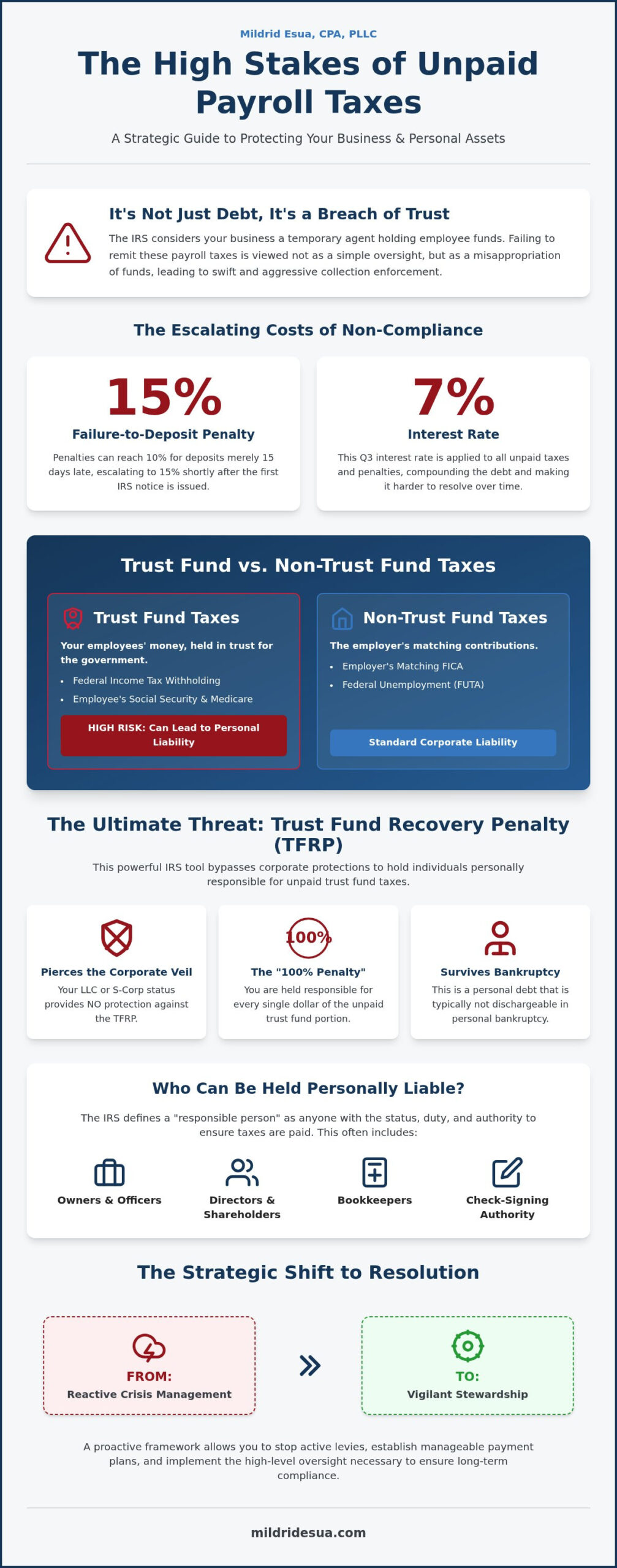
What if the IRS viewed your business’s unpaid payroll taxes not just as a corporate debt, but as a personal liability that could jeopardize your family’s bank account? For many entrepreneurs, the realization that they’ve fallen behind on payroll deposits brings an immediate, suffocating sense of dread. With 2026 failure-to-deposit penalties reaching as high as 15% and interest rates sitting at 7% for the third quarter, the financial weight can quickly feel insurmountable. It’s natural to feel overwhelmed by the complexity of “trust fund” portions versus employer contributions, especially when aggressive collection tactics begin to surface.
You deserve a strategic partner who acts as a vigilant steward of your interests. To effectively resolve payroll tax debt, you must move beyond reactive panic and toward a structured, professional resolution. This guide outlines the specific pathways to settle your liabilities, protect your personal assets from the 100% Trust Fund Recovery Penalty, and restore your standing with the government. We’ll examine how to stop active levies, establish manageable payment plans, and implement the high-level bookkeeping oversight necessary to ensure your business remains secure and compliant for the long term.
Key Takeaways
- Understand why the IRS views unpaid payroll withholdings as a breach of trust and how this perspective drives their aggressive collection tactics.
- Identify the specific triggers for the Trust Fund Recovery Penalty to protect your personal assets and bank accounts from business-level liabilities.
- Discover the “current and compliant” framework necessary to successfully resolve payroll tax debt through professional settlement pathways.
- Transition from reactive crisis management to a “Vigilant Stewardship” model by integrating high-level bookkeeping and payroll oversight into your daily operations.
- Leverage the strategic advantage of professional IRS representation to navigate complex negotiations while maintaining your focus on business growth.
The High Stakes of Payroll Tax Debt: Why the IRS Prioritizes Enforcement
The IRS views payroll tax as a sacred fiduciary trust rather than a standard corporate liability. When you withhold money from an employee’s paycheck, you’re acting as a temporary agent for the federal government. Failing to remit these funds isn’t just a financial oversight; the IRS characterizes it as a misappropriation of employee funds. While standard income tax collections often follow a more deliberate pace within the 10-year statute, payroll enforcement is notably more aggressive. Revenue Officers are typically assigned to these cases with much greater speed, and they’re empowered to move with a level of intensity that can catch even seasoned business owners off guard. To effectively resolve payroll tax debt, you must adopt a stance of “Vigilant Stewardship,” taking proactive control of your filings before the government initiates forced collection actions.
Trust Fund vs. Non-Trust Fund Taxes
Understanding the internal composition of your tax liability is the first step in building a strategic defense. “Trust Fund” taxes represent the money you’ve already deducted from your employees’ earnings, including federal income tax, Social Security, and Medicare withholdings. These are legally distinct from the “Non-Trust Fund” portion, which consists of the employer’s matching FICA and FUTA contributions. The IRS prioritizes the collection of the trust fund portion because it represents money that never belonged to the business in the first place. If these funds remain unpaid, the IRS can trigger the Trust Fund Recovery Penalty (TFRP), a powerful enforcement tool that allows them to bypass corporate protections and pursue individuals personally. Unlike other business debts, this penalty can follow an owner even through personal bankruptcy.
Common Triggers for IRS Payroll Inquiries
The path to an audit or a lien often begins with a simple clerical error or a delayed filing. Discrepancies on Form 941, the Employer’s Quarterly Federal Tax Return, act as immediate red flags for automated IRS systems. Even missing a single quarterly deposit can transition your file from a standard processing queue to an active collection status, often resulting in an immediate federal tax lien. The agency also monitors the timing of deposits with extreme precision. For example, in 2026, being more than 15 days late triggers a 10% penalty, which can escalate to 15% shortly after the first IRS notice is issued. In the context of these investigations, willfulness is defined as a responsible person’s intentional disregard of the law or plain indifference to the requirement of paying the taxes despite knowing they were due. Taking swift, professional action to resolve payroll tax debt at this stage is the only way to prevent a Revenue Officer from appearing at your place of business. If the IRS escalates its scrutiny beyond payroll deposits, understanding the realities of IRS audit representation in NC and the dangerous myths that cost taxpayers thousands can help you avoid costly missteps during any formal examination.
The Trust Fund Recovery Penalty (TFRP): Protecting Your Personal Assets
Most business owners believe their LLC or S Corp status acts as an impenetrable shield against corporate creditors. While this is generally true for vendor debts or commercial leases, it doesn’t apply to IRS employment tax regulations. The Trust Fund Recovery Penalty allows the IRS to pierce the corporate veil and hold individuals personally liable for the unpaid trust fund portion of payroll taxes. This assessment is often referred to as the “100% Penalty” because it holds you responsible for every cent of the withheld employee taxes, regardless of your business structure. Your corporate entity cannot protect you from this specific liability; the IRS views it as a personal debt from the moment the funds are withheld but not remitted.
The IRS doesn’t just look at the majority owner when searching for accountability. They define a “responsible person” as anyone with the status, duty, and authority to ensure taxes are paid. This includes owners and officers, but it can also extend to directors, shareholders, or even bookkeepers who have check-signing authority. If you had the power to decide which bills were paid and which were neglected, the IRS will likely target you. Our role as a Strategic Architect is to help you resolve payroll tax debt at the corporate level, creating a structural barrier that prevents the debt from migrating to your personal balance sheet.
The IRS Investigation Process (Letter 1153)
The investigation formally begins when you receive Letter 1153. This document is a critical crossroads, offering you a 60-day window to protest the assessment before it becomes final. During this time, the IRS uses Form 4180 interviews to determine “responsibility” and “willfulness.” These interviews are high-stakes encounters where your answers are recorded and used to build a case against you. Having professional IRS representation during these interviews is a strategic necessity to ensure your rights are protected. A single misstatement about your role in the company’s financial decisions can lead to an immediate personal assessment.
Consequences of Personal Assessment
Once the IRS assesses the TFRP personally, the debt becomes yours individually. They can place a federal tax lien on your home, garnish your personal bank accounts, and damage your credit score for years. This debt doesn’t disappear if the business closes or enters bankruptcy. It follows you across state lines and through different ventures, remaining a permanent fixture on your financial record until it is satisfied. We advocate for a proactive approach to resolve payroll tax debt early, ensuring the liability remains a business challenge rather than a personal catastrophe that threatens your family’s equity and long-term security.
Strategic Pathways to Resolve Payroll Tax Debt in 2026
When you face significant tax liabilities, the IRS doesn’t view resolution as a simple negotiation. It’s a rigorous test of your business’s future viability. Unlike standard commercial creditors who might settle for a quick payout, the IRS demands a comprehensive demonstration of “current and compliant” behavior before they’ll entertain any settlement. This means you must have all unfiled returns submitted and be making all current payroll tax deposits on time. If you aren’t meeting your current obligations, the agency will likely reject your proposal immediately. To resolve payroll tax debt effectively, you must treat these resolution options as strategic tools designed to stabilize your operations while shielding your personal assets.
In-Business Trust Fund Express Installment Agreements
For businesses with a total debt under $25,000, the In-Business Trust Fund Express Installment Agreement offers a streamlined path to compliance. This specific tool is highly advantageous because it often allows you to avoid the public filing of a Federal Tax Lien, provided the debt can be fully paid within 24 months or before the collection statute expires. However, this pathway requires a commitment to a “no-default” philosophy. A single late deposit or missed filing during the term of the agreement can trigger an immediate default, leading to aggressive collection actions and the loss of your lien-avoidance status. It’s a solution that rewards consistent, vigilant stewardship of your financial obligations.
Offer in Compromise (OIC) for Businesses
An Offer in Compromise is often viewed as the ultimate goal for those looking to resolve payroll tax debt because it allows you to settle the liability for less than the full amount owed. The IRS typically evaluates these requests under the “Doubt as to Collectibility” standard, which accounts for approximately 90% of all approved offers. However, business owners should be wary of the declining acceptance rates. In 2024, the acceptance rate for OICs was approximately 21%, and early 2025 data suggests it has tightened further to around 14%. Successfully navigating this path requires a “Strategic Architect” who can meticulously document your business’s limited ability to pay while presenting a compelling case for the government to accept a reduced sum.
Penalty Abatement and Relief
Reducing the overall balance of your debt is often more practical than seeking a full settlement. Through Penalty Abatement, we can often remove failure-to-pay or failure-to-deposit penalties if you can demonstrate “Reasonable Cause,” such as a natural disaster, serious illness, or unavoidable business disruption. If your business has a clean history of compliance for the preceding three years, you might also qualify for the “First-Time Abate” policy. By stripping away these non-tax additions, the total balance becomes much more manageable, allowing for a sustainable installment plan that doesn’t cripple your monthly cash flow.
A Proactive Framework for Preventing Recurrence
Successfully navigating the pathways to resolve payroll tax debt is a significant achievement for any business owner, but it’s only the first phase of a long-term strategic recovery. True stability requires a total transformation of your financial architecture to ensure that the pressure of back taxes never returns. Unlike a reactive approach that simply pays the current bill, a model of “Vigilant Stewardship” addresses the root causes of tax delinquency. Most payroll crises stem from the dangerous practice of treating tax withholdings as temporary working capital during lean months. This habit inevitably leads to the personal liabilities and aggressive enforcement actions we’ve examined.
Local businesses in Greensboro and Burlington benefit immensely from establishing a rigid separation of funds through customized accounting structures. We advise clients to maintain a dedicated payroll bank account where only net pay and tax liabilities reside. By transferring the total gross payroll amount into this account every pay period, you create a physical barrier that prevents you from “borrowing” from the IRS to cover operational overhead. This simple structural change provides the clarity needed to make informed decisions without risking your personal financial standing.
Step 1: Outsource Payroll and Bookkeeping
The most effective way to eliminate human error is to remove the burden of manual tax calculations from your daily operations. Professional bookkeeping and payroll services provide the automation necessary to ensure that every federal deposit is made on time and every Form 941 is filed accurately. Beyond mere compliance, an engaged advisor monitors your S Corp election and self-employment tax obligations, ensuring that your business structure remains optimized for both growth and tax efficiency. This level of continuous engagement allows you to focus on leadership while we act as the guardians of your financial integrity.
Step 2: Implement Cash Flow Monitoring
Maintaining a clear picture of your accruing liabilities is essential for strategic foresight. Using payroll taxes as “working capital” is often a symptom of poor cash flow visibility rather than a genuine lack of funds. To prevent this, implement a weekly review process that includes the following checkpoints:
- Verify that the payroll reserve account matches the current period’s estimated tax liability.
- Review the Balance Sheet to confirm that “Payroll Taxes Payable” isn’t growing faster than your cash reserves.
- Confirm that all quarterly filings align perfectly with the actual deposits made throughout the month.
When you understand how to read your Balance Sheet, you can spot potential crises months before they trigger an IRS inquiry. This proactive stance is what separates a thriving enterprise from one that is perpetually struggling to resolve payroll tax debt. By integrating these systems today, you build a foundation that supports sustainable expansion and professional peace of mind.
Partnering with a Greensboro CPA for Strategic Tax Resolution
Mildrid Esua, CPA, PLLC serves as the Strategic Architect for businesses throughout Greensboro, High Point, and Winston-Salem. Unlike transactional services that only look backward at past mistakes, our firm provides a holistic pathway to resolve payroll tax debt while simultaneously fortifying your future. We believe that true resolution requires more than just a signed agreement with the IRS; it requires a fundamental shift in how your business manages its fiduciary responsibilities. By positioning ourselves as your Vigilant Guide, we help you navigate the immediate crisis of back taxes while implementing the structural changes necessary for long-term financial standing.
The primary advantage of professional IRS Representation is the creation of a sophisticated buffer between you and the taxing authorities. You don’t have to face a Revenue Officer alone or spend your valuable time deciphering complex tax codes. We handle all direct communications with the IRS, ensuring that your rights are protected and that any proposed settlement is grounded in an accurate assessment of your business’s financial reality. This partnership allows you to maintain your focus on daily operations and growth while we manage the complexities of your tax controversy with constant attention and high-level expertise.
Why Local Representation Matters in North Carolina
Working with a local CPA who understands the specific business climate of the Triad area offers a level of personalized care that national “tax relief” mills simply cannot match. We are deeply invested in the success of the North Carolina business community, providing responsive service that is tailored to your unique challenges. Our expertise extends beyond mere tax resolution; we integrate comprehensive small business accounting and bookkeeping to ensure your compliance is sustainable. This localized, proactive methodology ensures that once your debt is settled, you have the year-round advisory support needed to prevent a recurrence of these high-stakes liabilities.
Your Path to Financial Clarity Starts Here
The journey toward restoring your business’s financial integrity begins with a thorough diagnostic review of your current tax standing. During our initial consultation, we analyze your unfiled returns, current deposit history, and the specific nature of your “trust fund” liabilities. We then architect a customized strategy that prioritizes the protection of your personal assets and the stabilization of your company’s cash flow. The sooner you take action to resolve payroll tax debt, the more strategic options remain available to protect your business’s legacy and your family’s equity. Take the first step toward a secure future and a steady hand in this complex environment.
Schedule a consultation with Mildrid Esua, CPA to resolve your payroll tax debt today
Restoring Your Business’s Financial Foundation
Navigating the complexities of IRS enforcement requires more than just a quick fix; it demands a strategy that safeguards your business and personal livelihood. By understanding the Trust Fund Recovery Penalty and identifying viable settlement pathways, you’ve already taken the first step toward reclaiming control. Transitioning to a model of vigilant stewardship through professional bookkeeping ensures that these liabilities remain a thing of the past. This approach transforms a moment of crisis into a foundation for future stability.
When you’re ready to resolve payroll tax debt with the precision of a seasoned advisor, our team is here to guide you. Unlike reactive measures that only address the current balance, our partnership focuses on long-term resilience. We provide expert IRS representation for small businesses in Greensboro and High Point, managing back taxes while building a strategic plan for growth. Through comprehensive bookkeeping designed to prevent future IRS disputes, we ensure your business remains secure. You don’t have to carry the weight of tax controversy alone.
Secure Your Business’s Future with Strategic Tax Resolution from Mildrid Esua, CPA. Your path to clarity and long-term stability is within reach.
Frequently Asked Questions
What is the Trust Fund Recovery Penalty and am I personally liable?
The Trust Fund Recovery Penalty is a 100% penalty assessed on the withheld portion of unpaid payroll taxes. If the IRS determines you are a “responsible person” with the authority to direct business funds, you are personally liable for this debt. This means the IRS can pursue your personal bank accounts and home equity regardless of your LLC or corporate structure. Professional intervention is essential to protect your individual assets during this assessment process.
Can I file for bankruptcy to get rid of payroll tax debt?
No, the trust fund portion of payroll tax debt is generally non-dischargeable in bankruptcy. While some employer-side taxes might be eligible for discharge under very specific conditions, the money withheld from employees is viewed as a fiduciary trust. Even if your business enters liquidation or you file for personal bankruptcy, the personal liability for the trust fund portion will likely follow you until it is satisfied or the collection statute expires.
How much does the IRS charge in penalties for late payroll tax deposits?
The IRS applies a tiered failure-to-deposit penalty that increases based on how late the payment is received. Deposits 1 to 5 days late incur a 2% penalty, which rises to 5% for 6 to 15 days, and 10% for anything over 15 days. If you fail to pay within 10 days of your first IRS notice, the penalty jumps to 15%. In 2026, these penalties are compounded by quarterly interest rates that have reached as high as 7% for underpayments.
What should I do if an IRS Revenue Officer visits my place of business?
You should remain professional but avoid providing immediate financial data or signing any documents during an unannounced visit. Revenue Officers are high-level enforcement agents who are building a case for collection or personal assessment. Request their credentials and inform them that you will have your CPA handle the investigation. Engaging professional IRS representation immediately allows you to resolve payroll tax debt through a controlled, strategic dialogue rather than a high-pressure confrontation.
Can I set up a payment plan if my business owes more than $25,000 in payroll taxes?
Yes, but the process is more rigorous than the “Express” options available for smaller debts. For liabilities exceeding $25,000, the IRS typically requires a full financial disclosure via Form 433-B, Collection Information Statement for Businesses. You must demonstrate that the business is currently making all new tax deposits on time before they will approve a long-term installment agreement. We act as your Strategic Architect to present this financial data in the most favorable light possible.
What is the difference between an Offer in Compromise and an Installment Agreement for payroll tax?
An Installment Agreement is a structured plan to pay the full debt over time, whereas an Offer in Compromise (OIC) allows you to settle for less than you owe. While an OIC sounds ideal, the IRS has become increasingly selective, with acceptance rates dropping to approximately 14% in early 2025. Most businesses find that a well-structured installment agreement is the most reliable way to resolve payroll tax debt while keeping operations running without the threat of seizure.
How long does it take to resolve a payroll tax dispute with the IRS?
The timeline for resolution varies significantly based on the complexity of your case and the specific relief you are seeking. A standard installment agreement might be finalized in a few weeks if the business is already compliant with its current filings. However, more complex negotiations, such as a Trust Fund Recovery Penalty protest or an Offer in Compromise, can take 6 to 18 months. Constant engagement with your CPA ensures the process moves as efficiently as possible through the IRS backlog.
Will the IRS close my business if I can’t pay my payroll taxes?
Closure is a last resort, but the IRS will move toward an injunction or seizure if they believe the business is “pyramiding” debt by continuing to accrue new liabilities. Their primary goal is to stop the loss of government funds. If you can demonstrate that you are “current and compliant” with all new deposits and have a viable plan for the back taxes, they generally prefer to keep the business open. Proactive communication is the only way to prevent the forced shutdown of your operations.