

What if your attempt to save money on overhead is actually costing you thousands in missed S Corp optimizations and undetected reporting errors? Many entrepreneurs in Greensboro and High Point treat their accounting software as a complete solution, yet 41% of financial reporting mistakes still trace back to simple human error. When you compare QuickBooks vs outsourced bookkeeping, the choice isn’t just about a monthly subscription fee versus a service contract. It’s a fundamental decision between reactive data entry and proactive financial stewardship.
You likely started your business to build a legacy, not to spend your nights untangling bank reconciliations or worrying about 2026 IRS audit triggers. We understand the pressure of managing complex filings while trying to decode reports that don’t seem to reflect your actual cash flow. This strategic guide explores how to move beyond basic record-keeping to achieve clean, audit-ready books and significant tax reduction. You’ll discover how the 2026 price increases for QuickBooks Online Plus and Advanced are shifting the value proposition toward professional partnerships that offer more than just software. We’ll preview the path from financial anxiety to a state of calm, strategic intent where your books finally serve your long-term growth.
Key Takeaways
- Understand the “Software Fallacy” and how relying solely on tools without professional expertise can lead to undetected reporting errors and missed deductions.
- Navigate the financial implications of QuickBooks vs outsourced bookkeeping by comparing subscription costs against the strategic value of professional oversight.
- Pinpoint the exact growth milestones and regulatory shifts in North Carolina that make transitioning to a professional partnership a strategic necessity.
- Learn how proactive stewardship transforms your financial data from static history into a roadmap for S Corp optimization and long-term tax savings.
- Gain clarity on how a dedicated CPA partner provides vigilant protection through IRS representation and ensures your business remains audit-ready.
The Hidden Costs of the DIY Bookkeeping Mindset
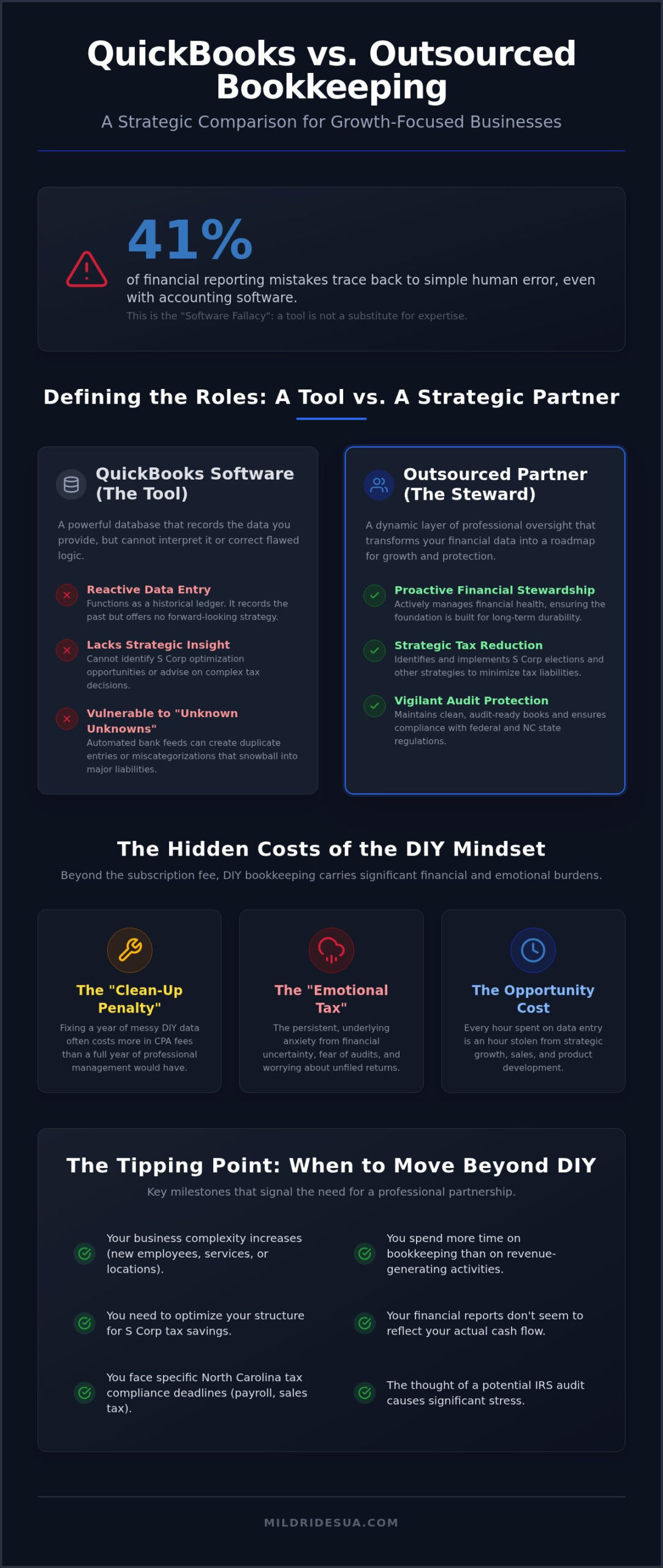
Owning a high-performance vehicle doesn’t grant you the skills of a professional racing driver. Similarly, the “Software Fallacy” leads many entrepreneurs to believe that a QuickBooks subscription is a substitute for financial expertise. When evaluating QuickBooks vs outsourced bookkeeping, it’s vital to recognize that the software is merely a database. It records what you tell it, but it cannot warn you when your underlying logic is flawed. This gap between having the tools and possessing the expertise often results in a “clean-up penalty” at year-end. CPAs frequently find that fixing a year of messy DIY data takes more time and resources than it would have cost to maintain professional oversight from the start.
The true cost of DIY management includes a heavy “emotional tax.” This is the persistent, underlying anxiety that stems from financial uncertainty. Instead of resting easy, you spend late nights wondering if a missed entry will trigger an IRS audit or if your unfiled returns are accumulating penalties. There is also a significant opportunity cost to consider. Every hour a business owner spends on data entry is an hour stolen from strategic growth, sales, or product development. If your time is valued at a professional rate, spending it on administrative reconciliation is one of the most expensive ways to run your firm.
The Risk of “Unknown Unknowns” in Financial Data
Modern accounting software relies heavily on automated bank feeds, which creates a false sense of security. Without professional stewardship, these feeds often generate duplicate entries or miscategorize owner draws as business expenses. These aren’t just clerical errors; they are “unknown unknowns” that snowball into significant tax liabilities over a fiscal year. By the time you realize your reports don’t make sense, the trail of data is often cold and difficult to reconstruct. Relying on automation without human oversight is a gamble that risks the long-term stability of your enterprise.
Impact on Local NC Business Compliance
For firms in Greensboro and High Point, the stakes are even higher due to specific North Carolina regulatory requirements. “Set it and forget it” software settings often fail to account for local payroll tax deadlines or nuances in NC sales tax reporting. A single misstep in these areas can lead to aggressive collection actions or the need for professional IRS representation. Unlike a software algorithm, a proactive partner acts as a vigilant guide, ensuring that your business remains compliant with both federal and state mandates. This level of protection prevents the need for future tax resolution and keeps your focus on the North Carolina market you serve.
Defining the Roles: QuickBooks Software vs. Professional Bookkeeping Services
Many business owners view software as a total solution when it’s actually just a container for data. When you evaluate QuickBooks vs outsourced bookkeeping, you’re choosing between a historical record and a forward-looking strategy. QuickBooks serves as a powerful database for recording transactions; however, it remains static. It doesn’t possess the professional intuition to identify a missed S Corp election opportunity or a subtle cash flow leak that could jeopardize your stability. A professional partner acts as a strategic architect, ensuring your financial foundation is built for long-term durability rather than just short-term compliance.
What QuickBooks Does (and Does Not) Do
QuickBooks excels at automating mechanical tasks like bank feeds, basic invoicing, and expense tracking. It’s a vital tool for any modern business. Yet, the limits of AI become clear when subjective strategic decisions are required. Software cannot determine if a specific expenditure should be structured for long-term depreciation or immediate expensing under 2026 tax standards. It records the data you provide but lacks the vigilant stewardship needed to protect you from systemic errors. Software is a tool for the bookkeeper, not a replacement for the seasoned expertise required to navigate complex IRS regulations.
The Scope of Professional Bookkeeping
Unlike a standalone software subscription, professional bookkeeping provides a dynamic layer of oversight and internal controls. This scope extends far beyond the ledger to include active management of your financial health. A professional engagement ensures your business maintains momentum through several key functions:
- Accounts Payable and Receivable: Managing the timing of cash flows to maintain liquidity and vendor trust.
- Payroll Integration: Ensuring seamless processing that accounts for North Carolina’s specific filing deadlines and withholding requirements.
- Insightful Analysis: Translating P&L statements into actionable business insights for growth in Greensboro or Winston-Salem.
- Real-Time Tax Readiness: Capturing every possible deduction as it happens, rather than searching for receipts at year-end.
The true “CPA difference” lies in moving from basic record-keeping to proactive tax architecture. A professional partner doesn’t just look at where your money went; they architect where it should go to minimize liability and maximize retained earnings. This constant attention ensures your books are always audit-ready, providing a steady hand in a complex regulatory environment. If you’re ready to transition from simple data entry to strategic growth, our bookkeeping for small businesses offers the vigilant protection your enterprise deserves.
Comparative Analysis: Cost, Accuracy, and Strategic Value
When analyzing QuickBooks vs outsourced bookkeeping, many owners focus solely on the line-item expense of a software subscription versus a professional fee. However, the 2026 pricing landscape has shifted the financial math. With QuickBooks Online Plus now at $140 per month and the Advanced tier reaching $340, the software itself is becoming a substantial operational cost. Unlike a static subscription that only records data, a professional partnership generates a return on investment through strategic tax architecture. For instance, executing a timely S Corp election can significantly reduce self-employment tax liabilities, a strategic move that software won’t suggest or manage on its own.
Accuracy benchmarks reveal a stark contrast between DIY efforts and professional management. Research indicates that human error causes 41% of financial reporting mistakes in the U.S. These errors aren’t just aesthetic; they are often the primary triggers for IRS audits. Having an expert who provides IRS representation already in your corner means you aren’t scrambling when a notice arrives. You have a vigilant guide who understands your financial history and is prepared to defend your filings with clean, reconciled data. This level of protection turns your bookkeeping from a chore into a shield for your business assets.
Financial Clarity and Decision Support
DIY bookkeeping typically results in reactive reporting. You only look at the numbers when tax season looms or a bank requires a profit and loss statement for a loan. In contrast, an outsourced model provides proactive advisory that guides your future. For a business scaling in the Winston-Salem market, real-time data allows for informed decisions on hiring or capital investments. You can leverage the permanent 100% first-year depreciation deduction for 2026 with confidence, knowing your cash flow projections are grounded in professional accuracy rather than automated guesses.
Tax Planning and Resolution Synergies
Clean, professionally managed books are your first line of defense against tax liens and levies. If you’re dealing with back taxes or unfiled returns, having reconciled data is the prerequisite for any successful tax resolution. This stewardship extends to complex international requirements as well. Managing FIRPTA withholding for international transactions requires a level of precision that basic software cannot provide. A professional partner ensures these nuances are handled correctly, preventing costly penalties before they arise and ensuring your business remains in good standing with both federal and North Carolina authorities.
Identifying the Tipping Point: When to Move Beyond DIY
Many entrepreneurs fall into the trap of waiting for an arbitrary revenue milestone before seeking professional help. However, the decision between QuickBooks vs outsourced bookkeeping is often dictated by complexity rather than just top-line income. If you’re managing a growing team in Greensboro or considering an S Corp election to optimize self-employment taxes, you’ve likely reached a critical tipping point. Complexity creates risk. When your transaction volume outpaces your ability to reconcile accounts weekly, your financial data loses its integrity. This transition isn’t just about offloading a task; it’s about securing a “Strategic Architect” who ensures your business structure supports your long-term vision.
Regulatory triggers often arrive faster than expected. Hiring your first employee in North Carolina introduces specific payroll tax deadlines and withholding requirements that “automated” software settings frequently miss. Similarly, if you’re expanding operations from High Point into neighboring states or preparing for a business sale, the need for audit-ready books becomes non-negotiable. A future buyer or a bank manager in Kernersville won’t accept “mostly accurate” records; they require a clean Balance Sheet that reflects the true health of your enterprise. Proactive management at this stage prevents the structural decay that leads to IRS intervention.
Signs Your DIY Setup is Failing You
The most visible sign of a failing DIY setup is a persistent disconnect between your bank balance and your financial reports. If you can’t explain why your cash on hand doesn’t match your profit and loss statement, your bookkeeping logic is broken. More urgent warnings include receiving IRS notices or “intent to levy” letters regarding unfiled returns. These aren’t just administrative hurdles; they are threats to your business’s existence. Relying on software while ignoring these signals is a reactive approach that often leads to costly tax resolution cases later. A stagnant ledger is a liability you can’t afford to carry.
Preparing for the Transition to Professional Support
Moving to professional support requires a methodical approach to data gathering. Start by organizing your historical records and any unfiled tax documents to provide your new partner with a clear baseline. At Mildrid Esua, CPA, PLLC, we simplify this onboarding process for local firms by establishing a rhythm of “Continuous Engagement.” We don’t just take over your data entry; we become a vigilant guide for your financial future. If you are ready to move from reactive record-keeping to proactive growth, explore our S Corp election and tax optimization services to see how we architect your success.
Beyond Data Entry: The Proactive Stewardship of Mildrid Esua, CPA
Choosing between QuickBooks vs outsourced bookkeeping is a decision that defines the trajectory of your business’s financial health. While software provides a place to store data, Mildrid Esua, CPA, PLLC offers a sophisticated layer of vigilant stewardship that a standalone subscription cannot replicate. Unlike traditional firms that treat ledger management as a clerical byproduct, we operate as a Strategic Architect for your enterprise. We integrate daily record-keeping with long-term tax planning, ensuring that every transaction recorded today serves a specific purpose in your future growth strategy. This proactive methodology transforms your books from a source of anxiety into a rigorous tool for informed decision-making.
Our partnership extends far beyond the digital ledger. We act as a protective ally for business owners across the NC Triad, providing the steady hand needed in a complex regulatory environment. Whether you are navigating the transition to a new fiscal year or facing the pressure of an audit, our firm provides expert IRS representation and resolution. We don’t just look backward at what happened; we look forward to navigate the challenges that haven’t arrived yet. This commitment to continuous engagement means your interests are being managed with constant attention and high-level expertise, allowing you to focus on the core mission of your company.
Specialized Services for Complex Needs
Many entrepreneurs come to us during a state of crisis, often involving unfiled returns or messy historical data that software alone couldn’t resolve. We specialize in professional reconstruction, turning chaos into clean, audit-ready books that restore your standing with the IRS. Our expertise also encompasses specialized areas that require a deep understanding of international and federal law, including:
- S Corp Election Strategies: We architect your business formation to minimize self-employment tax burdens and maximize retained earnings.
- International Tax and FIRPTA: Providing essential oversight for global-minded entrepreneurs dealing with complex withholding requirements.
- Tax Resolution: Offering a clear path forward for those dealing with back taxes, liens, or unfiled returns through dedicated stewardship.
Your Vigilant Guide in the NC Triad
Our deep roots in Greensboro, High Point, and Winston-Salem allow us to provide a level of local customization that national software providers cannot match. Business owners in Burlington and Oak Ridge trust our proactive methodology because it offers more than just accuracy; it offers peace of mind. We understand the specific North Carolina filing deadlines and local compliance nuances that impact your bottom line. By maintaining a year-round advisory relationship, we ensure your business remains stable and growth-oriented regardless of seasonal shifts. It is time to move beyond the limitations of DIY software and embrace a partnership built on intellectual rigor and professional passion.
Architecting Your Financial Stability in 2026
The shift from managing software to partnering with a Strategic Architect represents a fundamental evolution for your business. We’ve explored how the “Software Fallacy” often masks hidden costs, including the risk of 41% error rates in financial reporting and the persistent emotional burden of audit anxiety. By navigating the choice of QuickBooks vs outsourced bookkeeping with foresight, you transition from reactive data entry to proactive tax optimization. This move secures your legacy by ensuring that your financial data serves as a roadmap rather than a historical record.
As an IRS Representation Specialist and S Corp Tax Optimization Expert, Mildrid Esua, CPA, PLLC provides the vigilant protection needed to navigate North Carolina’s complex regulatory landscape. Whether you’re scaling operations in Greensboro, High Point, or Winston-Salem, your focus should remain on growth while we handle the complexities of compliance and tax resolution. It is time to replace uncertainty with the calm confidence that comes from professional stewardship. Secure Your Financial Future with Proactive Bookkeeping and Tax Resolution. Your business deserves a steady hand and a forward-looking ally; let’s build that stability together.
Frequently Asked Questions
Is QuickBooks enough for a small business without a bookkeeper?
QuickBooks is a powerful database, but it isn’t a substitute for professional judgment. Without a bookkeeper, you risk miscategorizing expenses and missing critical deductions that software algorithms can’t identify. When comparing QuickBooks vs outsourced bookkeeping, remember that the software only records the data you provide. It won’t warn you about structural tax risks or provide the vigilant stewardship needed to protect your business from future audits or reporting errors.
How much does it cost to fix messy books before tax season?
Fixing messy books before tax season often results in a “clean-up penalty” that exceeds the cost of year-round maintenance. The total depends on the volume of transactions and the number of years requiring reconstruction. While we don’t quote specific rates here, investing in proactive management prevents the stress of year-end scrambles. Clean records are essential for accurate filings and ensuring you don’t overpay the IRS due to unrecorded business expenses.
Can an outsourced bookkeeper help with IRS tax liens and back taxes?
Yes, an expert partner provides the essential data needed for effective IRS representation. Reconstructing your financial history is the first step in resolving tax liens or addressing back taxes. At Mildrid Esua, CPA, PLLC, we act as your vigilant guide through the resolution process. We ensure your books are audit-ready and compliant, which is a prerequisite for negotiating favorable terms or settlements with federal and state authorities.
What is the difference between a bookkeeper and a CPA for my NC business?
A bookkeeper typically focuses on recording daily transactions and maintaining the ledger’s accuracy. In contrast, a CPA firm like ours serves as a Strategic Architect for your business. We offer high-level tax planning, S Corp elections, and IRS representation that a standard bookkeeper cannot provide. For North Carolina firms, this means receiving guidance that integrates your daily financial records with a long-term strategy for stability and growth.
How does professional bookkeeping help with S Corp tax savings?
Professional bookkeeping ensures your salary and distribution splits meet IRS standards for reasonable compensation. This is the foundation of S Corp tax optimization. By maintaining clean records, we can accurately calculate the self-employment tax savings available to your business. This proactive approach prevents the misclassification of funds that often leads to penalties. It ensures your business structure remains a tool for wealth preservation rather than a source of regulatory risk.
Will I lose access to my QuickBooks data if I outsource my bookkeeping?
You retain full ownership and access to your financial data at all times. Cloud-based QuickBooks vs outsourced bookkeeping models prioritize transparency and real-time collaboration. We work within your existing ecosystem to provide oversight and internal controls without interrupting your daily operations. This continuous engagement allows you to view your financial health whenever needed while we handle the technical complexities of reconciliation and tax-ready reporting.
Does Mildrid Esua, CPA offer local services in Greensboro and Winston-Salem?
We maintain a strong local presence throughout the NC Triad, including Greensboro, Winston-Salem, and High Point. Our team understands the specific payroll tax deadlines and regulatory nuances unique to North Carolina businesses. Unlike distant national firms, we offer a consultative partnership grounded in the local economy. We serve clients from Burlington to Oak Ridge, providing the vigilant stewardship required to keep regional enterprises compliant and thriving.
What documents do I need to provide to an outsourced bookkeeping service?
You will typically need to provide bank and credit card statements, payroll records, and prior year tax returns. We also require documentation for any outstanding 1099s or specialized transactions like FIRPTA withholdings. Our onboarding process is designed to be methodical and reassuring. We help you gather these historical documents to create a fresh start, ensuring your financial foundation is solid before we begin our ongoing advisory relationship.