

What if your most significant business expense isn’t your overhead, but the 15.3% self-employment tax you pay simply because of how your business is structured? It’s exhausting to watch a substantial portion of your revenue vanish into Social Security and Medicare obligations before you can even reinvest in your growth. You likely feel the weight of these rising costs, especially as the Social Security wage base limit is projected to climb toward $184,500 in 2026. Learning how to elect S Corp status for an LLC is the critical first step toward reclaiming that capital and evolving from a reactive business owner into a proactive corporate officer.
This guide provides a precise roadmap for navigating IRS Form 2553 and meeting the vital March 16, 2026, filing deadline with confidence. We’ll explore how to establish a “reasonable salary” that satisfies IRS scrutiny while protecting your bottom line. By the end of this article, you’ll understand how to transform your financial structure into a resilient asset that prioritizes long-term stability and significant tax savings. Unlike generic filing services, we focus on the strategic depth required to ensure your election remains compliant and your business remains protected.
Key Takeaways
- Understand the structural shift from a disregarded entity to a corporate tax designation to unlock significant self-employment tax optimization.
- Discover the precise timeline and procedural requirements for how to elect S Corp status for an LLC, ensuring you meet the critical IRS 75-day filing window.
- Learn to navigate the “reasonable salary” requirement with the foresight of a vigilant guide to protect your business from IRS audit risks.
- Compare the financial impact of different filing obligations, including Form 1120-S and North Carolina’s specific franchise tax considerations for 2026.
- Transition to a model of proactive stewardship where monthly bookkeeping and strategic CPA oversight ensure your S Corp remains a resilient financial asset.
Beyond the Default: Why LLCs Consider the S Corp Election
Many business owners view their LLC as a static legal structure, but a Strategic Architect sees it as a flexible foundation. An S corporation is not a separate business entity like a C Corp or an LLC; instead, it’s a specific tax designation granted by the IRS. By default, the IRS classifies a single-member LLC as a disregarded entity and a multi-member LLC as a partnership. While these defaults offer simplicity during the startup phase, they often become a financial anchor as revenue grows. Understanding how to elect S Corp status for an LLC allows you to pivot from these reactive defaults toward a structure designed for long-term growth and stability.
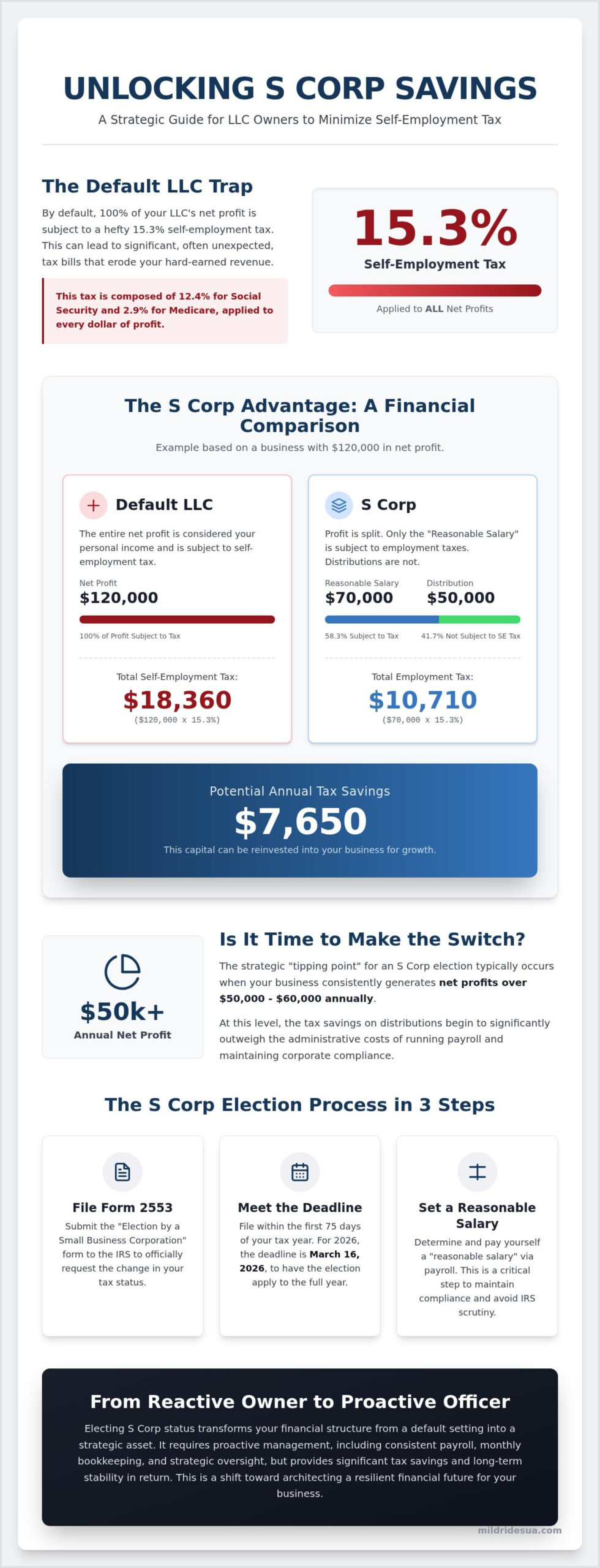
The strategic “tipping point” usually occurs when your business generates enough profit to pay yourself a competitive salary while still having remaining income to distribute. For most firms, this transition becomes financially viable once net profits consistently exceed $50,000 to $60,000, though the exact figure depends on your specific industry and operational costs. At this level, the tax savings on distributions begin to significantly outweigh the administrative costs of running payroll.
The Default LLC Trap: Understanding Self-Employment Tax
Under default rules, you pay a 15.3% self-employment tax on 100% of your net profits. This often leads to painful tax surprises in April, where a successful year results in an unexpectedly high bill. We view the transition to an S Corp as an act of Vigilant Stewardship. It’s about protecting your hard-earned income from unnecessary erosion. Instead of letting the IRS dictate your contribution to Social Security and Medicare based on your total success, you gain the power to define your compensation strategically. This shift removes the emotional burden of reactive tax planning and replaces it with a deliberate, controlled financial environment. Many of these challenges are compounded by common tax mistakes for startups NC business owners make when first establishing their entity structure.
S Corp Status: A Protective Shield for Your Revenue
This structure creates a forward-looking financial foundation by splitting your income into two streams: a W-2 salary and shareholder distributions. Only the salary portion is subject to employment taxes. This proactive methodology doesn’t just lower your current liability; it builds a more resilient business. Properly structured payroll and distributions also simplify matters if you ever face a tax resolution scenario. Having clear, compliant records of owner compensation is a powerful defense during IRS representation, as it demonstrates a commitment to regulatory standards rather than a reactive attempt to hide income. Learning how to elect S Corp status for an LLC ensures you aren’t just running a business, but architecting a legacy.
The S Corp Advantage: Optimizing Self-Employment Tax
A reactive LLC owner often views their tax bill as an inevitable consequence of success. In contrast, a proactive S Corp officer approaches their financial structure with strategic intent. The primary advantage of this shift lies in the surgical optimization of self-employment taxes. For 2026, the self-employment tax rate remains at 15.3%, consisting of 12.4% for Social Security and 2.9% for Medicare. By understanding how to elect S Corp status for an LLC, you gain the ability to shield a portion of your earnings from these specific levies, provided you adhere to the formal instructions for IRS Form 2553.
Consistent payroll management is the heartbeat of this structure. It isn’t merely about administrative compliance; it’s about establishing a steady, predictable rhythm for your business finances. This methodical approach ensures that your tax obligations are handled incrementally throughout the year, preventing the high-pressure environment of a massive year-end liability. It requires a high degree of involvement and tailored care, moving beyond the capabilities of generic automated software.
The Reasonable Salary Requirement: Avoiding IRS Scrutiny
The IRS requires shareholder-employees to receive “reasonable compensation” for the services they provide to the corporation. This isn’t a static number. It’s a nuanced figure based on your duties, industry standards, and the volume of your business. As your Vigilant Guide, Mildrid Esua, CPA, PLLC analyzes specific industry data to determine a salary that commands respect from auditors while maximizing your savings. Failing to meet this standard or neglecting unfiled tax returns can trigger aggressive IRS representation needs, as the agency may attempt to reclassify your tax-free distributions as taxable wages.
Distributions vs. Salary: The Math of Savings
The core of the savings math is simple yet profound. While your W-2 salary is subject to the full 15.3% employment tax, your shareholder distributions are not. For example, if your net profit significantly exceeds the Social Security wage base limit projected at $181,800 to $184,500 for 2026, the savings on the Medicare portion alone can be substantial. Setting these ratios requires intellectual and advisory depth to ensure the structure is both profitable and protective. If you’re ready to move toward a more sophisticated model of wealth preservation, exploring our small business accounting and tax planning services can provide the clarity you need to proceed.
S Corp vs. LLC Tax: Comparing the Financial Impact
While the standard LLC offers unparalleled flexibility, the transition to an S Corp introduces a level of strategic discipline that separates growing enterprises from static ones. For consultants in Greensboro or contractors in Winston-Salem, understanding how to elect S Corp status for an LLC is the bridge between administrative ease and long-term financial resilience. When comparing LLC vs. S Corp structures, a default LLC reports income on Form 1040, Schedule C, whereas an S Corp requires the more complex Form 1120-S. This shift isn’t merely about more paperwork; it’s about moving from a reactive self-employed mindset to a structured corporate officer approach.
Administrative Complexity vs. Strategic Depth
The decision of how to elect S Corp status for an LLC brings new regulatory obligations that require vigilant stewardship. Unlike the single year-end filing for a disregarded LLC, an S Corp must manage:
- Quarterly Form 941 filings for federal payroll taxes.
- Annual Form 940 filings for federal unemployment (FUTA) taxes.
- Monthly or semi-weekly payroll tax deposits.
- Detailed corporate minutes and record-keeping to maintain compliance.
Managing this complexity alone is a risk. A true Growth Partner ensures that quarterly estimated payments are handled with precision, preventing the cash-flow shocks that often cripple unadvised businesses. This strategic depth provides a clear view of your company’s health, allowing for informed decision-making throughout the fiscal year.
North Carolina State Tax Considerations
For businesses in Greensboro and High Point, local tax planning is essential. The North Carolina Department of Revenue (NCDOR) recognizes federal S elections, but it’s critical to understand that an LLC taxed as an S corporation in North Carolina is subject to a minimum franchise tax of $200 for 2026. This is in addition to the $200 annual report fee. We also frequently evaluate the North Carolina Pass-Through Entity Tax (PTET) election for our clients. This secondary strategy allows the entity to pay state income taxes at the corporate level, potentially bypassing the $10,000 federal cap on state and local tax (SALT) deductions. This level of foresight is what characterizes our proactive methodology, ensuring your business structure serves as a protective shield for your revenue. Avoiding the common tax mistakes for startups NC founders encounter with franchise tax and PTET elections requires this same level of advance planning.
The Election Process: Filing Form 2553 and Meeting IRS Deadlines
Executing the transition to a new tax designation requires a methodical adherence to IRS protocols. Understanding how to elect S Corp status for an LLC involves more than just downloading a form; it requires a meticulous approach to completing IRS Form 2553. One of the most critical, yet frequently overlooked, steps is obtaining consent from every single shareholder. The IRS is uncompromising on this point. Without 100% of the required signatures documented on the form, the election is invalid. This procedural precision is a hallmark of vigilant stewardship, ensuring your business isn’t left exposed to the default tax treatments we’ve previously analyzed.
Timely Filing: The 75-Day Window
The IRS is strict regarding the timing of your election. For existing calendar-year businesses, the “2-month and 15-day” rule dictates your window for action. To make the S Corp election effective for the 2026 tax year, your Form 2553 must be filed no later than March 16, 2026. This deadline is adjusted from the typical March 15th date because it falls on a Sunday. New businesses face a similar constraint, with the clock starting the moment they first have shareholders, acquire assets, or begin operations. Waiting until the final days of this window is a reactive risk that we don’t recommend. Instead, we advocate for strategic intent, preparing these documents well before the fiscal year begins to ensure a seamless transition.
Late Election Relief: Correcting Past Oversights
If you’ve missed the standard filing window, you aren’t necessarily locked out of the benefits for another year. IRS Revenue Procedure 2013-30 provides a pathway for late election relief, allowing businesses to secure the status they intended even after the deadline has passed. This process requires a “reasonable cause” statement, which is a formal explanation for the delay. Crafting these statements requires a steady hand and an intellectual depth that generic filing services simply cannot provide. We specialize in transitioning clients from reactive filing errors to proactive compliance by architecting these relief requests effectively. Whether the delay was due to a lack of awareness or a previous advisor’s oversight, we provide the vigilant guide you need to set things right.
If you need assistance navigating these critical deadlines or require professional IRS representation to correct a missed filing, explore our business formation and tax resolution services today to secure your financial future.
Strategic Oversight: Why North Carolina Businesses Need a CPA for S Corp Success
Many entrepreneurs believe that once they learn how to elect S Corp status for an LLC, the work is finished. In reality, this election isn’t a “set it and forget it” administrative task but a commitment to a higher standard of financial discipline. For firms in High Point and Burlington, the transition requires a shift from simple annual reporting to meticulous monthly bookkeeping. This continuous involvement ensures that your corporate records remain accurate and that your business formation in Winston-Salem is fiscally sound. Unlike on-demand software that lacks local context, Mildrid Esua, CPA, PLLC acts as a proactive ally, providing the vigilant stewardship necessary to manage these moving parts.
The Need for Continuous Engagement
Year-round advisory services offer a depth of protection that seasonal tax preparation cannot match. When you operate as an S Corp, you’re managing more than just income; you’re managing a payroll system, quarterly federal filings, and state-specific obligations. A reactive approach to these requirements often leads to stress and technical errors. By engaging in a constant, supportive cadence of financial review, you ensure that payroll taxes are deposited on time and that Form 941 filings are precise. This methodical rhythm prevents the “tax surprises” mentioned earlier and allows you to focus on growth rather than administrative catch-up.
Protecting Your Future: IRS Representation and Resolution
A properly managed S Corp is your first line of defense against IRS scrutiny. The agency frequently targets S Corp shareholder-employees regarding the “reasonable salary” standard. When your records are maintained with intellectual rigor, you significantly reduce the risk of an audit or the reclassification of distributions. If the IRS does question your filings, having a Vigilant Guide who specializes in IRS representation is invaluable. We understand the nuances of tax resolution and how to prevent the escalation of issues into federal tax liens. Our methodology focuses on foresight, ensuring that every decision made today protects your business assets for years to come.
If you’re ready to move beyond basic filing and embrace a sophisticated financial structure, schedule a consultation with Mildrid Esua, CPA, PLLC for your S Corp election. We provide the steady hand and strategic intent required to navigate the 2026 tax landscape with confidence.
Architecting Your Path to Financial Stability
Transitioning your business from a default tax structure to a more sophisticated model is a defining moment for any entrepreneur. By understanding how to elect S Corp status for an LLC, you move beyond reactive bookkeeping and embrace a system that prioritizes long-term wealth preservation. This shift requires more than just a one-time filing; it demands a proactive strategic planning methodology that balances reasonable compensation with optimized distributions. Unlike generic online services, Mildrid Esua, CPA, PLLC provides the vigilant stewardship needed to maintain compliance and protect your assets.
Our expertise in comprehensive small business accounting in Greensboro ensures your payroll and filings remain precise, while our background in IRS representation and tax resolution offers a steady hand if complex challenges arise. It’s time to evolve. Secure Your Strategic Tax Advantage; Consult with Mildrid Esua, CPA, PLLC Today. Your business deserves a structure that works as hard as you do.
Frequently Asked Questions
Can I elect S Corp status for my LLC in the middle of the year?
You can file Form 2553 at any time, but its effective date is strictly regulated. To make the change effective for the current year, you must file within two months and 15 days of the start of your tax year. Mid-year filings generally apply to the following fiscal year. Understanding how to elect S Corp status for an LLC mid-stream requires a clear view of your current year’s tax obligations and filing windows.
How much does it cost to maintain an S Corp versus a standard LLC?
Maintaining an S Corp is more expensive than a standard LLC due to increased administrative requirements. In North Carolina, you’ll pay a $200 minimum franchise tax in addition to the $200 annual report fee. You also need to account for payroll processing costs and professional accounting oversight. These expenses are strategic investments that typically yield significant net savings once your business reaches a specific revenue threshold that justifies the extra rigor.
Is an S Corp better than an LLC for a single-member business in North Carolina?
A single-member LLC in North Carolina often benefits from an S Corp election once net profits consistently exceed $50,000. Unlike a disregarded entity where you pay 15.3% self-employment tax on every dollar, an S Corp lets you designate a portion of income as a tax-free distribution. This transition moves you from a reactive tax position to a model of proactive stewardship over your revenue, providing long-term financial stability.
What is a “reasonable salary” for an S Corp owner in 2026?
A “reasonable salary” is a nuanced figure that reflects what an independent employer would pay for your specific services. The IRS looks at your duties, the time you spend on the business, and industry benchmarks. We use tailored data to help you set a salary that avoids audit triggers. This foresight ensures your compensation is defensible while you maximize the benefits of how to elect S Corp status for an LLC.
Do I need a new EIN if my LLC elects S Corp status?
You typically don’t need a new Employer Identification Number when your LLC makes an S Corp election. The IRS views this as a change in tax classification rather than the creation of a new legal entity. Your existing EIN will continue to serve as your primary identifier for payroll, banking, and federal tax filings. This continuity helps maintain a steady financial record without the complexity of updating every vendor and institution with new details.
What happens if I miss the IRS Form 2553 filing deadline?
Missing the March 16, 2026, deadline doesn’t automatically disqualify you from S Corp benefits for the year. You can request late election relief by filing Form 2553 with a “reasonable cause” statement. This requires a sophisticated explanation of why the deadline was missed. We provide the vigilant guidance needed to navigate this complex relief process, ensuring your business isn’t penalized for a simple administrative oversight or a previous advisor’s error.
Does North Carolina recognize the federal S Corp election automatically?
North Carolina recognizes federal S Corp elections without requiring a separate state-level filing for tax classification. Your business will be taxed as an S Corp for state income tax purposes once the IRS approves your Form 2553. You must remain aware of state-specific obligations, such as the $200 minimum franchise tax, to ensure your business remains in good standing with the North Carolina Department of Revenue throughout the fiscal year.
Can an S Corp help me resolve existing back taxes or IRS liens?
An S Corp election won’t directly resolve existing back taxes, but it establishes the structural discipline needed to avoid future IRS liens. If you’re currently dealing with tax debt, we integrate S Corp planning with our tax resolution services. This dual approach helps you settle past obligations while architecting a more resilient financial future that prevents the recurrence of high, unmanaged self-employment tax bills through proactive, year-round management.