

The right accountant should do more than organize last year’s records. They should help you make clearer decisions about the business ahead. To understand how to find a good accountant in Winston-Salem, look for services that match your needs, clear communication about the work, and advice that connects bookkeeping and tax decisions to your business goals.
It’s reasonable to want accurate records and dependable tax support without losing sight of day-to-day operations. The right fit depends on where you need help now, whether that’s routine bookkeeping, payroll, tax preparation, or guidance as your business grows.
This article explains how to assess bookkeeping, CPA and consulting services, and accounting firms in Winston-Salem. You’ll learn what different services cover, what to consider when comparing support, and how to identify a next step toward a more informed financial plan.
Key Takeaways
- Match bookkeeping support to your business’s recordkeeping and reporting needs.
- Understand how local CPA and consulting services can support business decisions beyond routine accounting.
- Distinguish bookkeeping tasks from broader accounting support to identify the right scope of help.
- Assess accounting firms by the services and guidance that fit your business priorities.
- Explore how bookkeeping, payroll, tax planning, and tax preparation can support small businesses.
Small-business accounting and bookkeeping
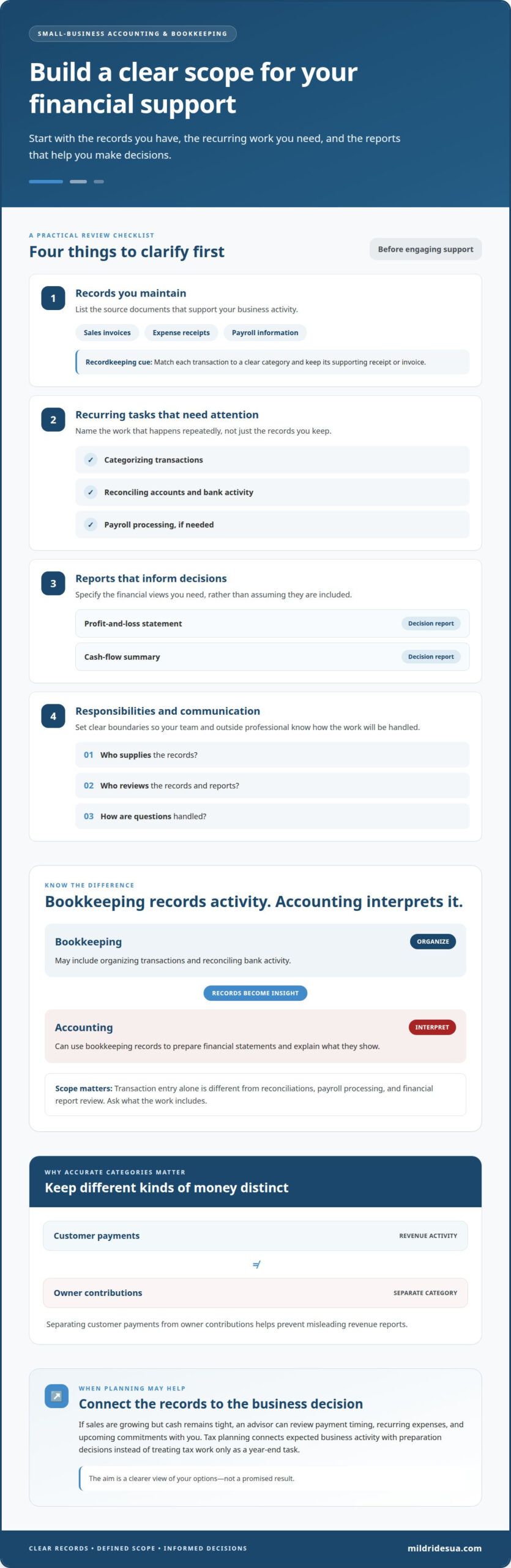
Small-business bookkeeping creates the records behind decisions about cash, expenses, payroll, and taxes. Start by matching each transaction to a clear category and keeping its supporting receipt or invoice. For example, separating customer payments from owner contributions helps prevent misleading revenue reports. Consistent records also give an accountant better information for tax planning and business accounting.
Bookkeeping records activity; accounting interprets it. A bookkeeper may organize transactions and reconcile bank activity, while an accountant can use those records to prepare financial statements and explain what they show. Ask what the work includes: transaction entry alone is different from reconciliations, payroll processing, and financial report review. A clearly defined scope makes responsibilities easier to understand.
Use a simple review process before engaging support:
- List the records you maintain, such as sales invoices, expense receipts, and payroll information.
- Identify the recurring tasks that need attention, such as categorizing transactions or reconciling accounts.
- Set out the reports you need to make decisions, such as a profit-and-loss statement or cash-flow summary.
- Clarify who supplies records, who reviews them, and how questions are handled.
These steps can also show where business consulting and planning may help. If sales are growing but cash remains tight, an advisor can review payment timing, recurring expenses, and upcoming commitments with you. Tax planning connects expected business activity with preparation decisions, rather than treating tax work as a year-end task. The aim is a clearer view of your options, not a promised result.
Business management consulting focuses on how a company operates. For example, reviewing invoice follow-up alongside cash reports may help an owner spot a process bottleneck. Business advisory services can extend the discussion to goals such as hiring, investment, or a change in business structure. A useful conversation starts with a decision you need to make and the financial information that can inform it.
What should I check in an accountant’s engagement letter and fee agreement? Confirm the scope, deliverables, responsibilities, communication process, and fee method, including how additional work is handled. Make sure the agreement reflects your needs, such as bookkeeping plus tax preparation, rather than assuming one service includes the other.
What are warning signs of an untrustworthy accountant? Promises of guaranteed tax outcomes, pressure to sign without an explanation of the terms, or requests to misstate business records are serious warning signs. A dependable professional should explain recommendations clearly and base the work on accurate records.
Local CPA and consulting services
A local CPA can connect financial records with decisions affecting a Winston-Salem business. Consulting may address a specific question, such as whether current cash flow supports hiring, or a broader planning need. A practical way to decide how to find a good accountant in Winston-Salem is to define the decision you need help making. That focus helps distinguish technical accounting work from ongoing financial consulting.
QuickBooks consulting and support can help when the software’s setup no longer reflects business operations. For example, a consultant might review how sales, expenses, and customer payments appear in reports. The goal is to make information easier to interpret, not simply add more categories. Bring a sample report or describe a recurring issue, such as payments appearing in the wrong account. Specific examples make the discussion practical.
Consulting and outsourcing address different needs. Consulting provides analysis or guidance, while outsourcing assigns recurring work, such as maintaining bookkeeping records, to an outside professional. A business may need one or both. If an owner spends time correcting transaction entries, outsourced bookkeeping could ease the workload. If records are accurate but cash decisions remain difficult, financial consulting may be more relevant.
A useful first conversation follows a clear sequence:
- Describe the business decision or accounting problem in plain language.
- Identify the records involved, such as a cash report or QuickBooks summary.
- Clarify whether you need advice, recurring support, or both.
- Agree on the expected deliverable, such as recommendations or organized records.
A free consultation can help establish whether a service fits, but “free” can refer to different meeting scopes. An introductory conversation may focus on goals, while a detailed records review may be separate work. Clarify what the meeting covers and what deliverable, if any, follows. A useful discussion should leave you with a clearer understanding of your needs, not pressure to commit.
In Winston-Salem, local knowledge can make communication and ongoing planning more direct, but proximity alone doesn’t establish fit. Consider whether the professional can explain a report in terms you understand. For instance, ask how a change in customer payment timing could affect your cash outlook. A useful response connects the financial information to your decision instead of relying on unexplained accounting language.
If you’re still deciding how to find a good accountant in Winston-Salem, consider how the firm will handle records and recommendations over time. Identify who will provide records, who will perform recurring tasks, and how advice will be shared. Those boundaries reduce duplicated work between your team and an outside professional. If your priorities include coordinated tax planning and bookkeeping, small-business accounting support can connect those needs within a broader financial picture.
Accounting and bookkeeping
Reliable accounting follows a consistent path from source documents to useful reports. For a sale, the process might begin with an invoice, continue with recording the payment, and end with a report showing revenue. Each step should preserve enough detail to explain what happened. If a customer pays in installments, the records should show both the amount invoiced and the payments received.
Bookkeeping organizes daily activity; accounting interprets the resulting information. A reconciled bank account, for example, helps identify transactions that don’t match the business’s own records. Reviewing those differences can uncover a duplicate entry, a missing expense, or a payment assigned to the wrong category. Clear records make later reporting more meaningful.
Owners can assess accounting support by tracing a transaction through the process. Start with a receipt or sales record, then ask how it appears in the ledger and reports. The answer should explain its category, supporting documentation, and effect on the financial picture. This practical test shows whether the process produces understandable guidance or merely stores entries.
- Separate business activity from personal transactions in the records.
- Keep invoices, receipts, and payment details connected to entries.
- Review reports for unusual changes, such as rising expenses or slower collections.
- Resolve discrepancies before using reports to make decisions.
Financial reports become more useful when owners connect them to a specific decision. A profit-and-loss report can help explain whether sales cover operating expenses. A cash-flow view can show why a profitable period still feels tight when customers pay later. These reports describe different aspects of the business, so relying on only one can obscure important context.
Consistency matters across bookkeeping periods. If an expense moves between categories without explanation, comparing reports becomes harder. A sound process records the reason for adjustments and keeps supporting details accessible. For example, documenting a corrected supplier charge helps an owner understand why the expense changed, rather than mistaking an adjustment for new spending.
Accounting support should fit the complexity of the business. A sole owner with few transactions may need organized records and periodic review. A business adding employees, sales channels, or inventory may need more detailed tracking. Map recurring transactions and identify which reports can support upcoming decisions.
Good guidance connects recordkeeping with action. If a report shows customer payments slowing, an owner can review invoice timing and follow-up practices. If expenses rise, the owner can examine categories and recurring commitments. This turns accounting from a backward-looking file into a tool for managing the next business decision.
Accounting firms near Winston-Salem
Choosing a nearby firm starts with fit, not distance alone. In Winston-Salem, compare the accountant’s experience with your business needs and consider how clearly they explain their work.
Industry and Tax Specialization
Does a Winston-Salem accountant specialize in my industry or tax situation? Some professionals focus on particular business types or tax matters, while others serve a broader range of clients. Describe your situation clearly, such as operating a service business, managing payroll, or addressing unfiled returns, and ask how that work fits their experience.
Look for specific explanations, not broad assurances. An accountant discussing a retail business, for example, should explain how sales records and operating expenses inform the work. For a tax concern, notice whether they clarify which documents and circumstances shape their approach.
Local Accounting Referral Resources
Are there local accounting referral resources in Winston-Salem or Forsyth County? Business associations, professional networks, and referrals from local business owners can help you identify firms serving the area. A referral can suggest a starting point, but it doesn’t establish that a firm matches your needs.
Ask the person making the referral what kind of work the accountant handled. A recommendation based on payroll support may not indicate experience with tax resolution or business planning. Use the referral to start a focused discussion about your priorities.
Build a short comparison around the work you need. One firm may focus on preparing returns, while another may also handle ongoing business accounting. Write down your priorities, such as recurring bookkeeping, tax planning, or support with a specific tax issue. Then compare how each firm defines its scope and deliverables.
Use an initial conversation to assess clarity. Explain a real issue, such as records that don’t distinguish owner contributions from sales. Notice whether the accountant identifies what information could clarify the issue and describes the next step in plain language. Clear communication helps you understand how the professional approaches unfamiliar details.
Before deciding, review the proposed engagement terms alongside the discussion. Confirm which tasks the firm will perform, what information you must provide, and how additional work is handled. For example, bookkeeping and tax preparation may be separate responsibilities. A written scope helps prevent mismatched expectations later.
Location can affect meeting preferences and document handoffs, but a nearby office doesn’t guarantee the right expertise. Consider how the firm will communicate, share records, and answer questions throughout the year. A clear process matters when you need guidance before a major decision, not only when preparing annual records.
Finally, evaluate the substance of the recommendation. A sound explanation should connect your records and circumstances to the proposed work. If your issue involves a tax lien or unfiled return, describe it directly. If you need routine business accounting, identify the recurring tasks. Specific needs make it easier to assess whether the firm is a suitable match.
What services do accountants in Winston-Salem offer?
Accounting support can range from organizing transactions to resolving complex tax concerns. A business owner may need bookkeeping throughout the year, tax preparation when filing, or guidance before a significant business decision. These services differ in scope, so identify the problem first. Late customer payments, for example, call for different support than unfiled returns or planning for a business launch.
Bookkeeping organizes income, expenses, payroll information, and supporting documents. Tax preparation uses financial records to prepare applicable returns, while tax planning considers how business activity may affect future tax decisions. These services can be coordinated, but one doesn’t automatically include the others. Ask for a clear description of the work, such as whether bookkeeping includes transaction categorization, account reconciliation, or report preparation.
Accountants may also support payroll, business formation, and decisions about business structure. A new owner, for instance, may need formation guidance alongside a system for tracking business activity. An established owner considering an S corporation election may need advice about potential tax implications and related self-employment tax considerations. Appropriate support depends on the business’s circumstances and records.
Tax concerns may call for a different kind of assistance. Tax resolution can address back taxes, tax liens, or unfiled tax returns. IRS representation involves assistance in dealing with the IRS about a tax matter. These services focus on resolving existing issues, unlike planning that looks ahead. A clear account of the issue and available records helps define the work.
Some accounting practices handle international tax matters involving business or personal financial activity across borders. Others focus on small-business accounting and ongoing records. A service’s relevance depends on your circumstances, not simply its label. Explain whether your need involves domestic business records, cross-border activity, payroll, or an unresolved tax issue.
Use this checklist to describe the support you need:
- Identify the immediate task, such as preparing a return or organizing records.
- Gather relevant documents, such as prior filings, invoices, or payroll records.
- Describe any upcoming decision, such as forming a business or evaluating an S corporation election.
- Clarify the expected work, deliverables, and responsibilities before starting.
Choose scope that addresses the current issue without overlooking related needs. A business with accurate records may need tax preparation, while disorganized accounts may require bookkeeping first. If you’re ready to discuss the work your business needs, review your accounting needs and identify the next step.
Mildrid Esua, CPA, PLLC: Accountant & Tax Advisor for Small Businesses
Mildrid Esua, CPA, PLLC supports small businesses with coordinated accounting and tax services. Turn to the firm for bookkeeping, payroll, tax planning, and tax preparation when you need help connecting financial records with tax decisions. If you’re dealing with back taxes, a tax lien, or unfiled returns, the firm provides tax resolution and IRS representation to address an existing tax matter. The right starting point depends on whether you need ongoing business support or help with a specific issue. Share the decision or concern you’re facing and relevant records to focus the conversation. Contact Mildrid Esua, CPA, PLLC to discuss your accounting or tax needs.
Build a Clearer Path for Your Business
Make accounting support part of how you plan, rather than a task you revisit only when pressure rises. As your business changes, review whether your needs have changed too. A new goal, operational shift, or unresolved concern can reshape the guidance that would be most useful.
Knowing how to find a good accountant in Winston-Salem means choosing support that fits today and leaves room for future decisions. Begin with the business question you want to address and the outcome you hope to understand. A focused conversation can clarify the next step, even if you haven’t settled every detail in advance.
When you’re ready to discuss your situation, start a conversation with Mildrid Esua, CPA, PLLC. Bring the priority on your mind, whether it concerns planning ahead or resolving a current challenge. With a clear starting point, you can move toward more informed decisions and a steadier view of what comes next.
Frequently Asked Questions
How do I verify a North Carolina CPA license?
Use the North Carolina State Board of CPA Examiners’ license lookup to search the accountant’s name and review the matching record. Confirm that the name corresponds to the person you’re considering, and review the license details shown. If several results appear, compare identifying information before relying on a match. This check helps distinguish a CPA credential from general accounting experience or another professional designation.
How can I find local accountants in Winston-Salem with good reviews?
Search for accounting firms serving Winston-Salem, then read reviews for details about the work involved. A comment mentioning small-business bookkeeping or tax preparation is more relevant if that matches your needs. Look for recurring themes about communication, clarity, and follow-through rather than relying on a single rating. Reviews offer perspective, but a conversation about your situation helps determine whether the firm’s approach fits.
What questions should I ask before choosing an accountant?
Ask who will handle your work, how you’ll share financial records, and how the accountant explains questions or corrections. If you use QuickBooks, ask how the professional works with your existing setup. Clarify what happens when your needs change, such as adding payroll or addressing a tax notice. These answers reveal how the working relationship operates beyond the initial engagement and whether communication fits your preferences.




Leave a Reply
Your email is safe with us.