


What should you look for in an international tax consultant North Carolina taxpayers can work with? Start with an advisor who asks about your cross-border connections before assuming which reporting duties apply. Foreign income, accounts, work, investments, or business activity can raise different questions depending on your circumstances.
A useful advisor will help identify which issues need professional review, explain how they’ll assess your situation, and clarify what information or follow-up may be needed. That matters whether you’re an individual with ties abroad or a business managing cross-border activity. A focused conversation can replace guesswork with a clearer picture of your responsibilities and next steps.
This guide covers common cross-border tax issues to discuss, how to evaluate an advisor’s relevant experience and working process, and what to bring to an initial consultation in North Carolina. Use it to assess whether an advisor is a fit and leave the conversation with practical next steps.
Key Takeaways
- Cross-border tax questions depend on your connections, income, accounts, ownership, and transactions, not a one-size-fits-all checklist.
- Learn how income-tax reporting, foreign-account reporting, business filings, and real-estate withholding differ and what facts may need review.
- Compare an international tax consultant North Carolina taxpayers can work with by considering relevant experience, communication, and follow-up.
- Prepare for a productive consultation by organizing prior returns, income and ownership records, relevant foreign tax information, deadlines, and questions.
- Consider whether Mildrid Esua, CPA, PLLC’s international tax services and FIRPTA withholding guidance fit your circumstances.
When should you consult an international tax advisor in North Carolina?
Cross-border tax questions depend on your facts, not assumptions about citizenship, where you live, or where a transaction took place. A U.S. resident with overseas income may need a different review from a business with foreign owners or someone involved in a U.S. property sale. Start by identifying the connection that prompted your question, then gather the relevant details.
An international tax consultant helps assess how a person’s or business’s cross-border activities may relate to U.S. and foreign tax reporting, and clarifies which issues merit further review. The title alone doesn’t establish universal credentials or expertise, so ask about the advisor’s experience with your particular issue and the scope of work they handle.
Which cross-border situations may need professional review?
Consider a focused review if you’re a U.S. resident who receives income from abroad, works overseas, holds foreign financial accounts, or owns international investments. The details matter, including residence, income source, and ownership. An advisor can help identify what to investigate rather than assuming every foreign connection creates the same reporting duties.
Businesses have distinct considerations. A foreign-owned U.S. business may raise different questions from a U.S. business with overseas operations or other international activity. Ownership structure and transaction details can shape the review. Similarly, a foreign seller involved in a U.S. real estate transaction may need to ask whether FIRPTA withholding applies. Applicability depends on the transaction and parties, so confirm the facts with a qualified tax professional before relying on a general description.
These scenarios reflect broader international taxation principles that make cross-border questions fact-sensitive. A general overview can provide context, but it can’t determine your specific filing responsibilities.
Does every international tax question require a specialist?
Not necessarily. Routine tax preparation may be appropriate when your return has no meaningful cross-border elements and your filing history is straightforward. Professional review becomes more useful when residency, income source, business or investment ownership, a property transaction, or prior filing history raises questions that a standard preparation process may not address.
If you’re unsure, start with a short issue review. Summarize the countries involved, your work or residence situation, relevant income and assets, business ownership, and any deadlines or previous filings you know about. Ask what can be handled as routine preparation and what requires additional international tax expertise. This can clarify service fit and practical next steps without promising a particular tax result. When comparing an international tax consultant North Carolina, consider whether the advisor’s experience matches your situation and whether they clearly explain the limits and scope of their work.
How international tax issues connect across U.S. and foreign reporting
Cross-border tax questions can involve more than one reporting category. Your residence or citizenship status, where income is earned, who owns an asset or business, and the type of transaction can all affect which rules need review. A person working abroad, for example, may have individual income-tax questions. A U.S. company selling or operating overseas may need a separate review of its business activity and ownership structure.
It helps to map the issues separately before considering how they interact:
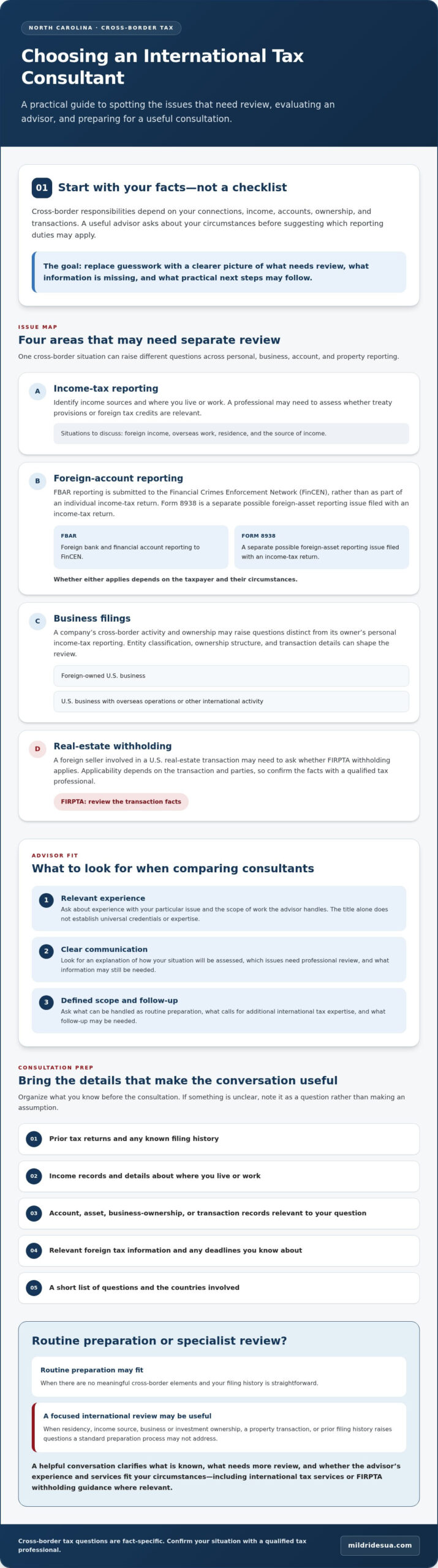
- Income-tax reporting: Identify income sources and where the taxpayer lives or works. A professional may need to assess whether treaty provisions or foreign tax credits are relevant. The IRS rules for international taxpayers offer a starting point for understanding U.S. tax topics involving international income.
- Foreign-account reporting: FBAR is the common name for foreign bank and financial account reporting submitted to the Financial Crimes Enforcement Network (FinCEN), rather than as part of an individual income-tax return. Form 8938 is a separate possible foreign-asset reporting issue filed with an income-tax return. Whether either applies depends on the taxpayer and their circumstances.
- Business filings: A company’s cross-border activity and ownership may raise questions distinct from its owner’s personal income-tax reporting. Entity classification and the jurisdictions involved are among the details to discuss with an advisor.
- Real-estate withholding: FIRPTA concerns possible withholding in certain dispositions of U.S. real property interests by foreign persons. It’s transaction-specific, not a rule that applies to every U.S. property sale.
How do residency, income, and ownership affect the review?
Two taxpayers with similar foreign income may have different filing questions if their residence, work arrangements, account ownership, or filing histories differ. A company’s overseas activity also shouldn’t be treated as interchangeable with its owner’s personal tax situation. Treaty interpretation, foreign tax credit eligibility, and how an entity is classified are issues to flag for professional review, not assume from a checklist.
What are FBAR, Form 8938, and FIRPTA in this context?
These terms refer to different potential reporting or withholding questions, not a universal package of forms. Filing obligations depend on the taxpayer’s facts and the rules in effect. Verify applicable 2026 details with current IRS and FinCEN guidance or a tax professional before acting. Thresholds, exceptions, and transaction facts matter.
For a discussion with an international tax consultant North Carolina, bring the countries involved, income sources, ownership details, and transaction records. Mildrid Esua, CPA, PLLC provides international tax services and FIRPTA withholding guidance. You can discuss your international tax situation to clarify whether the service fits your facts.
How to compare international tax consultants in North Carolina
A general tax preparer may be a good fit when your return is straightforward. The key question is whether your facts call for experience beyond routine preparation. Compare advisors based on the issues you need reviewed, not just a broad claim of international tax expertise. A person with overseas income, a business with foreign owners, and a seller facing a possible FIRPTA question may each need different support.
Use this framework to make the comparison concrete:
| What to compare | Questions to ask |
|---|---|
| Relevant case experience | Have you handled situations similar to mine, such as overseas income, foreign business ownership, or a qualifying FIRPTA transaction? |
| Service scope | Does the engagement include tax preparation, planning, IRS representation, or only selected services? What falls outside the agreed work? |
| Who handles the work | Who will be my main contact, who prepares or reviews the work, and how are complex questions escalated? |
| Communication and documentation | How will responsibilities, document requests, deadlines, and key decisions be explained and recorded? |
| Follow-up | Is the engagement for a defined tax year, or does it include ongoing planning? What follow-up should I expect after the work is completed? |
What experience should you ask an international tax CPA about?
Ask for examples of comparable fact patterns, without requesting confidential client details. An advisor who regularly works with overseas income may not handle foreign-owned U.S. businesses or FIRPTA-related real estate transactions. Broad international-tax marketing doesn’t establish experience with every issue. If treaties or cross-border policy are relevant, the U.S. international tax policy and treaties resource can help you identify topics to raise, but it won’t determine how they apply to your case.
How can you assess communication and service fit?
Notice whether the advisor explains next steps in language you understand and distinguishes confirmed facts from open questions. Clear expectations matter alongside technical familiarity. Compare each advisor’s answers with your priorities: you may need a defined return-preparation engagement, or you may be looking for tax planning and follow-up as your circumstances change.
Advisor-fit checklist: Ask whether the advisor has handled a comparable case, what the engagement covers, who is responsible for each step, how complex issues are escalated, what records and deadlines you’ll manage, and what follow-up is included. These answers can help you decide whether an international tax consultant North Carolina is a practical match. Mildrid Esua, CPA, PLLC provides international tax services alongside tax planning and preparation. You can discuss your tax service needs to clarify whether the scope fits your situation.
How North Carolina clients can prepare for an international tax consultation
A useful first discussion doesn’t require a perfectly organized file. It does benefit from a clear account of what happened, what you’re uncertain about, and any dates that may affect your situation. A few deliberate preparation steps can help an international tax consultant North Carolina clients speak with understand the issue and identify what information may be needed next.
- Summarize the issue. Write a brief timeline of the countries, people, businesses, income, accounts, or transactions involved. Note what changed and what you want clarified.
- Gather records you already have. Collect relevant prior federal and North Carolina returns, foreign income statements, account information, ownership documents, and transaction records. For business matters, prepare a plain-language summary of operations across borders.
- List known deadlines. Include tax or transaction dates you’re aware of, plus any notices or requests you’ve received. Mark uncertain dates as questions rather than assuming a deadline applies.
- Prepare questions. Identify what you need to decide or understand, and note any records you can’t locate.
Which records can help clarify your situation?
The right documents depend on the issue. Prior returns may show how related items were reported. Income records, foreign tax information, and account details can help describe personal circumstances. For a business, ownership records and a concise account of cross-border operations provide useful context. For a property transaction, gather available sale or ownership documents. Don’t postpone your initial questions because some records are missing. Make a list of what you have and what you’re still trying to find.
Business owners dealing with foreign ownership may also find this international tax compliance guide for foreign-owned U.S. businesses useful as background. If you’re considering a property sale, review the FIRPTA withholding accountant guide and ask whether it matches the transaction.
What questions should you ask during the first discussion?
Ask which issues appear relevant, what remains uncertain, and what information would help resolve those questions. Clarify the proposed service scope, who is responsible for each step, how the practice communicates document requests and deadlines, and whether another specialist may be needed. The answers can help you understand both the immediate review and any follow-up that might be appropriate.
Protect your information, too. Don’t send sensitive tax, account, or identity documents through an unsecured channel before receiving instructions on how to share them. When you’re ready to discuss your circumstances, contact Mildrid Esua, CPA, PLLC about international tax services and clarify whether the firm’s services fit your needs.
Working with an international tax consultant serving North Carolina
You’ve mapped the cross-border facts that may matter and identified what you want in an advisor. The next step is a focused conversation: explain the issue, name the relevant filing years or transactions, and ask whether the services offered fit your needs. A clear discussion can help establish responsibilities and practical next steps without assuming a particular tax outcome.
What support does Mildrid Esua, CPA, PLLC provide?
Mildrid Esua, CPA, PLLC provides international tax services and FIRPTA withholding guidance for qualifying U.S. real estate transactions. The firm also offers tax planning, tax preparation, and IRS representation, which may be relevant to a broader tax advisory relationship depending on your circumstances. Confirm directly which services apply to your situation and what work would be included.
The firm serves clients in Greensboro, High Point, Burlington, Winston-Salem, Kernersville, Jamestown, Oak Ridge, and Summerfield. For an overview of its international tax focus, see the global tax services overview for Greensboro businesses and residents. Use it as background, then discuss your own facts rather than assuming every service or example applies to you.
What happens after you request an initial discussion?
Start with a concise summary of what connects you to another country, such as foreign income, business ownership, or a U.S. property transaction. Identify the filing years or transaction dates involved, what you already know, and what remains uncertain. You don’t need to resolve every question before asking for guidance.
During your discussion, confirm whether the firm’s services fit the issue, what the proposed scope includes, how to share sensitive records securely, and what information or follow-up may be needed. Ask who will be responsible for the work and how questions outside the agreed scope will be handled. These details help turn an initial conversation into a clear working plan.
If you’re considering an international tax consultant North Carolina and want to assess service fit, Mildrid Esua, CPA, PLLC invites you to discuss your international tax situation. Bring your issue summary and questions, then use the conversation to clarify what support may be appropriate.
Turn cross-border questions into a clear next step
Choosing an international tax consultant North Carolina taxpayers can work with starts with your own facts: where you live and earn income, what you own, and which transactions or filing years need attention. Look for an advisor who can explain which issues merit review, define the scope of work, and make responsibilities and next steps clear.
Before you speak, organize a brief issue summary, relevant records, known deadlines, and questions. Compare advisors by their experience with situations like yours, who will handle the work, and how they communicate and follow up. You don’t need every answer in advance. A focused discussion can help clarify what support may fit.
Mildrid Esua, CPA, PLLC is owned and operated by Mildrid Esua, CPA, and provides international tax services and FIRPTA withholding guidance. To discuss your circumstances and clarify service fit, contact Mildrid Esua, CPA, PLLC about your international tax situation. Bring your issue summary and questions to start a focused conversation.
Frequently Asked Questions
When should I hire an international tax consultant?
Consider professional review when foreign income, overseas work, foreign financial accounts, international investments, business ownership across borders, or a U.S. real estate transaction raises questions about your tax responsibilities. You may not need ongoing specialist support for every foreign connection, but a review can help identify which issues deserve attention. Bring the countries involved, relevant filing years, and a brief summary of what changed so the advisor can assess the situation.
Can a regular CPA handle international tax matters?
Possibly, if the CPA has experience that matches your specific cross-border facts. A CPA credential alone doesn’t establish expertise in every international reporting or transaction issue. Ask whether the preparer has handled situations like yours, what work they’ll perform, and how they address questions outside their experience. A straightforward return may need routine preparation, while foreign ownership, multiple income sources, or a property transaction may call for more focused review.
What does an international tax consultant do?
An international tax consultant reviews how a person’s or business’s cross-border facts may affect U.S. tax reporting and related responsibilities. The work may involve identifying relevant income, account, ownership, or transaction questions and clarifying what information needs further review. Services vary by advisor, so confirm whether the engagement covers planning, tax preparation, IRS representation, or only selected work. The title itself doesn’t guarantee experience with every international tax matter.
Do I need to file an FBAR if I have a foreign bank account?
Not automatically. A U.S. person generally must consider an FBAR if the combined value of qualifying foreign financial accounts exceeded $10,000 at any point during the calendar year. The report, FinCEN Form 114, is separate from an income-tax return. Whether you’re a U.S. person for this purpose and which accounts count depend on your facts. Confirm current requirements with FinCEN guidance or a tax professional before deciding.
Does FIRPTA apply when a foreign person sells U.S. real estate?
FIRPTA may require withholding in certain dispositions of U.S. real property interests by foreign persons, but it doesn’t apply identically to every sale. The seller’s status, the property interest, and transaction details can affect the analysis. Before closing, ask a tax professional to review the specific transaction and clarify whether FIRPTA withholding guidance is appropriate. Mildrid Esua, CPA, PLLC lists FIRPTA withholding among its services.
What should I bring to an international tax consultation?
Bring a short timeline of the issue, relevant filing years or transaction dates, and questions you want answered. Useful records may include prior federal and state returns, foreign income statements, account details, ownership documents, transaction records, and relevant foreign tax information. Don’t delay an initial discussion because some documents are missing; identify what you have and what you still need. Before sending sensitive records, ask the advisor how to share them securely.
Can a North Carolina CPA help with tax issues involving another country?
Yes, a North Carolina CPA may be able to help if their experience and services fit your cross-border situation. Ask about relevant case experience, the scope of work, who will handle your matter, and how complex questions are addressed. Mildrid Esua, CPA, PLLC provides international tax services and serves clients in Greensboro, High Point, Burlington, Kernersville, Jamestown, Oak Ridge, Summerfield, and Winston-Salem. Confirm service fit directly with the firm.




Leave a Reply
Your email is safe with us.