


A fixed fee can still leave important work outside the agreement. If you’re comparing flat fee tax resolution Greensboro options, the key question isn’t just what you’ll pay. It’s what the fee covers, which case stages are included, and what could trigger additional charges.
It’s understandable to want a clear cost while facing back taxes, possible liens, or unfiled returns. But a flat fee is meaningful only when the scope is specific and documented. Representation, return preparation, and amounts owed to a tax authority may be handled separately. Clarifying these details before signing helps you compare providers on more than price alone.
This article explains what a tax-resolution engagement may include, what to ask about exclusions, communications, and payment terms, and how to assess a professional’s qualifications. You’ll also learn which records can help make an initial review more focused. Mildrid Esua, CPA, PLLC provides tax-resolution services and IRS representation, including assistance with back taxes, tax liens, and unfiled returns in Greensboro and nearby North Carolina communities. Understanding the engagement terms can help you decide whether the firm’s support fits your circumstances.
Key Takeaways
- A flat fee defines a professional’s charge for agreed work, not the amount of tax owed or the outcome of your case.
- Before signing, ask whether transcript review, unfiled-return preparation, correspondence, and IRS representation are included or billed separately.
- When comparing flat fee tax resolution Greensboro options, assess the written scope, terms for additional work, and who will handle communication with the IRS.
- Check the professional’s credentials and review the engagement terms so you understand the work, authorization, and next steps.
- Mildrid Esua, CPA, PLLC provides tax-resolution services and IRS representation for issues involving back taxes, tax liens, and unfiled returns.
Flat-Fee Tax Resolution in Greensboro: What the Fee Is Meant to Clarify
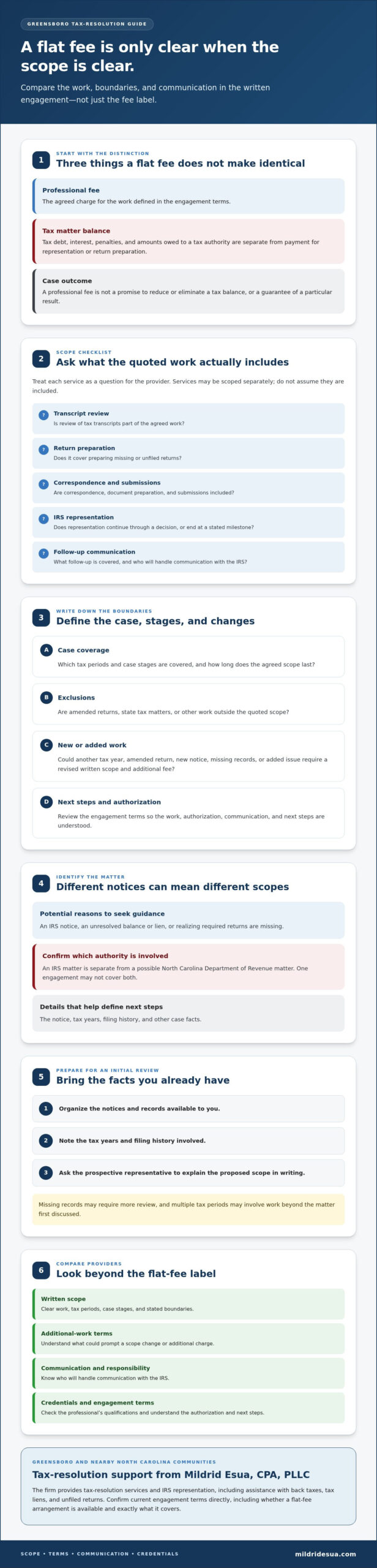
A flat fee can make professional costs easier to evaluate, but it doesn’t tell you by itself what work a tax-resolution professional will perform. For anyone comparing flat fee tax resolution Greensboro options, the engagement agreement should define the work covered and make clear that the fee is not a promise to reduce or eliminate a tax balance.
Keep the professional’s fee separate from the underlying tax matter. Tax debt, interest, penalties, and amounts owed to a tax authority are distinct from payment for representation or return preparation. A resolution strategy may involve considering options such as an Offer in Compromise, but whether an option is available or appropriate depends on the circumstances. A professional fee doesn’t guarantee a particular result.
For a general discussion of how flat fees may be used in tax-resolution work, watch this video:
What does flat-fee tax resolution usually describe?
A flat fee generally describes an agreed professional charge for defined work, subject to the written engagement terms. It might apply to one stage of a case rather than every task, from the initial review through final resolution. Ask what representation or preparation is included, which tax periods are covered, how long the scope lasts, and whether new issues or added work could require a revised agreement. Providers may define their services differently.
When might Greensboro taxpayers seek resolution help?
A taxpayer may seek professional guidance after receiving an IRS notice, facing an unresolved balance or lien, or realizing required returns are missing. First identify which authority is involved: an IRS matter is separate from a possible North Carolina Department of Revenue matter, and one engagement may not cover both. The notice, tax years, filing history, and other case facts help determine appropriate next steps.
Start by organizing the notices and records you have, then ask a prospective representative to explain the proposed scope in writing. Mildrid Esua, CPA, PLLC provides IRS representation and tax-resolution assistance, including help with back taxes, tax liens, and unfiled returns. Confirm the firm’s current engagement terms directly, including whether a flat-fee arrangement is available and exactly what it covers.
What a Greensboro Tax-Resolution Flat Fee May Include, and What to Confirm
A quote is useful only if you can tell what work it covers. For flat fee tax resolution Greensboro, treat every possible service as a question for the provider, not an automatic inclusion. Transcript review, tax-return preparation, correspondence, and IRS representation may be scoped separately. The written agreement should identify deliverables and clarify that the professional fee doesn’t guarantee a particular tax result.
Which case stages should the engagement define?
Ask whether the fee covers an initial review, strategy development, preparation or submission of documents, and follow-up communication. Confirm whether representation continues through a decision or ends at a stated milestone, such as submitting a response. If another tax year, amended return, or new notice enters the picture, find out whether that work requires a written scope change and additional fee.
Case complexity can affect what a provider is prepared to include. Missing records may require more review, and multiple tax periods may involve work beyond the matter initially discussed. Use this table to clarify the boundaries before signing:
| Agreement area | Questions to ask |
|---|---|
| Quoted work | Does it include transcript review, return preparation, correspondence, submissions, and representation? Which tax periods and case stages are covered? |
| Exclusions | Are amended returns, state tax matters, or work on later notices outside the stated scope? |
| Assumptions | Does the scope depend on providing complete records or responding to requests by agreed deadlines? |
| Additional services | How will new tax years, unexpected records, or added matters be priced and approved before work begins? |
Which fee terms deserve written confirmation?
Request a written description of the professional’s deliverables, your responsibilities, payment timing, and how the engagement can change. Ask what happens if documents reveal an additional issue or the tax authority sends a new notice. For example, clarify whether the provider will pause and request approval before doing out-of-scope work. A clear agreement helps you compare providers by scope, not just by the label “flat fee.”
The IRS offers guidance on choosing a tax professional. Use that resource alongside specific questions about who will handle your case and communicate with the IRS. Mildrid Esua, CPA, PLLC provides tax-resolution services and IRS representation. Ask the firm directly about current billing options and engagement terms. You can review the firm’s tax-resolution services and ask what any proposed engagement would cover.
Flat Fee or Open-Ended Billing? Compare the Engagement, Not Just the Label
A flat fee and hourly billing organize professional fees differently, but neither label tells you whether the engagement suits your tax matter. A flat fee may make budgeting more predictable when the work is clearly defined. Hourly billing ties charges to time worked, so the total can depend on how much work the case requires. Ask how estimates are developed, what updates you’ll receive, and how extra work is approved.
For flat fee tax resolution Greensboro, compare the written deliverables and communication expectations, not just the quoted amount. For example, one agreement might cover work through a specified submission, while another may define a different scope. The important question is what happens if the matter develops beyond the original assumptions.
- Flat fee: Ask which tasks, tax periods, and case milestones the agreed charge covers, and what would count as work outside that scope.
- Hourly billing: Ask how time is tracked, how often you’ll receive statements, and whether the professional can provide estimates or alert you as work expands.
- Either arrangement: Confirm who will do the work, how you’ll receive updates, and how added work must be approved.
How do flat-fee and hourly arrangements differ?
A defined flat fee can support planning, but it may not cover every issue or later development. Hourly billing can reflect the time required as a case evolves, but it may offer less certainty about the final total. Neither structure is automatically cheaper or better. Suitability depends on the case, the agreement, and your preference for a fixed scope or time-based billing.
Does paying a flat fee guarantee tax relief?
No. A professional fee pays for agreed services, not an IRS decision, debt reduction, or a particular resolution. A representative can review the facts, prepare work within the engagement, and communicate on your behalf, but the tax authority makes its own determinations. Treat promises of a guaranteed outcome as a reason to ask careful follow-up questions.
Before choosing, compare the scope, the professional’s relevant experience, how communication will work, and whether the proposed approach is explained realistically. Ask what is included if the IRS responds with a new request, and whether you’ll need to approve additional work before it begins. A clear engagement helps you understand both the professional’s responsibilities and your own, regardless of billing model.
How to Evaluate a Greensboro Tax-Resolution CPA Before You Sign
A careful first conversation should help you understand the issue, the professional’s role, and the boundaries of the proposed engagement. Use these steps to compare providers and prepare for a focused discussion about your circumstances.
- 1. Describe the issue clearly. Summarize the notices or unresolved concerns, the tax years involved, and whether returns may be missing. Separate what you know from what you’re unsure about. You don’t need to estimate your liability before asking for help.
- 2. Confirm credentials and responsibilities. Ask who will assess the matter, perform the work, and communicate with the IRS. If someone will represent you, ask what authorization may be needed and when it would be requested.
- 3. Identify the tax authority. Clarify whether the matter involves the IRS, the North Carolina Department of Revenue, or both. Don’t assume one engagement covers every authority or issue.
- 4. Test the proposed scope. Ask what facts the professional needs before discussing the engagement, which work is included, what could change the scope, and how you’ll receive updates. Request the terms in writing before signing.
- 5. Compare the explanation, not just the quote. Look for a realistic description of possible next steps, clear communication expectations, and answers that reflect your actual documents and circumstances.
Which records help clarify the case?
Gather the records you already have. A useful starting file may include IRS or state notices, prior filed returns, account information, payment records, and correspondence with tax authorities. Create a brief timeline of notices, calls, payments, and responses. Note any years you believe may be unfiled and list unresolved questions, but avoid guessing at the amount owed.
Keep copies in a secure location and ask the professional how to transmit sensitive documents. An organized record set can make an initial review more focused. If there are gaps, they can be identified for follow-up rather than overlooked.
If you’re comparing flat fee tax resolution Greensboro providers, use this preparation to evaluate whether the proposed work matches the facts of your case. For a broader overview of representation considerations in the state, review the North Carolina tax resolution guide. To discuss IRS representation or tax-resolution assistance with Mildrid Esua, CPA, PLLC, contact the firm about your tax-resolution needs.
Discuss Your Greensboro Tax-Resolution Needs With Mildrid Esua, CPA, PLLC
Once you’ve identified what matters in a written engagement, determine whether a professional’s services fit your situation. Mildrid Esua, CPA, PLLC provides IRS representation and tax-resolution assistance, including support with back taxes, tax liens, and unfiled returns. The firm serves taxpayers in Greensboro, High Point, Burlington, Kernersville, Jamestown, Oak Ridge, Summerfield, and Winston-Salem. These services may be relevant if you’re assessing flat fee tax resolution Greensboro options, but confirm the firm’s current billing options and specific engagement terms directly.
What to expect when discussing a potential engagement
Give an accurate overview of the notices you’ve received, which returns have or haven’t been filed, the tax periods involved, and any deadlines shown on your documents. If you’re uncertain about a detail, say so rather than guessing. That context can help establish what information is needed to assess the matter and whether the firm’s services appear relevant.
Use the conversation to clarify the working relationship before you decide:
- Ask whether the matter fits the firm’s IRS representation or tax-resolution services.
- Confirm who would communicate with the IRS and what authorization may be needed.
- Request a clear explanation of the work covered, the boundaries of representation, and how updates will be handled.
- If you’re considering a flat fee, ask whether that billing option is available for your case and what could fall outside its scope.
Next steps depend on the case details and the firm’s process. A conversation doesn’t establish an engagement, guarantee eligibility for a particular resolution, or promise a specific IRS outcome. Review any proposed written terms carefully before deciding whether to proceed.
How to take the next step without pressure
If you’re also thinking beyond an immediate tax issue, the 2026 strategic tax planning guide for NC entrepreneurs offers a related resource for considering future tax planning.
Greensboro-area taxpayers can take a measured first step by organizing their records and asking questions about fit, scope, and terms. To discuss your circumstances with Mildrid Esua, CPA, PLLC, Discuss your tax-resolution needs with Mildrid Esua, CPA, PLLC. You can seek clarity before deciding whether to enter an engagement.
Choose Your Next Step With Clarity
A flat fee is useful only when the written agreement clearly defines the professional work, case stages, and potential additional charges. As you compare flat fee tax resolution Greensboro options, look beyond the billing label: confirm who will represent you, how communication will work, and what happens if new issues arise. A professional fee covers agreed services, not a guaranteed IRS decision or reduction in tax debt.
Mildrid Esua, CPA, owns and operates Mildrid Esua, CPA, PLLC, which provides IRS representation and assistance with back taxes, tax liens, and unfiled returns in Greensboro and nearby North Carolina communities. Ask directly whether the firm’s current services and engagement terms fit your circumstances, including whether a flat-fee arrangement is available and what it would cover.
Clear questions and organized records can help you approach the decision with greater confidence. Discuss your Greensboro tax-resolution needs and take an informed next step at your own pace.
Frequently Asked Questions
What does a flat fee for tax resolution usually cover?
A flat fee generally covers the professional work specifically listed in a written engagement agreement. It may apply to a defined stage or set of tasks, rather than every matter related to your taxes. Ask whether transcript review, return preparation, submissions, IRS correspondence, and representation are included. For flat fee tax resolution Greensboro, compare the written scope and exclusions carefully, since providers may define their services differently.
Does a flat-fee tax resolution service guarantee that the IRS will reduce my tax debt?
No. A professional fee pays for agreed work, not a guaranteed decision, tax-debt reduction, or other IRS outcome. A representative can review your circumstances, prepare work within the engagement, and communicate with the IRS if authorized, but the agency makes its own determinations. Be cautious of promises of a specific result. Ask instead how the professional will assess your situation and explain possible next steps.
How do I compare flat-fee and hourly tax-resolution services?
Compare the scope, billing terms, communication expectations, and treatment of added work. A flat fee may help with budgeting when tasks and milestones are clearly defined; hourly billing is based on time worked, and the total can depend on the work required. Neither model is automatically cheaper or better. Ask for written terms, what could change the scope, and how you’ll be notified before extra work proceeds.
Can a CPA represent me before the IRS?
Yes, a CPA can provide IRS representation, and Mildrid Esua, CPA, PLLC lists IRS representation among its services. Confirm who would handle your matter, what representation covers, and what authorization may be needed for the professional to communicate with the IRS. The specific role and scope should be clear in the engagement terms. Greensboro-area taxpayers can ask these questions before deciding whether a proposed arrangement fits their needs.
What documents should I bring to a Greensboro tax-resolution consultation?
Bring any IRS or North Carolina tax notices, prior tax returns, account information, payment records, and correspondence related to the issue. A short timeline of contacts, payments, and deadlines can help organize the discussion. Note any tax years you believe may have missing returns, but don’t guess at the amount owed. Keep copies secure and ask how to send sensitive records safely if you’re meeting remotely.
Can a tax-resolution CPA help with unfiled returns and tax liens?
A tax-resolution CPA may assist with these matters when they fall within the professional’s services and the agreed engagement. Mildrid Esua, CPA, PLLC lists tax-resolution assistance involving unfiled returns, tax liens, and back taxes, along with IRS representation. Ask which tax periods and tasks are included, and whether return preparation and representation are covered separately. The appropriate next steps depend on your records and case details.
How do I know whether my tax issue is with the IRS or North Carolina?
Check the notice or correspondence for the agency name and contact information. IRS documents identify a federal tax matter, while notices from the North Carolina Department of Revenue concern a state matter. If you’re unsure, keep the envelope and notice together and ask a qualified professional to help identify the authority. A Greensboro taxpayer may have an issue with one agency or both, so confirm which matters any engagement covers.




Leave a Reply
Your email is safe with us.