

Could your current business structure be the very thing quietly eroding your growth potential in 2026? For many entrepreneurs in Greensboro and Winston-Salem, the weight of a 15.3% self-employment tax feels like an unavoidable cost of doing business, but it often represents a strategic oversight rather than a legal necessity. Unlike traditional reactive accounting, our approach at Mildrid Esua, CPA, PLLC, focuses on building a protective tax architecture that preserves your capital. Understanding the s corp tax benefits north carolina provides is the first step toward reclaiming that revenue and reinvesting it into your firm’s long-term stability.
We recognize the frustration of navigating North Carolina’s shifting tax rates and the anxiety surrounding IRS “reasonable salary” requirements. This guide offers a precise breakdown of exactly how much money you can save by optimizing your distributions. We’ll explore the impact of the state’s 2.00% corporate tax rate and provide a clear roadmap for a compliant transition before the March 16, 2026, election deadline. You’ll move from tax-season uncertainty to a position of informed, strategic control over your business’s financial trajectory.
Key Takeaways
- Understand how to bypass the 15.3% federal self-employment tax on a portion of your earnings by utilizing strategic S Corp distributions.
- Identify the specific income threshold where the s corp tax benefits north carolina offers outweigh the increased administrative requirements of the structure.
- Master the “reasonable compensation” requirement to protect your business from IRS scrutiny while maximizing your reinvestable capital.
- Navigate the 2026 North Carolina tax environment, including specific state-level filing obligations and the upcoming phase-out of corporate income taxes.
- Learn how a proactive partnership with a Greensboro-based tax advisor can streamline your transition from a reactive LLC to a strategically architected S Corp.
The Strategic Advantage of S Corp Status for North Carolina Small Businesses
The S Corp election is often misunderstood as a physical entity change, but it’s actually a sophisticated tax designation that overlays your existing legal structure. By choosing this path, you aren’t abandoning your limited liability protection; you’re simply changing how the IRS views your income. This distinction is vital for those looking to leverage s corp tax benefits north carolina offers in 2026. For a foundational perspective on these mechanics, you can review this S corporation overview to see how federal rules serve as the base for our state-specific strategies.
To better understand the mechanics of this transition, watch this helpful video:
At Mildrid Esua, CPA, PLLC, we view the S Corp not as a set-and-forget filing, but as a strategic growth architecture. Unlike a standard LLC, which often leaves owners vulnerable to high self-employment taxes, an S Corp allows for a more nuanced distribution of profits. This proactive methodology ensures that your business doesn’t just survive the tax season but actually thrives because of it. By positioning yourself as both an employee and a shareholder, you create a dual-stream income model that is both tax-efficient and audit-resistant.
The S Corp Election vs. Legal Business Formation
Many entrepreneurs in Greensboro and Kernersville begin their journey as a single-member LLC for its simplicity. As revenue scales, the transition to S Corp status becomes a logical evolution. You remain an LLC in the eyes of the North Carolina Secretary of State, yet you gain the ability to split income between a salary and shareholder distributions. This shift is a core component of strategic tax planning for businesses, providing a framework that shields a portion of your hard-earned revenue from the full 15.3% self-employment tax burden while maintaining your corporate shield.
North Carolina Corporate Tax Trends in 2026
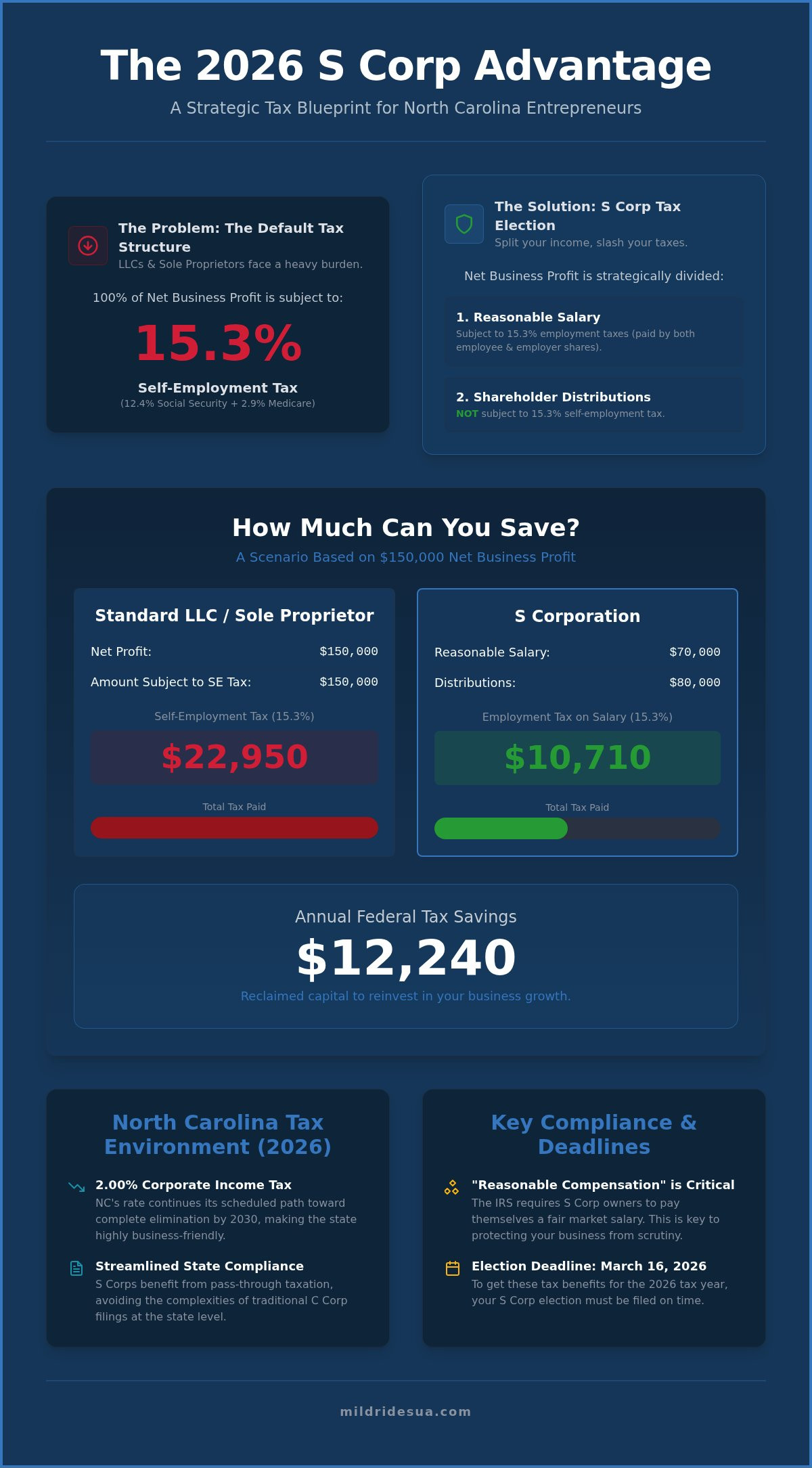
The 2026 tax year represents a pivotal moment for businesses in Winston-Salem and High Point. North Carolina’s corporate income tax rate has dropped to 2.00%, continuing its scheduled path toward total elimination by 2030. While this makes NC one of the most competitive states for business, it also adds layers of complexity regarding pass-through conformity. S Corps are particularly favored in this climate because state-level compliance remains streamlined compared to traditional C Corps. Our firm acts as a vigilant guide, ensuring your business structure aligns with these evolving state trends while maintaining strict federal compliance. Local expert guidance in the Burlington market is essential to navigate these decoupling nuances effectively.
Maximizing Self-Employment Tax Savings: The Federal and NC Impact
The primary catalyst for seeking s corp tax benefits north carolina entrepreneurs prioritize is the reduction of the federal self-employment tax burden. For most sole proprietors and standard LLC members, the IRS levies a 15.3% tax on 100% of business profits. This figure consists of 12.4% for Social Security and 2.9% for Medicare. While these contributions are essential for future benefits, they often represent a disproportionate drain on a growing company’s liquid capital. By electing S Corp status, you gain the ability to categorize a portion of your income as a shareholder distribution, which is entirely exempt from these FICA taxes. You can find more detail on these specific federal regulations in the IRS S Corporation guidelines.
In 2026, the Social Security wage base is projected to reach $184,500. For high earners in the Triad area, this means every dollar earned above that threshold is still subject to the 2.9% Medicare tax, while every dollar below it faces the full 15.3% hit. A vigilant business owner recognizes that over a five-year trajectory, failing to optimize this split can result in tens of thousands of dollars in unnecessary tax leakage. Our role at Mildrid Esua, CPA, PLLC, is to act as your strategic architect, ensuring your compensation model remains defensible while preserving your business’s momentum.
The Math of S Corp Savings
To visualize this “Tax Shield,” consider a business in Greensboro with a net income of $100,000. As a standard LLC, the owner would face approximately $14,130 in self-employment taxes. However, by transitioning to an S Corp and setting a reasonable salary of $40,000, only that salary is subject to FICA taxes. The remaining $60,000 is distributed as profit, potentially saving the owner over $8,000 in a single year. For a more granular breakdown of these calculations, our S Corp election for self-employment tax guide provides the specific formulas needed to project your exact savings. This proactive shift allows you to reinvest that capital into equipment, marketing, or talent acquisition rather than sending it to the treasury.
Pass-Through Entity (PTE) Tax Benefits in North Carolina
Beyond federal savings, North Carolina offers a sophisticated mechanism known as the Pass-Through Entity (PTE) tax. This allows S Corps to pay state income taxes at the entity level rather than the individual level. For business owners in High Point and Kernersville, this is a critical tool to circumvent the federal $10,000 SALT (State and Local Tax) deduction cap. By electing to pay the 3.99% NC individual rate through the business, the tax becomes a fully deductible business expense on your federal return. This dual-layered strategy ensures that your 2026 filing is not just a compliance exercise but a strategic victory. If you’re ready to move beyond reactive filing, consider how a customized tax roadmap could stabilize your long-term growth.
S Corp vs. LLC: Evaluating the Optimal Structure for NC Business Growth
For a new venture in Burlington or High Point, the initial simplicity of a standard LLC is often the right choice. However, as your net profits climb, that very simplicity can become a financial liability. The “tipping point” where an S Corp becomes more profitable than an LLC typically occurs when your business income significantly exceeds what you would pay a third party to perform your role. While both structures offer similar asset protection, the divergence in tax liability is stark. This S Corp vs. LLC comparison provides a foundational look at these differences, but the real advantage lies in how we architect s corp tax benefits north carolina to suit your specific growth trajectory.
Operational Complexity vs. Financial Reward
Transitioning to an S Corp requires a shift from a reactive mindset to one of vigilant stewardship. Unlike a standard LLC, an S Corp demands that you treat yourself as an employee, which necessitates regular payroll processing and tax withholdings. This added layer of administration has a “true cost,” yet the financial rewards often far outweigh the effort. To ensure the IRS respects your structure, monthly bookkeeping for small businesses is non-negotiable. For example, a Winston-Salem-based consultant we recently advised was able to save approximately $8,000 annually after accounting for the increased administrative costs. This represents capital that can be immediately redirected into marketing or equipment upgrades.
Strategic Growth and Scalability
Selecting the S Corp designation is more than a tax play; it’s a move toward long-term stability and corporate maturity. This structure makes your business more attractive to future investors or buyers by providing a transparent, professional record of earnings and compensation. In the Triad area’s competitive labor market, an S Corp also offers a more robust framework for providing employee benefits, helping you attract and retain top-tier talent. Understanding the full scope of s corp tax benefits north carolina provides is essential for any owner looking to move beyond a transactional relationship with their finances. Consult the regional small business strategic growth study for data-driven insights into how entity selection impacts your long-term trajectory. At Mildrid Esua, CPA, PLLC, we act as your growth partner, ensuring your transition from a simple LLC to a sophisticated S Corp is seamless and compliant.
Navigating NC Compliance and the Reasonable Salary Requirement
Maintaining the s corp tax benefits north carolina allows requires more than an initial election; it demands a commitment to what we call vigilant stewardship. As we move into the 2026 tax year, the IRS has signaled a significant increase in oversight regarding pass-through entities. Their primary focus remains on shareholder-employees who underpay their own salaries to minimize FICA tax exposure. This isn’t an area where you want to guess. Unlike a standard LLC, where all profit is treated as self-employment income, the S Corp requires a clear, defensible distinction between your role as a strategic owner and your role as an active employee.
The North Carolina Department of Revenue (NCDOR) also maintains its own rigorous expectations for corporate behavior. While the state generally follows federal guidelines for S Corp recognition, failing to manage your local payroll obligations can lead to state-level penalties that quickly erode your tax savings. Our firm, Mildrid Esua, CPA, PLLC, acts as your protective ally, ensuring that every compliance box is checked before it becomes a liability. We focus on building a robust audit trail that supports your business’s long-term stability.
Determining Your Reasonable Salary in North Carolina
The IRS doesn’t provide a universal formula for “reasonable compensation.” Instead, they evaluate a “facts-and-circumstances” analysis that includes your specific duties, years of professional experience, and the current market rates for similar roles within the Triad. If you’re running a professional services firm in Winston-Salem, your salary must reflect what a comparable firm would pay a hired executive with your level of authority. You cannot simply pay yourself a nominal fee to maximize your tax-free distributions. Such aggressive tactics are the fastest way to trigger an audit. Should you find your previous compensation levels under scrutiny, having expert tax resolution in North Carolina is essential to defend your business’s financial integrity.
Steps to File Form 2553 and NC State Notifications
Timing is everything when securing your 2026 tax status. For existing calendar-year businesses, the deadline to file IRS Form 2553 is March 16, 2026. Missing this window often means waiting another full year to realize the s corp tax benefits north carolina provides. Beyond the federal filing, you must register for NC-specific payroll accounts, including State Unemployment Insurance (SUI) and income tax withholding. These state-level registrations are mandatory once you begin paying yourself a W-2 salary.
Maintaining corporate formalities is equally vital for owners in Greensboro and High Point. You should keep meticulous minutes of annual meetings and formalize all corporate resolutions. These records serve as your first line of defense during an inquiry, proving that your entity is a legitimate corporation. If you’re concerned about your current compliance standing, schedule a strategic compliance review with our team to lock in your 2026 savings.
Implementing Your S Corp Election with a Greensboro Tax Advisor
Successfully capturing the s corp tax benefits north carolina offers requires moving beyond the traditional, reactive model of accounting. Many business owners view tax season as a backward-looking event; a mere summary of what has already transpired. At Mildrid Esua, CPA, PLLC, we reject this transactional approach. We position ourselves as your Strategic Architect, transforming tax compliance into a proactive growth engine. By establishing a year-round advisory relationship, we ensure your business remains agile. This allows you to pivot as North Carolina’s tax climate continues to evolve toward its 2030 corporate tax elimination. Our goal is to provide the constant attention your complex interests deserve.
Unlike a distant clerk who only processes forms, we stay deeply engaged with your business trajectory. We don’t just look at where you’ve been; we focus on where you’re going. This forward-looking mindset is what distinguishes a mere service provider from a true growth partner. We act as a vigilant guide, helping you navigate the transition from a simple business structure to a sophisticated, tax-efficient entity. This intellectual and advisory depth is essential for maintaining long-term stability in a complex regulatory environment.
The Mildrid Esua, CPA, PLLC Onboarding Process
Our onboarding begins with a deep diagnostic of your current entity structure and tax liability. We don’t believe in a one-size-fits-all strategy. For firms in Burlington and Winston-Salem, we build a customized S Corp implementation plan that aligns with your specific industry and growth goals. This process involves more than just filing Form 2553. We integrate your bookkeeping and payroll systems to ensure seamless, audit-ready compliance. This vigilant stewardship protects your profits from day one, allowing you to focus on leadership while we manage the complexities of your financial architecture. We ensure every detail is handled with strategic intent, from initial setup to ongoing management.
Taking the Next Step for Your NC Business
The most common mistake entrepreneurs make is waiting until the April filing deadline to consider their structure. By then, the opportunity to claim s corp tax benefits north carolina provides for the current year has often passed. The March 16, 2026, deadline for existing businesses is a hard cutoff that requires foresight. If you’re a business owner in High Point or Kernersville, now is the time to secure your financial legacy. A consultation with our team provides the clarity needed to transition from complexity to informed decision-making. We invite you to Secure your 2026 tax savings with Mildrid Esua, CPA, PLLC and begin a partnership dedicated to your long-term stability and growth. Don’t let your growth be stifled by a reactive tax strategy.
Securing Your Business Growth Through Strategic Tax Architecture
Transitioning to an S Corp is more than a simple administrative shift; it’s a commitment to protecting your business’s long-term trajectory. By optimizing the split between salary and distributions, you can significantly reduce your federal tax burden while leveraging the evolving s corp tax benefits north carolina offers in 2026. This strategy allows you to reclaim capital that would otherwise be lost to self-employment taxes, providing the fuel needed for reinvestment and expansion. Navigating the “reasonable salary” requirement and state-level compliance demands the steady hand of a seasoned expert.
Unlike reactive firms that only look at past figures, Mildrid Esua, CPA, PLLC, serves as a vigilant guide and growth partner for Triad entrepreneurs. Our Greensboro-based PLLC provides the deep NC tax code expertise and IRS representation necessary to ensure your election remains a source of stability, not a liability. Take control of your financial legacy by moving from complexity to informed decision-making. We’re here to help you build a resilient financial foundation that withstands regulatory shifts.
Schedule a Strategic Tax Consultation with Mildrid Esua, CPA, PLLC to lock in your 2026 savings and ensure your business is built for long-term endurance.
Frequently Asked Questions
What are the main S Corp tax benefits for North Carolina businesses in 2026?
S Corp status allows you to split income between a W-2 salary and shareholder distributions. This strategy effectively shields the distribution portion from the 15.3% federal self-employment tax. In 2026, North Carolina businesses also benefit from a reduced 2.00% corporate tax rate as the state moves toward a total phase-out. These combined factors create a powerful environment for s corp tax benefits north carolina entrepreneurs can use to reinvest in their own growth.
Is there a specific income threshold when an S Corp election makes sense in NC?
While there’s no legal minimum, the “tipping point” usually occurs when your net business profit exceeds a reasonable salary by at least $20,000 to $30,000. At this level, the tax savings on distributions typically outweigh the added costs of payroll processing and corporate tax preparation. Our team at Mildrid Esua, CPA, PLLC, provides a diagnostic analysis to determine if your specific revenue justifies the shift from a standard LLC to a more sophisticated structure.
Does North Carolina recognize the federal S Corp election automatically?
North Carolina generally recognizes the federal S Corp election without requiring a separate state-level entity filing. Once the IRS approves your Form 2553, the North Carolina Department of Revenue will treat your entity as a pass-through for income tax purposes. However, you must still register for state withholding and unemployment insurance accounts. This ensures you’re compliant with local payroll requirements in Greensboro or Winston-Salem while maintaining your federal status and protecting your business’s legal standing.
What happens if the IRS decides my S Corp salary is not reasonable?
If the IRS determines your salary isn’t “reasonable,” they may reclassify your distributions as wages. This results in immediate liability for unpaid FICA taxes, interest, and significant penalties. To mitigate this risk, we act as a vigilant guide by benchmarking your compensation against Triad market data. If a challenge arises, our firm provides professional IRS representation and tax resolution services to defend your compensation model and protect your business’s long-term financial stability.
Can a single-member LLC in Greensboro elect to be taxed as an S Corp?
Yes, a single-member LLC in Greensboro can absolutely elect to be taxed as an S Corp. This is a common evolution for solo entrepreneurs whose profits have grown beyond the efficiency of a standard LLC. By filing Form 2553, you retain your legal liability protection while adopting a more advantageous tax architecture. This transition allows you to move from a reactive tax position to a proactive partnership that prioritizes long-term wealth preservation and growth.
How does the North Carolina Pass-Through Entity (PTE) tax work with an S Corp?
The North Carolina Pass-Through Entity (PTE) tax allows S Corps to pay state income taxes at the entity level rather than passing them to the individual’s return. This is a strategic workaround for the $10,000 federal SALT deduction cap. By electing this treatment, the 3.99% state tax becomes a fully deductible business expense on your federal return. This dual-layered approach maximizes the s corp tax benefits north carolina provides for high-earning business owners in Burlington and High Point.
What are the filing deadlines for an S Corp election in 2026?
For existing calendar-year businesses, the deadline to file Form 2553 for the 2026 tax year is March 16, 2026. If you’ve recently formed a new business in Kernersville or Jamestown, you have exactly two months and 15 days from your date of formation to make the election. Missing these windows can delay your tax savings by an entire year. We recommend starting the planning process at least 60 days before the deadline to ensure all documentation is precise.
Do I need a separate business bank account for my NC S Corp?
A separate business bank account is essential for maintaining corporate formalities and the “corporate veil.” For an S Corp, co-mingling personal and business funds is a major audit trigger that can lead to the IRS disregarding your tax status. Proactive bookkeeping requires a clean trail of business-only transactions. This practice provides the clarity needed for accurate payroll and ensures your entity remains a steady hand in a complex and evolving financial environment.




Leave a Reply
Your email is safe with us.