


What if the most successful real estate exit you’ve ever planned leaves you with significantly less cash than you anticipated? Many Greensboro investors spend years building equity, only to see a massive portion of their hard-earned profit vanish during the final transaction. It’s a common fear, especially when you’re facing the dual pressure of federal obligations and the specific nuances of capital gains tax on investment property NC. You’ve worked too hard to let avoidable tax liabilities dictate your financial future.
Unlike the traditional approach of calculating taxes after the sale is finalized, a proactive strategy ensures you’re never caught off guard. This guide empowers you to move from a reactive stance to a position of strategic control. You’ll master the federal and North Carolina tax implications of selling investment real estate while discovering actionable ways to protect your equity. We’ll provide a clear estimate of your potential liability, explain the confusion surrounding depreciation recapture, and analyze the impact of the projected 3.99% flat tax rate for 2026. From 1031 exchanges to professional advisory strategies, you’ll learn exactly how to manage this complex landscape with the precision of a seasoned architect.
Key Takeaways
- Understand how the interaction between federal rates and North Carolina’s projected 3.99% flat tax rate creates a dual-layer obligation for real estate investors in 2026.
- Learn to accurately calculate your adjusted basis to minimize capital gains tax on investment property NC by distinguishing between capital improvements and routine maintenance.
- Identify the specific tax gaps between investment holdings and primary residences, including the strict requirements of the Section 121 exclusion.
- Master strategic deferral methods like the 1031 exchange while preparing for the 25% depreciation recapture tax that often catches sellers off guard.
- Discover how a proactive partnership with a local Greensboro CPA provides the foresight needed to navigate complex filings and protect your equity.
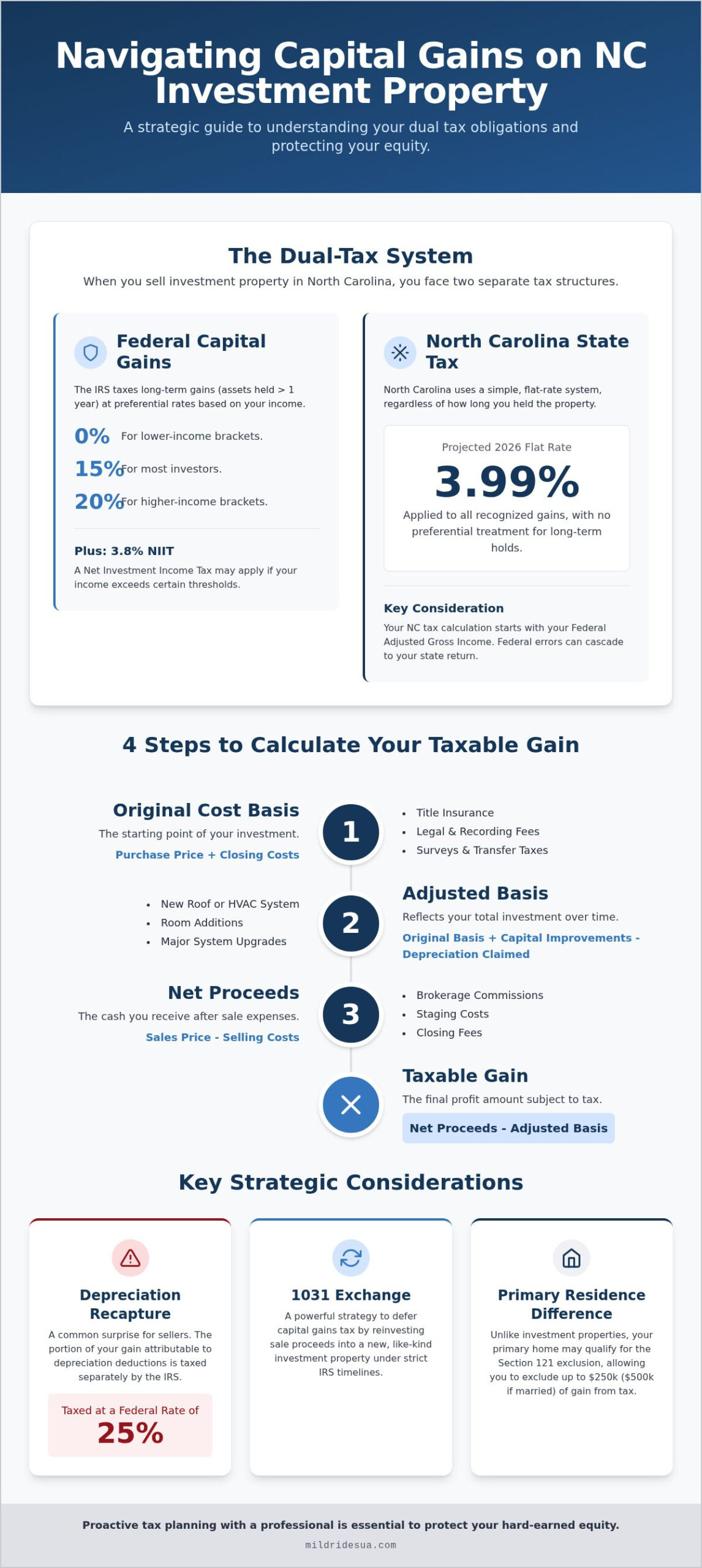
The Dual-Tax System: How NC and the IRS Tax Investment Property
Selling an investment property in North Carolina involves more than just a handshake and a deed transfer. It triggers a dual-layered tax obligation that requires precise planning to navigate successfully. Unlike liquid assets such as stocks or bonds, real estate is a complex physical asset with unique rules regarding cost basis and depreciation. When you finalize a sale, you aren’t just reporting to the IRS; you’re also answering to the North Carolina Department of Revenue (NCDOR). This dual-taxation reality means that a single oversight in your filing can lead to unexpected liabilities at both the federal and state levels.
Many investors fall into the trap of reactive filing, treating their tax obligations as a post-sale chore rather than a strategic component of the transaction. A vigilant guide understands that capital gains tax on investment property NC is a predictable expense that can be managed with foresight. Without a proactive approach, you risk overpaying on gains that could have been deferred or reduced through sophisticated accounting methods.
Federal Capital Gains Framework
The IRS categorizes your profits based on how long you held the asset. Short-term gains apply to properties held for one year or less and are taxed at your ordinary income tax rates. Long-term gains, which apply to properties held for more than a year, benefit from preferential rates of 0%, 15%, or 20% depending on your taxable income. Capital gains are defined as the difference between the net sales price and the property’s adjusted basis. For high-earning investors, the 3.8% Net Investment Income Tax (NIIT) remains a critical threshold to monitor in 2026. This additional levy applies when your modified adjusted gross income exceeds specific limits, effectively increasing the federal burden on your real estate exit.
The North Carolina Flat Tax Advantage
North Carolina’s approach to taxation is distinct from the federal tiered system. For the 2026 tax year, the state’s flat tax rate is projected at 3.99% based on current legislative schedules. While this rate is relatively low compared to many other states, it’s important to recognize that North Carolina does not offer a lower preferential rate for long-term gains. Whether you held the property for fourteen months or fourteen years, the NCDOR applies the same flat rate to your profit.
The NCDOR typically uses your federal adjusted gross income as the starting point for its own calculations. This means that while the state’s math is simpler, any errors made on your federal return will automatically cascade into your state filing. Relying on a strategic architect to align these two systems ensures that your equity remains protected from the friction of dual-taxation.
- Federal Focus: Tiered rates based on duration and income levels.
- State Focus: A consistent 3.99% flat tax on all recognized gains.
- The Risk: Inconsistent reporting between the IRS and NCDOR.
Calculating Your Taxable Gain on NC Real Estate
Determining the final amount you’ll owe in capital gains tax on investment property NC requires more than a simple subtraction of the purchase price from the sales price. It’s a multi-stage audit of the property’s entire lifecycle. Unlike a casual investor who might guess at their profit, a strategic architect views the calculation as a series of four deliberate steps designed to protect equity.
- Step 1: Original Cost Basis. This is your starting point. It includes the purchase price plus specific settlement costs like title insurance, legal fees, and recording fees.
- Step 2: Adjusted Basis. You must adjust your original basis by adding the cost of capital improvements and subtracting any depreciation deductions you’ve claimed over the years.
- Step 3: Selling Costs. Deduct the expenses required to exit the investment. In Greensboro, this typically involves brokerage commissions, staging costs, and transfer taxes.
- Step 4: The Final Calculation. Subtract your adjusted basis from your net proceeds (sales price minus selling costs). The resulting figure is your taxable gain.
Precision at this stage is vital. If you’re unsure how your specific property improvements affect your bottom line, consulting a Greensboro tax advisor can clarify your position before you sign a closing statement.
The Power of Adjusted Basis
Meticulous bookkeeping in Winston-Salem isn’t just about organization; it’s a defensive shield against overpayment. To maximize your basis, you must distinguish between “repairs” and “improvements.” A repair, like fixing a leaky faucet, is an immediate expense. A capital improvement, such as replacing a roof or installing a new HVAC system, is added to your basis. This distinction is critical because every dollar added to your basis is a dollar that isn’t subject to the dual-taxation of the IRS and NCDOR. Commonly overlooked expenses include legal fees for zoning changes or the cost of new utility connections, both of which serve to increase your basis and lower your tax hit.
2026 Tax Rate Table for Investors
The total tax burden is the sum of federal tiers and the state’s projected flat rate. While the NCDOR maintains a steady 3.99% flat rate for 2026, the federal government’s tiered approach creates a variable burden that shifts with your total annual income. Consider a hypothetical sale of a luxury condo in Greensboro with a taxable gain of $300,000. If the investor falls into the highest federal bracket, they’ll face a 20% federal rate, a 3.8% Net Investment Income Tax (NIIT), and the 3.99% NC flat tax. This creates an effective tax rate of approximately 27.79% on the profit. A vigilant guide identifies these thresholds early, ensuring you aren’t surprised by a six-figure tax bill at the end of the year.
Investment Property vs. Primary Residence: The Tax Gap
The tax code treats your family home as a sanctuary, but it views your rental holdings as a commercial enterprise. This philosophical difference creates a significant financial gap when it’s time to exit an investment. While homeowners enjoy the Section 121 exclusion, allowing them to shield up to $250,000 (or $500,000 for married couples) of profit from taxation, real estate investors are generally ineligible for this relief. For an investor, every dollar of profit is exposed to capital gains tax on investment property NC, which includes the federal tiers we’ve discussed and the state’s 3.99% flat rate.
Strategic Greensboro owners must recognize that this isn’t just a minor difference in filing; it’s a fundamental shift in how your equity is protected. Unlike a primary residence sale, where the goal is often simple liquidity, an investment sale requires a sophisticated defensive posture to prevent the IRS and NCDOR from eroding your long-term wealth.
The High Cost of Rental Status
The disparity in the final tax bill is often stark. A homeowner selling a primary residence with $200,000 in profit might pay zero in capital gains. An investor selling a rental with the same profit could face a bill exceeding $50,000 once federal rates, the NIIT, and NC state taxes are factored in. The IRS effectively “claws back” benefits by requiring taxes on the very profit you worked to build. Because the stakes are so high, choosing between TurboTax vs. Professional CPA becomes a critical decision for your 2026 filing. DIY software often fails to capture the nuances of mixed-use properties or the “unforeseen circumstances” safe harbor that might allow for a partial exclusion if you’re forced to sell early due to health or employment changes.
Converting Investment Property to Primary Residence
Can you bridge this gap by moving into your rental? The short answer is yes, but the strategy requires a long-term horizon and meticulous timing. Under the “2-out-of-5-year” rule, you must live in the property as your primary residence for at least 24 months within the five years preceding the sale. However, don’t expect a full, clean exclusion. The IRS applies a “non-qualified use” calculation, which prorates the exclusion based on the time the property was a rental versus a primary home.
If you’re planning for a 2027 or 2028 sale in the Triad, moving into the property today is a strategic move that starts the residency clock. This proactive shift transforms a fully taxable asset into one that qualifies for partial tax-free gains. A vigilant guide ensures you don’t just move in, but that you also document the transition properly to withstand an audit of your residency status.
Strategic Mitigation: 1031 Exchanges and Depreciation Recapture
Sophisticated investors rarely accept a massive tax bill as an inevitability. Instead, they utilize the 1031 exchange to defer their obligations indefinitely. This “Strategic Architect” tool allows you to swap one investment for another without triggering an immediate bill for capital gains tax on investment property NC. It’s a powerful method to keep your equity working for you rather than handing it over to the IRS and NCDOR. Effective utilization of this strategy requires a deep understanding of strategic tax planning for businesses, as your real estate holdings are often just one part of a broader financial ecosystem.
Unlike a standard sale where the transaction ends at the closing table, a 1031 exchange creates a continuous chain of investment. By reinvesting the proceeds into a new property, you shield your profit from the dual-taxation of federal tiers and the North Carolina 3.99% flat rate. This proactive stance ensures that your wealth continues to compound over time.
Executing a 1031 Exchange in North Carolina
The timeline for a 1031 exchange is rigid and unforgiving. You have exactly 45 days from the sale of your relinquished property to identify potential replacements and 180 days to close on the new asset. Missing these deadlines by even a single day results in a fully taxable event. The definition of “like-kind” is fortunately broader than many realize. You can trade a single-family rental in Greensboro for a commercial office space in High Point, provided both are held for investment. To maintain the integrity of the exchange, you must engage a Qualified Intermediary (QI) to hold the sale proceeds. Touching the cash yourself invalidates the tax deferral immediately.
Navigating Depreciation Recapture
While the 1031 exchange defers gains, depreciation recapture is a distinct “tax trap” that often surprises sellers at the eleventh hour. Over the years, you’ve likely claimed depreciation deductions to offset your rental income. The IRS requires that these benefits be accounted for at the time of sale. Instead of the standard long-term capital gains rate, the IRS taxes the total depreciation claimed at a flat 25% rate.
Consider a Kernersville rental property where you’ve claimed $40,000 in depreciation over a decade. Upon sale, that $40,000 is taxed at 25%, creating an immediate $10,000 liability before you even calculate your actual capital gains. A vigilant guide looks for ways to offset this hit, such as harvesting losses from other Greensboro business assets or timing the sale to coincide with lower-income years. Working with a small business tax advisor in Kernersville can help you audit your depreciation schedules and identify IRS resolution strategies before you list your property for sale. If you’re concerned about hidden liabilities, partner with a tax advisor to audit your depreciation schedules before you list your property for sale.
Why Professional Greensboro Tax Advisory is Essential
Relying on generic DIY software to calculate your capital gains tax on investment property NC is a gamble that rarely pays off for sophisticated investors. While these programs handle standard W-2 income adequately, they often lack the intellectual depth required to manage complex real estate transactions involving basis adjustments, depreciation recapture, and dual-layer state obligations. A single mischaracterized improvement or a missed closing cost deduction can result in thousands of dollars in overpayments. Unlike a detached algorithm, a professional advisor provides the vigilant stewardship necessary to ensure every cent of your equity is accounted for and protected.
Mildrid Esua, CPA, PLLC acts as a vigilant guide for Triad investors, moving beyond simple data entry to offer proactive partnership. We understand that your real estate exit isn’t an isolated event; it’s a strategic milestone that impacts your entire financial trajectory. Our firm provides comprehensive support, from the initial pre-sale analysis to rigorous IRS representation should your transaction ever face an audit. Accurate basis protection begins long before you list a property, which is why we emphasize the value of monthly bookkeeping for small businesses in Greensboro and High Point. Maintaining real-time records ensures that every capital improvement is documented and ready to serve as a shield against taxable gains.
Customized Planning for NC Residents
The specific 3.99% flat tax environment in North Carolina requires a tailored approach that generic national services often overlook. We specialize in integrating your real estate gains with your broader business structure, such as aligning your property sale with an established S Corp tax strategy. This holistic view allows us to identify opportunities for offsetting gains through other business losses or timing the recognition of income to minimize your effective rate. As the North Carolina Department of Revenue continues to adjust its legislative landscape, our firm remains continuously engaged, providing the foresight needed to navigate future shifts in state tax policy.
Next Steps for Your 2026 Sale
Preparation is the foundation of a successful real estate exit. To ensure your filing is handled with strategic intent, we recommend gathering all historical purchase documents, settlement statements, and a comprehensive list of capital improvements. A pre-sale consultation is the most effective way to estimate your potential liability and identify any last-minute opportunities for mitigation, such as a 1031 exchange or loss harvesting. If you’re ready to secure your financial legacy and minimize the impact of taxes on your hard-earned profit, contact Mildrid Esua, CPA, PLLC for Greensboro-based expertise and a dedicated growth partner who stays invested in your long-term stability.
Strategic Stewardship for Your Real Estate Exit
Managing the dual burden of federal tiers and North Carolina’s projected 3.99% flat rate requires more than just careful math; it demands a proactive defensive strategy. By mastering the nuances of your adjusted basis and anticipating the 25% depreciation recapture trap, you transform a potentially massive liability into a managed expense. Unlike a reactive approach that only considers taxes after the sale, strategic planning ensures that your wealth remains within your control. Navigating the capital gains tax on investment property NC is a complex journey, but it’s one that leads to long-term stability when handled with foresight.
Mildrid Esua, CPA, PLLC provides the vigilant stewardship that Triad investors need to protect their hard-earned equity. As a Greensboro-based CPA with over 10 years of IRS expertise, our firm specializes in NC real estate tax mitigation and customized advisory services. We don’t just file your returns; we act as your growth partner to ensure your complex interests are managed with constant attention. Secure Your Real Estate Profits with a Strategic Tax Consultation today. Your financial legacy deserves the precision of a strategic architect, and we’re ready to help you navigate your next successful property sale with confidence.
Frequently Asked Questions
Is capital gains tax higher in North Carolina than other states?
North Carolina’s projected 3.99% flat tax for 2026 is competitive compared to high-tax states like California or New York. However, it’s higher than states with no income tax, such as Florida or Tennessee. The primary distinction is that NC doesn’t offer a lower preferential rate for long-term holdings. Every dollar of profit is taxed at the same flat rate, regardless of how long you’ve held the property.
Can I avoid capital gains tax on an investment property by moving into it?
You can’t eliminate the tax entirely, but you can secure a partial exclusion by converting the rental into your primary residence. To qualify, you must live in the home for at least two of the five years preceding the sale. The IRS will still tax the portion of the gain attributed to non-qualified use periods when the property was a rental. This strategy requires a long-term horizon and precise documentation.
What is the 1031 exchange deadline in 2026?
The 1031 exchange deadlines are strictly tied to your property’s closing date rather than a specific calendar deadline. You have exactly 45 days from the sale of your original asset to identify potential replacement properties in writing. You must then finalize the purchase of the new property within 180 days of the initial sale. Missing these timelines by a single day triggers the full capital gains tax on investment property NC.
Does North Carolina have a short-term capital gains tax rate?
North Carolina doesn’t distinguish between short-term and long-term gains in its tax code. While the federal government taxes short-term gains at higher ordinary income rates, the North Carolina Department of Revenue applies the same 3.99% flat tax to all recognized profit. This simplicity is beneficial for flippers but means long-term buy-and-hold investors don’t receive a state-level discount for their patience. Consistent reporting between federal and state returns remains essential.
How much is the federal capital gains tax on investment property for 2026?
Federal rates for 2026 are tiered at 0%, 15%, or 20% based on your total taxable income. Most real estate investors fall into the 15% or 20% brackets. High-earning individuals must also factor in the 3.8% Net Investment Income Tax (NIIT) if their income exceeds specific thresholds. When combined with state obligations, your total effective tax rate can often reach 25% or higher, necessitating a proactive approach to identifying every available deduction.
What happens if I sell my investment property at a loss in NC?
Selling at a loss creates a capital loss that can offset other capital gains realized in the same tax year. If your losses exceed your gains, you can use up to $3,000 of the excess loss to offset your ordinary income. Any remaining loss is carried forward to future years. This tax-loss harvesting is a strategic way to mitigate the tax impact of more profitable sales elsewhere in your investment portfolio.
Do I have to pay capital gains tax if I inherited the property in Greensboro?
Inherited properties receive a step-up in basis to the fair market value at the date of the previous owner’s death. You only pay capital gains tax on the appreciation that occurs after you inherit the asset. If you sell the Greensboro property shortly after inheriting it for its appraised value, your taxable gain might be zero. However, you must still account for any depreciation you claim if you operate it as a rental before selling.
Can I deduct repairs and maintenance from my capital gains tax?
Routine repairs and maintenance are operating expenses that you deduct annually from your rental income, so they don’t reduce your capital gains. Only capital improvements, such as a new roof or a kitchen remodel, are added to your adjusted basis. Increasing your basis is the most effective way to lower your capital gains tax on investment property NC because it reduces the total profit recognized upon sale. Meticulous records are required for these adjustments.




Leave a Reply
Your email is safe with us.