

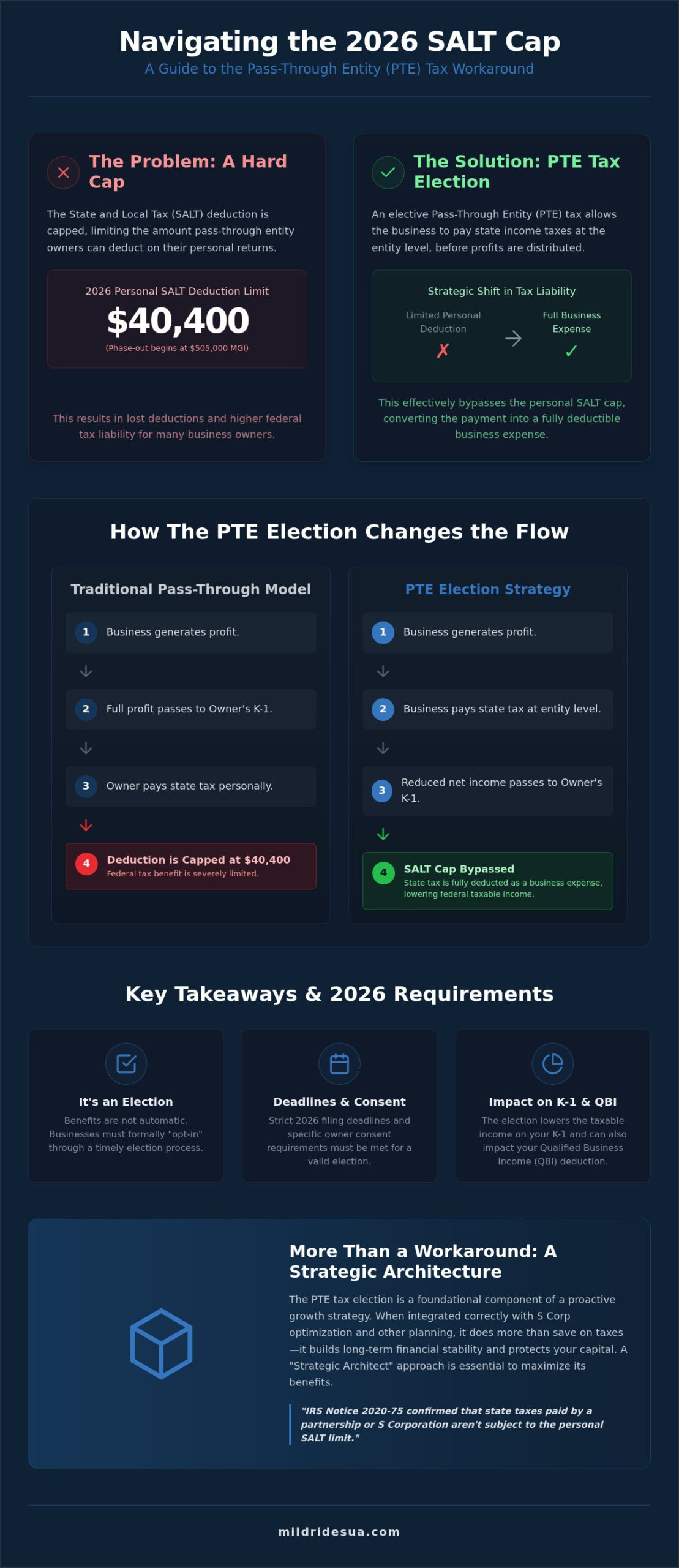
The $40,400 ceiling on state and local tax deductions for 2026 doesn’t have to be an immovable barrier; it’s a hurdle that proactive business owners are now clearing with precision. If you’ve felt the weight of restricted deductions, you’re likely searching for a more sophisticated way to protect your hard-earned revenue. Leveraging a pass through entity tax election allows your business to pay state income taxes at the entity level, effectively shifting those costs from a limited personal deduction to a fully deductible business expense. This strategic architecture doesn’t just bypass the cap. It fundamentally redefines your federal tax liability for the 2026 tax year.
It’s natural to feel some confusion when navigating the nuances of entity-level versus individual-level taxation. You want to ensure you aren’t missing out on legitimate savings, yet you need a clear path forward before making a commitment. This guide will help you discover how the pass through entity tax serves as a vital workaround to the SALT cap and whether it’s the right move for your specific situation. We’ll provide a clear framework to help you decide if you should make the election and show you how a vigilant CPA can manage this transition to ensure long-term stability.
Key Takeaways
- Understand the mechanism that transforms state tax liabilities into a federal deduction, effectively neutralizing the restrictive impact of the SALT cap.
- Discover how a pass through entity tax election can lower the taxable income reported on your K-1, providing a direct benefit to your personal bottom line.
- Review the essential 2026 filing deadlines and owner consent requirements to ensure your election is both valid and strategically timed for maximum impact.
- Explore the North Carolina specific tax rates and how they create unique opportunities for tax arbitrage when compared to traditional individual filing.
- Learn why a “Strategic Architect” approach is necessary to integrate these elections with other high level growth strategies like S Corp optimization.
What is Pass-Through Entity (PTE) Tax?
A pass through entity tax isn’t just another compliance requirement; it’s a sophisticated elective mechanism designed to mitigate federal tax burdens. At its core, this tax allows partnerships and S Corporations to pay state income tax at the entity level rather than passing that liability through to the individual owners. By opting into this regime, a business transforms what would have been a non-deductible personal expense into a fully deductible business expense at the federal level. It’s a proactive shift from reactive filing to strategic stewardship of your firm’s capital. Because this is an elective regime, you must actively “opt-in” to the strategy through a formal election process, as benefits don’t apply automatically.
The Traditional Pass-Through Model vs. The Elective Model
In a standard arrangement, business profits aren’t taxed at the source. Instead, they flow through to the owners, who then report that income and pay any resulting state taxes on their personal 1040 returns. To understand the baseline, one must first ask, What is a Pass-Through Entity? These are typically partnerships or S Corporations that avoid double taxation by moving tax responsibility to the individual. The elective model changes the sequence. The qualified entity pays the state tax directly. This reduces the net income reported on the owners’ Schedule K-1s, effectively lowering their federal taxable income before it even reaches their personal returns.
A Brief History: Why PTE Taxes Became Essential
The landscape shifted dramatically with the 2017 Tax Cuts and Jobs Act (TCJA). This legislation introduced a cap on State and Local Tax (SALT) deductions, which for the 2026 tax year is set at $40,400 for most taxpayers. For high-earning business owners in states with significant income taxes, this cap meant losing thousands in legitimate deductions. The $40,400 limit is even more restrictive for higher-income earners, with a phase-out beginning at a modified adjusted gross income of $505,000.
The solution emerged when states began enacting elective taxes as a workaround. The IRS eventually provided clarity through Notice 2020-75, confirming that state taxes paid by a partnership or S Corporation aren’t subject to the personal SALT limit. This acceptance turned the pass through entity tax into an essential strategy for those seeking to reclaim their full tax benefits. It’s no longer just an option; for many, it’s a necessary component of a vigilant tax plan that prioritizes long-term stability and growth.
The SALT Cap Workaround: How PTE Taxes Save You Money
Unlike traditional filing methods where state income taxes hit an immovable personal ceiling, the pass through entity tax creates a clear path for full deductibility at the business level. This mechanism is frequently referred to as The SALT Cap Workaround. By utilizing this strategy, your business doesn’t just pay a bill; it actively reduces the federal taxable income that eventually flows to your personal return. This proactive shift ensures that state tax obligations serve as a strategic lever rather than a lost deduction. Most owners see a direct correlation between this election and a lower federal tax bill, provided the implementation is handled with vigilant stewardship.
Bypassing the Deduction Limit
C Corporations have never faced the restrictive SALT cap issues that have plagued S Corps and Partnerships since 2017. The PTE election finally levels the playing field for small business owners by moving the tax liability from the individual’s 1040 to the business’s 1120-S or 1065. While the 2026 SALT cap has increased to $40,400 for most taxpayers, high-earners often find that their combined property and income taxes still exceed this limit. By shifting the tax burden to the entity, owners can effectively deduct state taxes without being restricted by personal itemization limits. This transition protects your wealth from being taxed twice at the federal level.
Federal Taxable Income Reduction
The beauty of this election lies in its “above-the-line” nature. When your business pays the tax, it deducts that amount from its gross income. Consequently, the profit reported on your K-1 is lower. This reduction can also have a nuanced impact on your Qualified Business Income (QBI) deduction, as it lowers the overall business income used in the calculation. Maximizing these moving parts requires a commitment to strategic tax planning for businesses throughout the year rather than just during filing season. It’s about looking forward to capture every available cent of savings.
Consider a Greensboro based S Corp with $1,000,000 in net income. Under the 2026 North Carolina PTE tax rate of 3.99%, the entity would pay $39,900 directly to the state. Instead of the owner trying to fit this $39,900 into a personal SALT cap already crowded by local property taxes, the corporation deducts it entirely. The owner then receives a K-1 reflecting only $960,100 in income and a state tax credit for the $39,900 already paid. This dual benefit underscores why we act as a growth partner for local firms; we ensure you don’t just comply with the law, but master it. If you’re unsure if your current setup captures these benefits, it might be time to consult with a strategic tax advisor who prioritizes your long term stability.
How Pass-Through Entity Elective Taxes Work in 2026
Executing a pass through entity tax strategy requires a high degree of precision to ensure the intended federal benefits actually materialize. It’s not enough to simply desire the deduction; you must follow a rigid procedural timeline that begins long before tax season. Unlike reactive filing, where you look back at the previous year’s data, this election demands foresight and active participation from every stakeholder in the business. Once you make this election for the 2026 tax year, it’s typically irrevocable, meaning you can’t change your mind if your personal tax situation shifts later. This permanence underscores the need for a vigilant guide to oversee the entire process.
The 5-Step Process for Implementing a PTE Strategy
The transition to an elective model follows a logical progression that integrates your business and personal tax profiles. The first step involves determining eligibility based on your entity type and the residency status of your owners. The legal foundation of Pass-through taxation remains the same, but the elective layer adds new compliance duties. Second, you must project your qualified net income to calculate the elective tax due. Third, you’re required to make timely estimated payments throughout the year; for example, California businesses must meet a June 15, 2026, prepayment deadline to avoid penalties. Fourth, the formal election is made on your timely filed original 2026 business return. Finally, you distribute K-1s that clearly show the state tax credit, allowing shareholders or partners to claim the benefit on their personal returns.
Deadlines and Documentation Requirements
Timing is everything when managing a pass through entity tax election. For North Carolina S Corporations and Partnerships, the original filing deadline for the 2026 tax year is March 15, 2027. You cannot make this election on an amended return, so missing the initial window effectively closes the door on these savings for the year. Additionally, you must maintain clear documentation of owner consent. While some states allow a majority vote, others require unanimous agreement, making it essential to have a signed record of the decision in your corporate minutes.
Accuracy in your income projections is the only way to avoid underpayment penalties at the entity level. This is why we emphasize the importance of monthly bookkeeping for small businesses to provide the real-time data needed for precise tax calculations. You’ll also need to account for the “add-back” requirement on your state return. States generally require you to add the entity-level deduction back to your state taxable income to prevent a double benefit at the state level. The net gain remains a federal one, but failing to handle the state add-back correctly can trigger unwanted audits and interest charges.
Evaluating the Benefits for North Carolina Small Businesses
North Carolina’s approach to the pass through entity tax provides a unique opportunity for local entrepreneurs to reclaim federal deductions lost to the SALT cap. For the 2026 tax year, the North Carolina PTE tax rate is set at 3.99%. While the state maintains a flat tax structure, the primary advantage remains the federal above-the-line deduction that reduces your overall taxable income. This isn’t just about paying a different rate; it’s about the intellectual depth of your tax strategy. Unlike a reactive approach that treats all businesses the same, a vigilant guide looks at how this 3.99% interacts with your specific federal tax bracket to ensure the math actually works in your favor.
Executing a pass through entity tax election for a multi-state operation adds layers of complexity. Businesses in the Greensboro and High Point areas frequently operate across state lines, particularly into Virginia or South Carolina. As a Strategic Architect, we analyze how paying tax in North Carolina affects your ability to claim credits for taxes paid to other jurisdictions. It’s a delicate balance of maximizing the federal deduction without inadvertently increasing your total state tax liability through uncoordinated filings. Our goal is to provide a steady hand, ensuring your multi-state growth doesn’t lead to unnecessary tax leakage. Business owners who also hold investment real estate should be aware that proceeds from property sales carry their own distinct obligations; understanding the capital gains tax on investment property in NC is an essential part of a complete tax picture.
North Carolina’s PTE Landscape in 2026
The interaction between North Carolina’s flat tax and the elective tax requires a high degree of foresight. Under NC law, the definition of Qualified Business Income is specific. Owners in Winston-Salem or Burlington must evaluate if their personal deductions already offset their state liability. If your personal tax bracket is effectively lower than the 3.99% PTE rate due to other credits or losses, the election could lead to a higher immediate cash outlay for a delayed federal benefit. We prioritize your long-term stability by modeling these outcomes well before the March 15, 2027, deadline. Entrepreneurs in the Triad region can also benefit from working with a small business tax advisor in Kernersville who specializes in proactive IRS resolution and tax-efficient growth strategies tailored to the local business landscape.
Potential Pitfalls and Limitations
There are scenarios where the election might not be beneficial. One significant risk involves trapped credits. If the elective tax paid by your S Corp exceeds your personal North Carolina income tax liability, you may end up with a credit you can’t fully utilize in the current year. We also see complications with the Credit for Taxes Paid to Other States (OSPC). If your entity makes elections in multiple states, you must ensure these credits don’t cancel each other out or lead to double taxation. The complexity of these calculations is why many owners move away from DIY software. Choosing professional tax preparation ensures that these multi-state nuances are managed with constant attention. If you’re ready to move from reactive filing to a proactive partnership, consult with our strategic tax architects to verify your 2026 eligibility.
Strategic Implementation: Why You Need a Proactive Growth Partner
Managing a pass through entity tax election requires more than a seasonal check-in. Unlike a reactive clerk who simply records your financial history, a proactive growth partner anticipates the shifts in your revenue and tax landscape. We move beyond basic compliance to offer vigilant stewardship of your business assets. This election is a dynamic strategic choice, not a static law. It needs to be integrated into your broader financial framework to be truly effective. It’s about moving from a state of uncertainty to a position of informed decision-making.
A core component of this framework is how the election fits into an overall S Corp election for self employment tax strategy. When these two mechanisms work in tandem, the cumulative savings can be substantial. One optimizes your social security and medicare exposure, while the other reclaims your federal state tax deduction. This holistic approach is what defines our role as a Strategic Architect. We ensure that one tax move doesn’t negatively impact another, keeping your long-term stability as the primary objective.
Continuous engagement is the only way to manage these moving parts successfully. Revenue fluctuates. Markets change. If your business experiences a sudden surge in profit, your estimated payments must adjust in real time to avoid underpayment penalties at the entity level. A steady hand is required to navigate these transitions. We stay engaged throughout the year, ensuring your pass through entity tax strategy remains on track regardless of how the economic environment shifts. This proactive methodology ensures you’re never caught off guard by a filing deadline or an unexpected tax bill.
Modeling Your Tax Savings
Before pulling the trigger on an irrevocable election, you need clarity. A small business accountant in Charlotte or Greensboro can create a custom tax model that visualizes your exact potential savings. We perform deep “what-if” analyses to test different income scenarios against current 2026 tax rates. This rigor ensures that your decision supports long-term stability rather than just providing a short-term benefit. We look ahead to future tax years to protect your growth trajectory and ensure your wealth remains protected.
Navigating IRS and NCDOR Compliance
The filing requirements for both federal and state authorities are dense and unforgiving. Proper implementation today is the best defense against the need for expert tax resolution in the future. We manage the intricate documentation and reporting standards required by the IRS and NCDOR, from owner consent records to the complex “add-back” calculations on state returns. This meticulous attention to detail allows you to focus on leading your company with the confidence that your interests are being managed with constant attention. If you’re ready to architect a more sophisticated 2026 tax strategy, we invite you to schedule a consultation with our team today.
Architecting Your 2026 Tax Advantage
The 2026 tax landscape requires more than simple compliance; it demands a shift toward intellectual depth and strategic foresight. By mastering the pass through entity tax, you reclaim the federal deductions that the SALT cap otherwise erases. This strategy transforms state tax liabilities into powerful federal levers, providing a steady hand for your business’s long-term stability. Unlike traditional reactive filing, this approach ensures your wealth is protected before the tax year even ends.
Success hinges on precise execution and constant engagement. Missing a filing deadline or failing to model multi-state impacts can turn a potential win into a missed opportunity. As a strategic growth partner for NC entrepreneurs and an expert S Corp & PTE tax architect, we provide the vigilant IRS representation and compliance oversight you need to navigate these complexities with confidence. Don’t leave your financial trajectory to chance when you can move forward with clarity.
Secure Your 2026 Tax Strategy with Mildrid Esua, CPA
Your business deserves a guide that looks ahead. Let’s build a more resilient and growth-oriented financial future together.
Frequently Asked Questions
Is the pass-through entity tax mandatory for all S Corps?
No, the pass-through entity tax is an elective regime, not a mandate. Your S Corp must proactively choose to “opt-in” by making a formal election on its timely filed return. This flexibility allows us to act as a Strategic Architect, evaluating your specific income levels to ensure the election actually provides a net benefit. If you don’t make the election, your business defaults to the traditional flow-through model where all state taxes are paid personally.
Can a single-member LLC elect to pay the PTE tax?
Most states, including North Carolina, require an entity to be a partnership or an S Corporation to qualify for the election. A single-member LLC that’s treated as a disregarded entity for federal purposes typically cannot make this election on its own. However, if that LLC has elected to be taxed as an S Corp, it becomes a qualified entity. We look at your business formation closely to determine if a structural change is necessary to unlock these savings.
What happens if I pay too much in elective PTE tax at the entity level?
If your entity overpays its state elective tax, the treatment of that excess depends on specific state regulations. In North Carolina, overpayments are generally handled through the credit distributed to owners on their K-1. If your personal state tax liability is lower than the credit received, you may be eligible for a refund or a carryforward to future tax years. Constant attention to your estimated payments helps prevent these trapped credits from tying up your business’s working capital.
Does the PTE tax affect my Qualified Business Income (QBI) deduction?
Yes, paying a pass through entity tax will likely reduce your Qualified Business Income (QBI) deduction. Because the tax is deducted at the entity level, it lowers the overall net business income reported on your K-1. A lower net income figure directly results in a smaller Section 199A deduction. Our proactive methodology involves modeling this trade-off to ensure the federal tax savings from the SALT workaround outweigh the reduction in your QBI benefit.
Is the PTE tax election irrevocable once it is made?
For the 2026 tax year, the election is typically irrevocable once it’s formally made on a timely filed return. This means you can’t change your mind later if your individual tax situation shifts or if personal deductions become more favorable. Because of this permanence, we emphasize the need for a consultative approach before filing. We analyze your full financial picture to ensure that pulling this lever aligns with your long-term stability and growth goals.
How does the North Carolina PTE tax interact with taxes paid to other states?
North Carolina allows owners to claim a credit for taxes paid to other states, but the interaction with PTE elections can be complex. If your business pays elective taxes in multiple states, we must carefully coordinate these credits to avoid double taxation or lost benefits. Some states don’t recognize the PTE taxes paid to other jurisdictions, which could lead to a higher overall state tax burden. We manage these multi-state nuances to protect your revenue across all borders.
Can I make the PTE election on an amended tax return if I missed the deadline?
No, you cannot make a retroactive election on an amended return if you miss the initial filing window. Most state authorities, including the NCDOR, require the election to be made on a timely filed original return, including extensions. This rigid requirement is why we act as a vigilant guide, tracking every deadline to ensure you don’t miss out on legitimate tax-saving strategies. Failing to file correctly by the March 15, 2027, deadline effectively closes the door for 2026.
Do I still need to pay personal estimated taxes if my business pays the PTE tax?
You might still need to pay personal estimated taxes if you have significant income from other sources outside of the pass-through entity. While the pass through entity tax covers the state liability for your business profit, it doesn’t account for capital gains, interest, or other personal income. For business owners who also hold investment real estate, understanding the implications of capital gains tax on investment property in NC is critical to accurately projecting your total personal tax obligations. We provide year-round advisory services to adjust your total tax payments as your revenue fluctuates. This continuous engagement ensures you remain fully compliant while maximizing your cash flow and avoiding underpayment penalties.