


A tax extension isn’t a sign of organizational failure; it’s often the hallmark of a sophisticated financial strategy. While many entrepreneurs feel pressured to rush through the spring deadlines, the most vigilant leaders recognize that haste often leads to overlooked deductions and costly errors. Securing a business tax deadline extension NC provides the necessary breathing room to ensure your financial records are precise and your filings are strategically aligned with your long-term goals.
We recognize the weight of the March and April deadlines, especially when the fear of NCDOR penalties looms over your daily operations. It’s difficult to maintain a growth-oriented mindset when you’re buried in incomplete records and confusing state requirements. This 2026 guide promises to help you secure a vital six-month filing cushion while maintaining strict compliance. We’ll explore the automatic extension process, the distinction between filing and payment deadlines, and how to ensure your state strategy mirrors your federal tax planning for maximum stability.
Key Takeaways
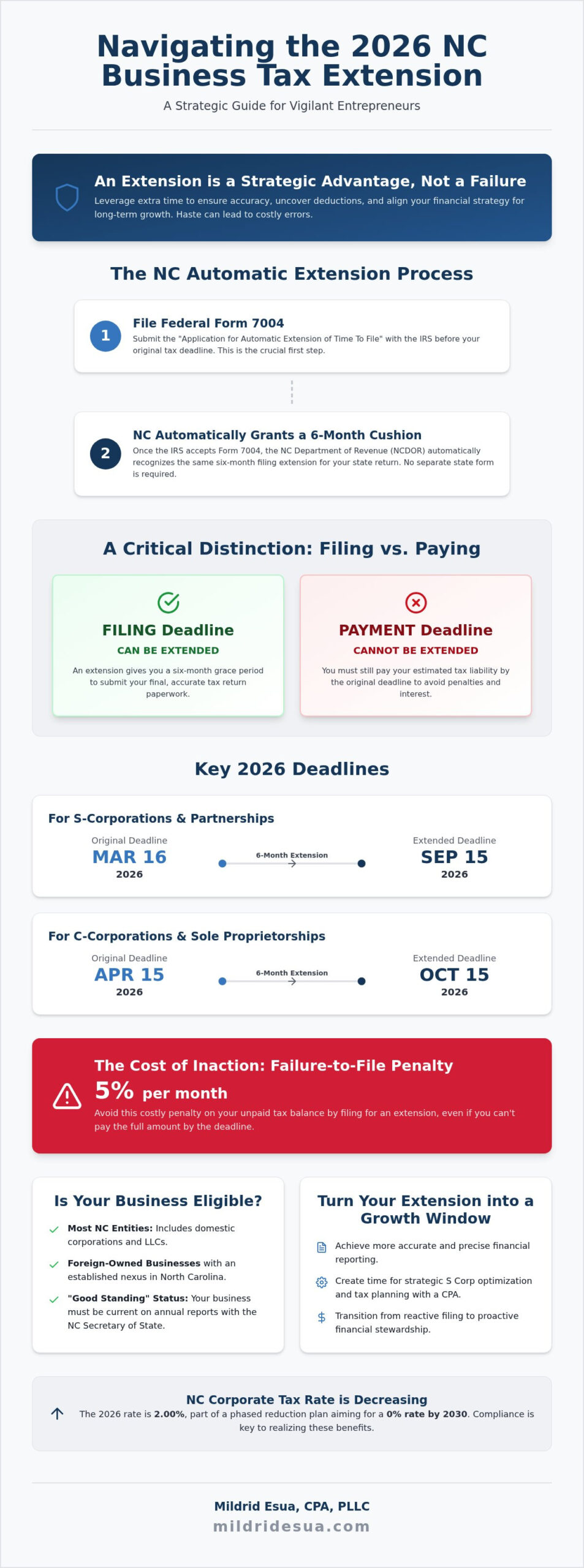
- Leverage the automatic state extension rule by filing federal Form 7004, which grants your business a vital six-month cushion for more accurate financial reporting.
- Understand the critical distinction between filing and payment deadlines to prevent the 5% monthly failure-to-file penalty and safeguard your company’s cash flow.
- Utilize the business tax deadline extension NC as a strategic window for S Corp optimization and proactive tax planning with a professional advisor.
- Identify the specific financial data your CPA needs to calculate a precise “good faith” estimate, ensuring you remain in compliance even while deferring your final return.
- Transition from reactive filing to a model of vigilant stewardship, where continuous engagement and monthly bookkeeping can eventually eliminate the need for last-minute extensions.
Understanding the 2026 Business Tax Deadline Extension in NC
A North Carolina business tax extension acts as a strategic six-month deferral of your filing obligations. It’s designed for entrepreneurs who prioritize financial stewardship over rushed compliance. Unlike a simple delay, this extension provides a window to refine your records and align your state filings with complex federal requirements. The North Carolina Department of Revenue (NCDOR) oversees this process to ensure that businesses maintain accuracy even when they need additional time to compile their annual data. By utilizing this deferral, you’re positioning your company to avoid the errors that frequently occur during the chaotic spring filing season.
In 2026, the stakes for precision are higher than ever. North Carolina continues its phased reduction of the corporate income tax, which sits at 2.00% this year. This legislative shift is part of a broader plan to reach a 0% rate by 2030. While these lower rates are beneficial, the NCDOR has intensified its focus on compliance. Failing to secure a business tax deadline extension NC properly can trigger penalties that negate the advantages of the state’s business-friendly tax climate. Vigilant leaders use this extra time to ensure every deduction is verified and every credit is claimed.
It’s vital to distinguish between the various tax types handled under this extension. For C-corporations, the extension covers both corporate income and franchise taxes, the latter of which applies even if the business isn’t yet profitable. S-corporations and partnerships use the extension primarily for informational returns that impact individual shareholder liabilities. Regardless of your structure, the extension applies only to the paperwork; it doesn’t excuse the obligation to pay estimated taxes by the original due date.
Critical 2026 Deadlines for NC Businesses
The filing calendar begins early for pass-through entities. S-corporations and partnerships must meet their initial deadline on March 16, 2026. If a business secures an extension, this date shifts to September 15, 2026. For C-corporations and sole proprietorships, the primary deadline falls on April 15, 2026, the date historically recognized as Tax Day. An approved extension moves this requirement to October 15, 2026, providing a significant cushion for complex financial audits and strategic tax planning.
Who is Eligible for an NC Tax Extension?
Eligibility for a business tax deadline extension NC extends to most domestic corporations and LLCs operating within Greensboro and the surrounding Piedmont Triad. Foreign-owned businesses that have established a nexus in North Carolina through physical presence or economic activity are also eligible. To qualify, your entity must remain in “Good Standing” with the North Carolina Secretary of State. This means you’ve stayed current with your annual reports and haven’t faced administrative dissolution. Maintaining this status is the first step in acting as a vigilant guide for your company’s long-term stability and growth.
The synergy between federal and state tax authorities is a cornerstone of efficient business management. Most North Carolina entrepreneurs don’t realize that their path to a business tax deadline extension NC is often paved by the work they do for the IRS. This integrated approach isn’t just about convenience; it’s a mechanism for ensuring that your financial narrative remains consistent across all levels of government. By aligning these two processes, you reduce the risk of conflicting data that often triggers unwanted regulatory scrutiny.
Under the “Automatic Extension” rule, the North Carolina Department of Revenue (NCDOR) acknowledges that if the federal government has granted you more time, the state should follow suit. This proactive policy eliminates the need for redundant paperwork for many Greensboro businesses. However, this convenience doesn’t absolve you of the need for vigilant record-keeping. You must ensure your federal request is flawless, as a rejection at the federal level often invalidates your state-level extension, leaving you vulnerable to late-filing penalties.
Leveraging Federal Form 7004 for NC Compliance
To secure your extra time, you must first file IRS Form 7004 before your original filing deadline. Once the IRS accepts this form, the NCDOR automatically recognizes the same six-month cushion for your state return. For 2026, North Carolina business entities receive an automatic six-month filing deferral that mirrors the federal timeline provided they have a validly filed federal extension on record. Always retain your federal confirmation receipt, as it serves as your primary defense during a state compliance review.
When Form CD-419 is Mandatory
There are specific scenarios where the automatic rule doesn’t apply and you must file Form CD-419 directly with the NCDOR. If you didn’t request a federal extension but still need more time for your state return, this form becomes your primary tool. Additionally, if you expect to owe state taxes, you must use Form CD-419 to submit your “good faith” payment by the original deadline. Multi-state entities with complex NC nexus requirements often find this form essential for maintaining precise state-level stewardship.
Precision in these filings is what separates a thriving enterprise from one bogged down by administrative errors. Discrepancies between your federal and state reports can create red flags that last for years. Acting as a strategic architect for your business means ensuring every number matches, regardless of which agency is reviewing the return. If you’re feeling overwhelmed by these moving parts, partnering with a dedicated accountant and tax advisor for small businesses can provide the clarity and foresight needed to navigate these requirements with confidence.
The most expensive misconception an entrepreneur can harbor is that a filing extension is synonymous with a payment holiday. This error accounts for a significant portion of the penalties issued by the North Carolina Department of Revenue each year. While a business tax deadline extension NC grants you six additional months to perfect your paperwork, the NCDOR expects you to settle your estimated tax liability by the original spring deadline. Failing to distinguish between these two obligations turns a strategic deferral into a costly financial burden.
Vigilant stewardship requires a proactive approach to cash flow management during this six-month window. According to the official NC business tax extension rules, any tax not paid by the original due date is subject to interest and potential penalties, regardless of whether a valid extension was filed. Acting as your own strategic architect means identifying your tax liability early so you can remit a “good faith” payment that protects your company’s capital from unnecessary erosion.
Estimating Your Tax Liability Without the Stress
Calculating an accurate estimate when your records are still being finalized can feel like a high-stakes guessing game. Many Greensboro businesses utilize the “safe harbor” method, paying 100% of the previous year’s tax liability to mitigate the risk of underpayment. This is where strategic tax planning for businesses becomes indispensable. By analyzing your year-to-date performance against historical data, you can determine if a slight overpayment today is a more prudent investment than facing interest charges tomorrow. It’s always better to claim a refund in October than to receive a deficiency notice in May.
Interest and Penalties: The Cost of Waiting
For 2026, the NCDOR continues to apply a rigorous interest accrual mechanism on any unpaid balance from the original deadline. Interest is calculated daily, meaning the cost of your tax debt grows every 24 hours you wait to file. If your payment falls short by more than 10% of the total tax due, you may face a 20% underpayment penalty, a heavy price for a simple calculation error. Unlike a reactive approach that ignores these mounting costs, a growth-oriented leader addresses them head-on. If you’ve already missed a payment or find yourself facing significant back taxes, seeking expert tax resolution North Carolina can help you navigate the relief options available to Greensboro entrepreneurs before the situation escalates.
How to File Your NC Business Tax Extension: A Step-by-Step Guide
Executing a business tax deadline extension NC requires more than a last-minute signature; it demands a structured approach to document collection and submission. Before you even open a filing portal, your financial records must be in a state of readiness. A vigilant CPA needs your preliminary profit and loss statement, balance sheet, and a record of any estimated payments made throughout the year. This data allows for the “good faith” estimate required to satisfy the NCDOR’s payment rules while buying your business the necessary time to finalize complex year-end adjustments.
The documentation trail you create during this process is your primary defense against future compliance audits. Once you’ve submitted your request, you must maintain a permanent record of the confirmation. This includes digital time-stamps for online filings or postal receipts for paper submissions. After the extension is secured, immediately mark your calendar for the new September or October deadlines. Treating these extended dates as firm, non-negotiable targets is the hallmark of a strategic architect who prioritizes long-term stability over perpetual extensions.
Using the NCDOR e-Services Portal
The most efficient way to manage your extension is through the NCDOR online portal, specifically using the CD-419 voucher system. This platform allows you to submit your filing deferral and any necessary payments simultaneously. You’ll need your active North Carolina Secretary of State ID to ensure the payment is applied to the correct corporate account. When paying, you can choose between a direct bank draft or a credit card, though it’s vital to account for the convenience fees associated with card transactions. Digital filing provides an immediate confirmation number, offering the peace of mind that comes with instant verification.
Paper Filing: The Traditional Route
While digital options are preferred for their speed, some Greensboro businesses still rely on paper filing. If you choose this route, you must mail Form CD-419 to the NCDOR office in Raleigh. In 2026, manual processing delays remain a significant risk, making it imperative that you send your documents via certified mail with a return receipt requested. This is the only safe way to prove your extension was postmarked by the original deadline. Without this physical proof, you’re at the mercy of administrative processing times, which can lead to erroneously issued late-filing notices.
Mastering these administrative steps ensures your business remains protected while you focus on deeper financial analysis. If you’re ready to move beyond the stress of manual filing and embrace a more proactive approach to your company’s fiscal health, it’s time to partner with a dedicated accountant and tax advisor for small businesses who can manage these complexities on your behalf.
Partnering with a Greensboro CPA for Proactive Tax Stewardship
True financial leadership involves moving beyond the cycle of reactive filing. While a business tax deadline extension NC offers a temporary reprieve, it’s merely a single component of a much larger fiscal narrative. Unlike a distant clerk who only appears once a year, a professional advisor acts as a growth partner, ensuring your business remains resilient against shifting regulations. By integrating monthly bookkeeping for small businesses into your operations, you transform your financial data from a source of stress into a tool for informed decision-making. This level of organization often makes the need for last-minute extensions entirely unnecessary.
Greensboro entrepreneurs trust Mildrid Esua, CPA, PLLC to serve as a vigilant guide through the complexities of both state and federal compliance. We don’t just process forms; we provide high-level IRS and NCDOR representation that protects your company’s interests. This protective stewardship is essential in an environment where even a minor administrative oversight can lead to significant penalties. By maintaining a year-round advisory relationship, you’re ensuring that your business tax deadline extension NC is used as a period of strategic refinement rather than a desperate scramble for missing records.
Customized Strategies for S Corps and LLCs
The six-month extension period provides a unique opportunity for entity structure optimization. It’s the ideal time to evaluate whether your current setup still serves your long-term growth objectives. For many Greensboro business owners, exploring the S Corp election for self-employment tax can act as a powerful lever for tax reduction. We provide the professional oversight needed to execute these transitions correctly, ensuring your final filing reflects a sophisticated approach to wealth preservation and compliance.
Continuous Engagement: More Than Just a Tax Form
A strategic architect monitors the horizon for legislative shifts that could impact your bottom line. In North Carolina, where corporate tax rates are in a state of phased reduction, staying informed is a full-time commitment. Continuous engagement means your advisor is already preparing for next year while finalizing this year’s returns. This proactive methodology is your best defense against an NCDOR audit, providing a steady hand and a clear documentation trail. Transitioning from extension-induced panic to strategic clarity begins with a commitment to year-round stewardship. It’s time to stop looking backward at deadlines and start looking forward at your company’s trajectory.
Transforming Your Extension into a Strategic Growth Window
Mastering a business tax deadline extension NC is more than an administrative delay; it’s a commitment to precision and long-term fiscal health. By aligning your federal and state filings, you avoid the common pitfalls of underpayment interest and legislative misalignment that often trap reactive businesses. This six-month period offers a vital opportunity to refine your entity structure and ensure every deduction is maximized through vigilant stewardship rather than rushed compliance.
As a member of the NC Association of CPAs, Mildrid Esua, CPA, PLLC acts as a forward-looking ally for entrepreneurs throughout the Triad. We specialize in complex tax resolution and S Corp optimization, providing the high-level expertise needed to navigate the evolving North Carolina tax landscape. Located in the heart of Greensboro, our firm is dedicated to being the steady hand that guides your company toward lasting stability and growth. Secure your business future with a strategic tax consultation in Greensboro.
Your company’s trajectory depends on the proactive decisions you make today. We look forward to partnering with you to turn tax complexity into a clear path for success.
Frequently Asked Questions
Does filing an extension in NC increase my chances of a tax audit?
Filing an extension does not increase your audit risk. On the contrary, taking the extra time to ensure your financial records are accurate often prevents the mathematical errors and inconsistencies that trigger NCDOR inquiries. Vigilant entrepreneurs use this period to conduct deeper tax planning, which results in a more robust and defensible return. It’s a strategic choice for accuracy rather than a red flag for non-compliance.
Is there a fee for filing a business tax extension in North Carolina?
North Carolina doesn’t charge a specific administrative fee to process your extension request. However, it’s vital to remember that a business tax deadline extension NC only applies to the paperwork. If you have an outstanding tax liability, the NCDOR will continue to accrue interest on the unpaid balance from the original due date. Strategic cash flow management ensures you remit a “good faith” payment to avoid these mounting costs.
Can I get an extension for my NC sales and use tax or withholding tax?
No, extensions are generally unavailable for sales and use taxes or employee withholding taxes. These are considered “trust taxes” that your business collects on behalf of the state, and the NCDOR requires timely remittance according to your assigned filing frequency. Unlike corporate income tax, failing to pay these on time can lead to personal liability for business owners. Proactive bookkeeping is the only way to ensure these obligations are met without fail.
What happens if I miss the extension deadline for my NC corporation?
Missing the extension deadline exposes your corporation to immediate late-filing penalties. The NCDOR applies a failure-to-file penalty of 5% of the net tax due for each month the return is late, capping at 25%. Beyond the financial cost, missing this secondary deadline can damage your company’s “Good Standing” status with the Secretary of State. A vigilant advisor helps you monitor these dates to protect your business from such avoidable administrative risks.
How long is the North Carolina business tax extension valid for in 2026?
The North Carolina business tax extension is valid for exactly six months from your original filing date in 2026. For S-corporations and partnerships, this shifts the deadline from March 16 to September 15. For C-corporations, the date moves from April 15 to October 15. This period is designed to allow for the completion of complex audits and federal reporting requirements, providing the stability needed for high-level strategic planning.
Do I need to file Form CD-419 if I already have a federal extension?
You don’t need to file Form CD-419 if you have an approved federal extension and don’t owe additional state taxes. North Carolina’s “automatic extension” rule honors your federal Form 7004 filing. However, if your business tax deadline extension NC involves an estimated tax payment, you must use Form CD-419 to submit those funds by the original deadline. This ensures your payment is correctly credited to your account and prevents underpayment interest.
What is the penalty for filing my NC business taxes late without an extension?
The penalty for filing late without a valid extension is 5% of the tax due per month, reaching a maximum of 25%. This is separate from the failure-to-pay penalty, which is 10% of the unpaid tax. When combined with daily interest accrual, the cost of non-compliance grows rapidly. Acting as a strategic architect for your business means securing an extension early to eliminate the failure-to-file portion of these aggressive state penalties.
Can a Greensboro CPA file my NC extension electronically on my behalf?
Yes, a Greensboro CPA can and should file your extension electronically to ensure an immediate documentation trail. Electronic filing via the NCDOR e-Services portal provides an instant confirmation number, which acts as your primary defense against potential late-filing notices. Partnering with a local advisor for this process ensures that your state-level stewardship is handled with the same professional depth as your federal tax planning and year-round bookkeeping.