

Most business owners view April 15 as the finish line, but for a resilient company, it’s actually just a progress report on a strategy that should have started twelve months prior. True business tax planning and preparation isn’t about looking back at what you spent. It’s about architecting what you’ll keep through vigilant stewardship and strategic foresight.
You’ve likely felt that sinking sensation when an unexpectedly high tax bill arrives or the anxiety of wondering if your bookkeeping could withstand an IRS inquiry. It’s exhausting to feel like you’re reacting to regulations rather than leading your business. We understand that you want predictable liabilities and the confidence that every legal deduction is working in your favor. This guide will show you how to transition from reactive filing to a proactive tax architecture that minimizes liabilities and secures your financial future.
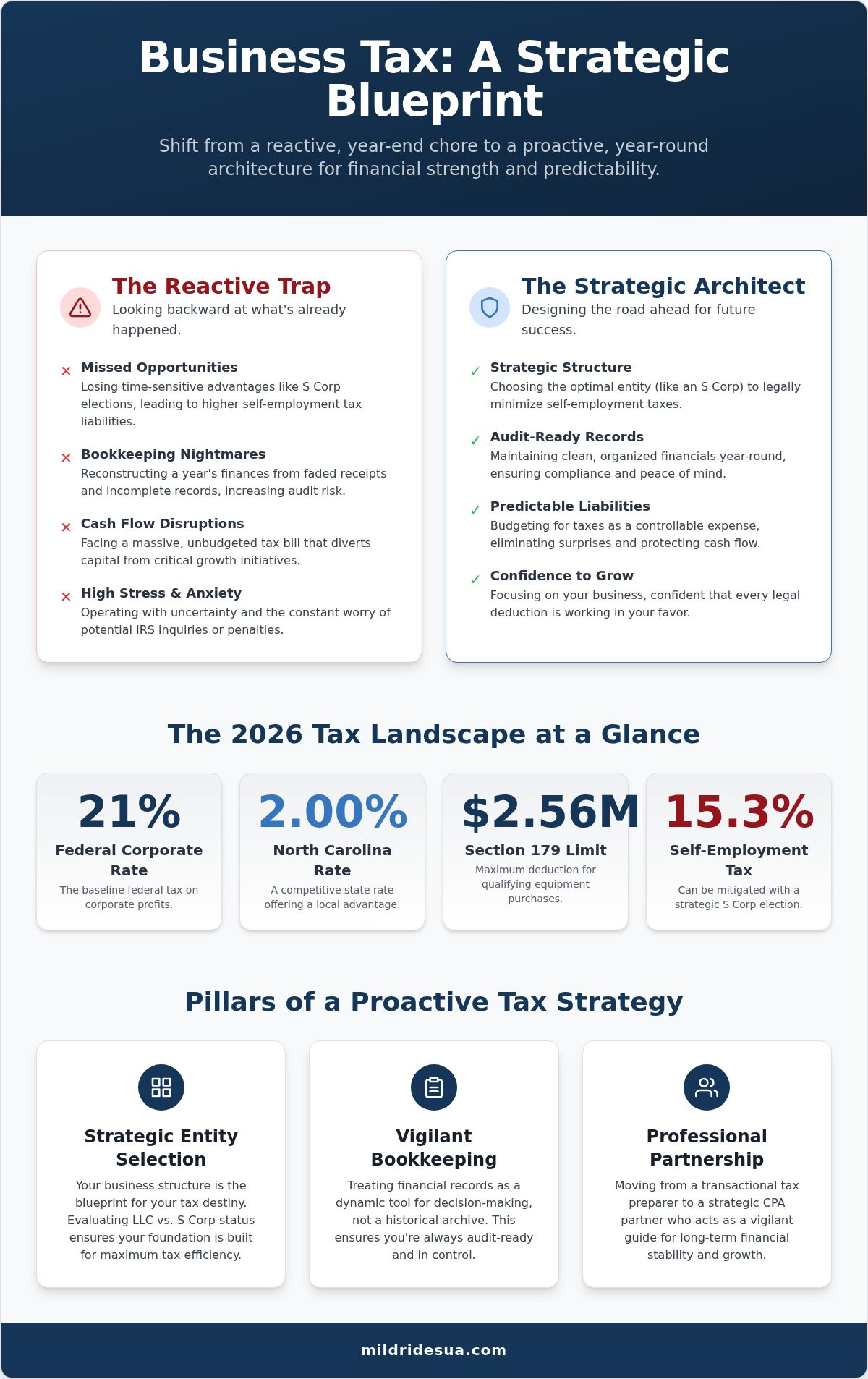
We’ll examine the 2026 tax landscape, from the 21% federal corporate rate to the $2,560,000 Section 179 deduction limit. You’ll discover how to leverage North Carolina’s 2.00% corporate tax rate and implement systems that ensure you stay audit-ready while focusing on long-term stability and growth.
Key Takeaways
- Move beyond seasonal tax filing toward a year-round model of business tax planning and preparation to gain total control over your financial trajectory.
- Evaluate how entity selection and S Corp elections serve as the architectural blueprint for reducing self-employment tax liabilities in 2026.
- Resolve IRS complexities and secure professional relief for back taxes or liens with the support of a vigilant guide.
- Uncover advanced 2026 federal deductions and North Carolina-specific tax incentives designed to fuel small business growth and local investment.
- Transition from a transactional service model to a strategic partnership that prioritizes long-term stability and audit-ready financial records.
The Evolution of Business Tax: Why Planning Outperforms Simple Preparation
Tax compliance is often treated as a seasonal obligation. Most business owners view their annual filing as an unavoidable ritual, much like a post-mortem on the previous year’s finances. However, there is a profound difference between looking through the rearview mirror and designing the road ahead. Tax preparation is merely the historical record of transactions that have already occurred. It’s the process of reporting what you spent and what you earned after the opportunity for change has passed. In contrast, tax planning is a forward-looking roadmap. It allows you to influence future outcomes by making deliberate decisions throughout the fiscal year.
Developing a foundational understanding corporate tax is the first step in recognizing that these liabilities aren’t static penalties. They are variables that can be managed through comprehensive business tax planning and preparation. In the 2026 landscape, where federal corporate rates sit at 21% and North Carolina’s corporate rate is a competitive 2.00%, the margin for error has narrowed. Proactive stewardship is no longer a luxury for large firms; it’s a survival mechanism for small businesses in the Triad area.
The Cost of Reactive Filing
The “Reactive Trap” is where many entrepreneurs lose their competitive edge. Waiting until the spring to address your tax burden means you’ve already missed critical windows for optimization. This delay leads to several avoidable points of friction:
- You lose the ability to make time-sensitive S Corp elections that could’ve significantly lowered your self-employment tax liabilities.
- You face the administrative nightmare of reconstructing a year’s worth of expenses from faded receipts instead of relying on organized, year-round bookkeeping.
- You risk severe cash flow disruptions when a massive, unbudgeted tax bill arrives, forcing you to pull capital away from growth initiatives.
The Strategic Architect Approach
Adopting the mindset of a Strategic Architect transforms your relationship with the IRS. Unlike a transactional service that only appears once a year, a proactive partnership treats your CPA as a vigilant guide and a growth partner. We view taxes as a controllable business expense rather than a fixed burden. By maintaining continuous engagement, we can identify specific growth opportunities, such as maximizing Section 179 equipment deductions or navigating the nuances of North Carolina’s planned corporate tax phase-out. This shift moves you from being a passive participant in your finances to being an informed leader who directs every dollar with intent. A consultative partnership ensures your financial records are always audit-ready, providing a sense of calm confidence that a last-minute filing simply cannot offer.
Pillars of a Proactive Tax Strategy: Entity Selection and Bookkeeping
If tax planning is the roadmap for your financial future, your business structure is the architectural blueprint that dictates your tax destiny. Many entrepreneurs in the Greensboro area begin as sole proprietorships or single-member LLCs, often unaware that these default settings can lead to unnecessary fiscal leakage. A sophisticated approach to business tax planning and preparation starts with an audit of your current entity to ensure it aligns with your growth trajectory. Unlike a standard tax preparer who simply records your choice, a Strategic Architect evaluates how different structures interact with the 15.3% self-employment tax and North Carolina’s evolving regulatory environment.
Optimizing Self-Employment Tax with S Corp Elections
For many profitable small businesses, the transition from a standard LLC to an S Corp election represents a significant pivot toward tax efficiency. In a traditional LLC, the IRS treats the entire net income as subject to self-employment tax. By electing S Corp status, you can bifurcate your income into a reasonable salary and shareholder distributions. Only the salary portion is subject to the 15.3% Social Security and Medicare taxes, while distributions remain exempt. S Corp status typically becomes a profitable architecture for a small business when its net profits significantly exceed the cost of a reasonable salary and the additional administrative payroll requirements. This strategy requires a vigilant guide to ensure your salary meets IRS standards for “reasonableness” while maximizing your total savings.
Bookkeeping as a Strategic Asset
Effective tax architecture is impossible without the foundation of precise, real-time bookkeeping. Moving beyond the disorganized “box of receipts” allows you to view your financial health with clarity rather than apprehension. Accurate monthly records do more than just simplify the year-end scramble; they serve as an early warning system for IRS red flags and missed opportunities. When your books are maintained with professional rigor, you can consult the IRS Tax Guide for Small Business with a clear understanding of how specific rules apply to your unique situation. This level of organization ensures you are always audit-ready and capable of identifying year-end deductions before the calendar turns. If you’re unsure if your current structure is optimal, exploring professional business formation services can provide the clarity needed for long-term growth.
Integrating your payroll, bookkeeping, and tax planning into a single, cohesive ecosystem eliminates the friction often found in fragmented financial management. This continuous engagement ensures that every payroll cycle and every equipment purchase is executed with an eye toward your final tax liability. By treating these pillars as interconnected parts of a larger strategy, you transform your financial department from a cost center into a powerful engine for stability.
Navigating Complexities: IRS Resolution, Audits, and International Nuances
While proactive business tax planning and preparation serves to minimize risk, complex challenges often arise from past oversights or international expansion. Unfiled tax returns represent more than just a clerical error; they are a significant roadblock to securing business credit, selling a company, or obtaining government contracts. Resolving these issues requires a transition from reactive fear to a structured, strategic recovery. As your vigilant guide, we don’t just look at the numbers; we manage the relationship between your business and the regulatory bodies that govern it.
IRS Representation and Dispute Resolution
Receiving an IRS notice can trigger immediate anxiety, but it shouldn’t paralyze your operations. Professional representation provides the necessary buffer between your business and the authorities. Unlike a transactional service that leaves you to face an auditor alone, a proactive partner manages every communication with strategic intent. We handle the intricacies of back taxes and tax liens, utilizing tools like installment agreements or an Offer in Compromise to prevent levies and asset seizures. As of 2026, the application fee for an Offer in Compromise is $205, a small investment compared to the potential for significant debt reduction. The psychological relief of having a CPA stand between you and the IRS allows you to focus on leading your business while we architect a path back to full compliance and long-term stability.
International Interests and FIRPTA Compliance
For foreign business owners operating in the North Carolina Triad, international tax nuances add a layer of sophisticated complexity that standard bookkeeping cannot address. FIRPTA withholding is a primary concern for those with real estate interests. When a foreign person disposes of a U.S. real property interest, the buyer is generally required to withhold 15% of the amount realized. Managing this 15 percent withholding requires meticulous paperwork and a deep understanding of cross-border liabilities to ensure you aren’t overpaying or triggering penalties. We act as a protective ally, managing global intangible low-taxed income (GILTI) and other international regimes with constant attention. Our expertise ensures that your cross-border interests remain a source of growth rather than a source of legal friction.
Whether you are dealing with a correspondence audit, which accounted for 81% of all audits in 2025, or navigating the “One Big Beautiful Bill Act” (OBBBA) changes to international income, professional guidance is essential. We provide the steady hand needed to move from a place of uncertainty to one of informed decision-making and clear financial records.
Maximizing Your Bottom Line: Advanced Deductions and Local NC Tax Incentives
Optimization is the hallmark of a mature financial strategy. While basic compliance keeps you out of trouble, sophisticated business tax planning and preparation transforms your tax return into a tool for capital preservation. For the 2026 fiscal year, the opportunities for significant tax relief are substantial, provided you have the foresight to architect your spending around current regulations. Unlike a standard tax preparer who simply records what you’ve done, a Strategic Architect identifies where your business can leverage federal and state-level incentives to fuel reinvestment and growth.
2026 Federal Deduction Strategies
The federal landscape for 2026 offers powerful incentives for businesses willing to invest in their own infrastructure. The Section 179 deduction limit is $2,560,000, allowing you to expense the full purchase price of qualifying equipment, vehicles, or software immediately rather than depreciating it over several years. This is complemented by the 100% bonus depreciation for qualified property acquired and placed in service after January 19, 2025. For those who travel for business throughout the Triad, the standard mileage rate has increased to 76 cents per mile for the latter half of 2026. The Qualified Business Income (QBI) deduction remains a vital tool, allowing eligible self-employed individuals and pass-through entity owners to deduct up to 20% of their qualified business income from their federal income taxes.
North Carolina State-Specific Considerations
North Carolina continues to position itself as a premier destination for entrepreneurs by phasing out its corporate income tax. In 2026, the corporate rate is 2.00%, moving steadily toward a 0% goal by 2030. This, combined with a flat personal income tax rate of 3.99%, creates a highly competitive environment for businesses in Greensboro, Winston-Salem, and High Point. However, navigating the NC franchise tax and local compliance requirements requires a vigilant guide to prevent missed local credits. Cities within the Triad often provide specific cash grants or incentives for job creation and capital investment that are tied to incremental local tax revenue. Local CPA expertise is vital here to ensure your business formation choices align with these state-specific benefits, particularly when managing the nuances of local tax rates in the Greensboro and Burlington areas. To ensure you aren’t leaving money on the table, you should consult with an expert tax advisor who understands the unique intersection of federal law and North Carolina incentives.
By moving beyond the basics of home office deductions and into R&D credits or strategic equipment expensing, you change the narrative of your business’s financial health. These advanced strategies require year-round engagement and a commitment to methodical bookkeeping. When your financial records are audit-ready and your deductions are legally maximized, you achieve a level of stability that allows for bold, informed decision-making.
The Strategic Architect: How Professional CPA Guidance Transforms Your Business
The final transformation for any entrepreneur is the shift from being a manager of daily tasks to becoming a strategic leader of a growing enterprise. This evolution requires a foundation of financial clarity that only a year-round advisory relationship can provide. Unlike a standard tax preparer who simply processes historical data, a Strategic Architect works alongside you to build a fortress around your business and personal assets. Professional business tax planning and preparation ensures that your growth isn’t undermined by unexpected liabilities or regulatory friction. By separating your personal financial security from the inherent risks of business ownership, we provide a protective layer that allows for bolder, more informed decision-making.
Your Growth Partner in the Carolinas
The difference between a transactional service and a strategic tax partner lies in the depth of engagement. A partner doesn’t just appear in April; they stay continuously involved to ensure your tax architecture scales with your revenue. For businesses in Greensboro, Winston-Salem, and Burlington, this means having a vigilant guide who understands the local economic pulse. We’ve seen businesses move from the brink of insolvency due to back taxes and liens toward a state of robust financial health. This transition is achieved by replacing disorganized records with methodical bookkeeping and proactive planning. When you have a dedicated partner like Mildrid Esua, CPA, PLLC, you can stop looking backward at past mistakes and start focusing on future expansions with the assurance that your financial foundation is solid.
Securing Your 2026 Financial Future
The most effective time to influence your 2026 tax outcome is not during the filing season, but right now. Every decision you make today regarding equipment purchases, payroll structures, or international interests will be reflected in your final tax architecture. Vigilant stewardship means we are constantly monitoring changes in federal law and North Carolina’s planned corporate tax phase-out to protect your interests. This steady hand provides the calm confidence needed to navigate a complex environment where audit rates for large corporations are expected to triple. You deserve a growth partner who is as invested in your long-term trajectory as you are. To move from reactive filing to proactive architecture and secure your business’s financial legacy, Schedule your strategic tax consultation with Mildrid Esua, CPA, PLLC today. We are ready to help you transition from complexity to clarity, ensuring that your business remains a source of stability for years to come.
Architecting Your Business Legacy for 2026 and Beyond
Transitioning from a reactive filing mindset to a proactive tax architecture is the defining step for any strategic leader. By embracing a forward-looking roadmap, you secure more than just compliance; you secure your business’s long-term financial future. Moving from the stress of seasonal filing to comprehensive business tax planning and preparation allows you to reclaim vital capital for growth while mitigating the risks of IRS audits or unexpected penalties.
Whether you require an S Corp election expert to optimize self-employment taxes or a dedicated IRS representation specialist to resolve complex disputes, professional stewardship is your greatest asset. We serve entrepreneurs throughout Greensboro, High Point, and Winston-Salem, acting as a protective ally and a steady hand in an ever-shifting regulatory environment. It’s time to move beyond the rearview mirror and start building a stable, audit-ready financial legacy. Partner with a Strategic Architect for your business tax needs and transform your tax liability into a powerful engine for stability and growth. Your business deserves a partner who is as invested in your future as you are.
Frequently Asked Questions
What is the difference between tax planning and tax preparation?
Tax preparation is the tactical act of recording historical financial data, while business tax planning and preparation involves the strategic design of future financial outcomes. Unlike preparation, which looks backward at what you’ve already spent, planning allows you to influence your tax liability before the fiscal year ends. This proactive stewardship ensures you aren’t simply reporting a number but are actively managing it to preserve your business’s capital.
How can an S Corp election reduce my self-employment tax in North Carolina?
An S Corp election reduces self-employment tax by allowing you to pay yourself a reasonable salary while taking remaining profits as shareholder distributions. In North Carolina, this strategy is particularly effective because distributions aren’t subject to the 15.3% self-employment tax. This architectural shift ensures that more of your revenue stays within your business for reinvestment and growth rather than being lost to avoidable tax burdens.
What should I do if I have unfiled business tax returns from previous years?
You should prioritize filing unfiled returns immediately to stop the accumulation of failure-to-file penalties and restore your business’s legal standing. Unfiled returns act as a significant roadblock to securing loans, obtaining business credit, or selling your enterprise. A vigilant guide can help you reconstruct missing records and negotiate with the IRS to resolve back taxes through structured settlement options.
Does my Greensboro-based business need a local CPA for tax preparation?
A local CPA provides a distinct advantage by navigating North Carolina’s specific tax climate, including the planned corporate tax phase-out and local franchise tax requirements. Greensboro businesses benefit from an advisor who understands the Triad’s economic landscape and local grant programs. This specialized knowledge ensures you don’t overpay state taxes while maximizing every available federal deduction.
What is FIRPTA, and do I need an accountant for it?
FIRPTA is a federal law requiring a 15% withholding on the sale of U.S. real property by foreign persons. You absolutely need an accountant to manage the complex documentation and ensure you receive any eligible refunds of the withheld amount. Professional oversight prevents the buyer from over-withholding and ensures your international interests remain compliant with evolving IRS regulations.
How can I resolve an IRS tax lien on my business?
Resolving a tax lien typically involves negotiating an Installment Agreement or an Offer in Compromise with the IRS to prove you’re taking steps toward resolution. As of 2026, the application fee for an Offer in Compromise is $205, a necessary investment to settle your debt for less than you owe. A CPA acts as your representative, architecting a resolution that protects your business assets from seizure while establishing a path to full tax relief.
What records do I need to keep for audit-proof tax preparation?
To ensure audit-ready records, you must maintain digital copies of all business receipts, bank statements, payroll records, and 1099 forms for at least three to seven years. Methodical bookkeeping is the foundation of this process, transforming a chaotic “box of receipts” into a defensible financial history. This level of organization provides calm confidence if the IRS ever requests a correspondence audit, which represented 81% of all audits in 2025.
Can a CPA help with both federal and North Carolina state tax compliance?
A CPA provides an integrated approach that manages both federal and North Carolina state compliance within a single, cohesive strategy. This prevents “double taxation” and ensures that your federal business tax planning and preparation aligns with North Carolina’s 2.00% corporate tax rate. By managing these layers simultaneously, your growth partner ensures that no deduction or local incentive is overlooked across different jurisdictions.