


Most entrepreneurs view the tax season as a defensive battle against the IRS, but the most resilient North Carolina firms treat their annual filing as a strategic reinvestment opportunity. You likely feel the weight of complex forms and the constant pressure to stay compliant with 2026 regulations. It’s natural to worry that claiming small business tax credits incorrectly might invite unwanted scrutiny or an intrusive audit. We understand that your time is better spent leading your team than deciphering the latest updates from the North Carolina Department of Revenue.
This guide empowers you to shift from a reactive stance to one of vigilant stewardship. You’ll discover how to leverage overlooked federal and state incentives to significantly reduce your tax liability and fuel your long-term growth. Unlike traditional, transactional accounting that only looks backward, we provide a roadmap of the specific credits available this year. We’ll preview how a proactive approach turns tax complexity into a clear, informed path for reinvesting in your business’s future.
Key Takeaways
- Understand the multiplier effect of tax credits, which provide a dollar-for-dollar reduction in your liability rather than just lowering taxable income.
- Identify high-impact federal small business tax credits like the WOTC and R&D credits that reward hiring and innovation in the Piedmont Triad.
- Navigate North Carolina’s specific landscape of Article 3J credits to capture incentives for local job creation and capital investment.
- Implement a “Vigilant Guide” approach to contemporaneous documentation to ensure your credit claims remain fully defensible against IRS scrutiny.
- Shift from reactive filing to proactive tax planning by partnering with a Greensboro CPA who identifies strategic savings opportunities year-round.
Understanding Small Business Tax Credits vs. Deductions
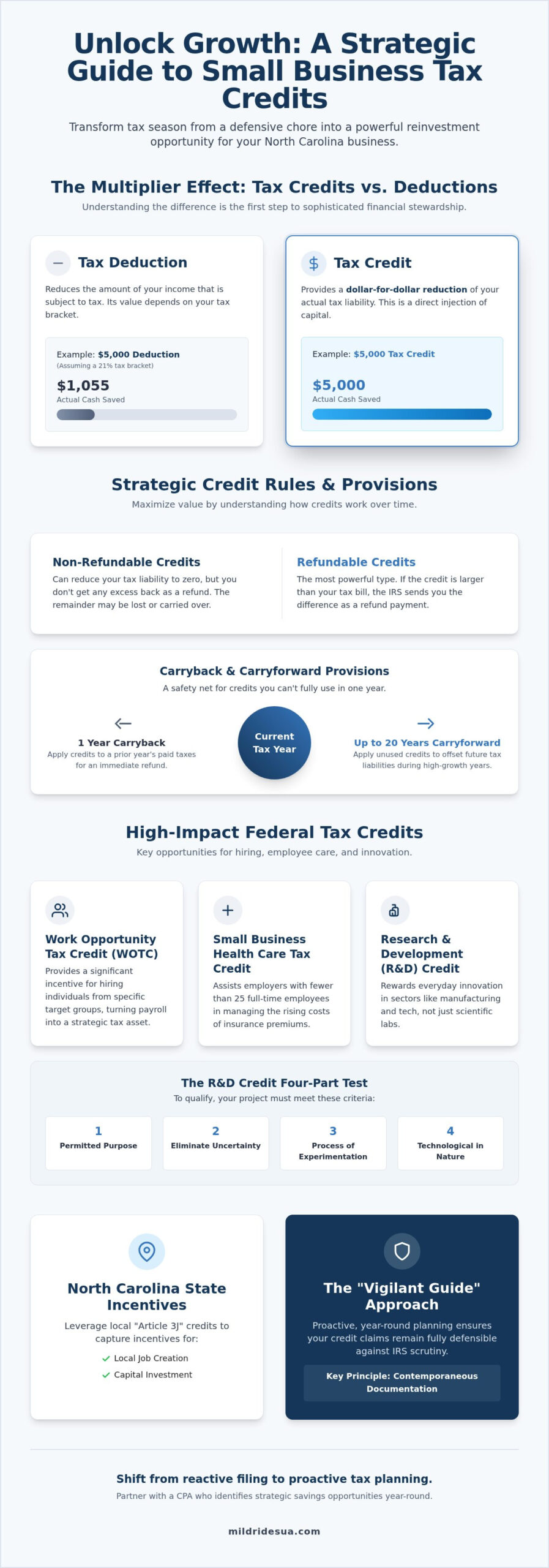
Distinguishing between a tax credit and a deduction isn’t just a matter of semantics; it’s the foundation of sophisticated financial stewardship. While a deduction reduces the portion of your income subject to taxation, a tax credit provides a dollar-for-dollar reduction of your actual tax liability. For a Greensboro startup, the “Multiplier Effect” illustrates this value clearly. If your business sits in a 21% tax bracket, a $5,000 deduction only saves you $1,055 in actual cash. Conversely, $5,000 in small business tax credits puts exactly $5,000 back into your operating budget. This immediate capital injection acts as a powerful lever for reinvestment, allowing you to fund new hires or equipment upgrades that a simple deduction cannot support.
Gaining a foundational Understanding Tax Credits requires recognizing the distinction between refundable and non-refundable incentives. Non-refundable credits can reduce your tax bill to zero, but any excess is typically lost or carried over to other years. Refundable credits are even more potent, as they can result in a payment from the IRS if the credit amount exceeds your total tax liability. Most of these incentives are claimed under the umbrella of the General Business Credit (Form 3800), which serves as a centralized reporting mechanism for various specialized incentives. By consolidating these credits, the IRS can apply specific limits and rules to your total business incentive package.
The Strategic Value of Tax Credits in 2026
In 2026, credits represent more than just seasonal savings; they are strategic assets that enhance your company’s valuation and long-term stability. By securing immediate liquidity, you reduce your reliance on high-interest debt and improve your cash flow position for future expansion. This proactive approach is essential because 2026 regulations have introduced more rigorous eligibility requirements that demand precise documentation. You need an architect’s precision to ensure your business structure, such as an S Corp or LLC, is positioned to capture small business tax credits without triggering unnecessary IRS inquiries.
Carryback and Carryforward Rules
The IRS provides a safety net for credits that you cannot fully utilize in the current fiscal year. Most business credits allow for a one-year carryback, which can generate an immediate refund by applying the credit to a prior year’s paid taxes. If you still have an excess after the carryback, you can utilize the carryforward provision to offset future liabilities. Tax credit carryforward is a provision that allows businesses to apply unused credits to future tax years for a period of up to 20 years. This flexibility allows you to save credits for anticipated high-growth years when your tax liability will likely be at its peak, ensuring no strategic advantage is left on the table.
Top Federal Tax Credits for Small Businesses in 2026
Federal small business tax credits serve as powerful instruments for those who look beyond standard deductions to find strategic growth opportunities. In 2026, several key programs remain underutilized by Greensboro business owners simply because the application process feels daunting. For instance, the Work Opportunity Tax Credit (WOTC) provides a significant incentive for hiring individuals from specific target groups, turning a standard payroll expense into a strategic tax asset. Similarly, the Small Business Health Care Tax Credit assists employers with fewer than 25 full-time equivalent employees in managing the rising costs of insurance premiums, provided they meet certain average wage requirements.
Capturing these incentives requires a level of foresight that traditional, reactive accounting often misses. Unlike a simple deduction that merely lowers your taxable income, these credits act as a direct injection of liquidity into your firm. Because the IRS maintains strict oversight on these claims, it’s vital to treat them as part of a year-round compliance strategy rather than a last-minute filing addition. Engaging in professional tax preparation Greensboro business owners trust ensures that credit identification is woven into your financial architecture from the very start of the fiscal year.
The R&D Credit for Non-Traditional Industries
Many local entrepreneurs mistakenly believe the Research and Development (R&D) Tax Credit is reserved for pharmaceutical giants or laboratory scientists. In reality, Greensboro’s manufacturing and tech sectors often qualify through everyday innovation. To claim this credit, your project must pass the Four-Part Test: it must have a permitted purpose, seek to eliminate technical uncertainty, involve a process of experimentation, and be technological in nature. We often see overlooked eligibility in custom software development or the creation of more efficient production lines. Maintaining contemporaneous documentation is vital to survive an IRS challenge, as the burden of proof rests entirely on the taxpayer. If you’re unsure if your current projects qualify, a proactive tax advisor can help you audit your activities before the fiscal year ends.
Retirement Plan Startup Credits (SECURE 2.0)
The SECURE 2.0 Act has fundamentally changed the landscape for small business retirement benefits. For firms with up to 50 employees, the retirement plan startup credit now covers 100% of administrative costs, capped at $5,000 per year for the first three years. This removes the financial barrier to entry for High Point businesses looking to compete for top-tier talent. Additionally, the Employer Contribution Credit offers a direct tax break for matching employee funds, effectively subsidizing your efforts to build a loyal, long-term workforce. These small business tax credits ensure that your commitment to your employees’ future also strengthens your company’s current bottom line.
North Carolina State Tax Incentives and Local Business Credits
North Carolina’s Department of Revenue (NCDOR) maintains a targeted approach to business incentives, focusing on regional economic stimulation rather than broad federal mandates. Unlike the IRS, which often uses credits to influence social policy, North Carolina utilizes small business tax credits as precision instruments to drive specific industrial and geographic growth. Local rules matter. Understanding how these state-level incentives interact with your federal liability is a hallmark of sophisticated tax planning. Because state tax payments are often deductible on federal returns, a reduction in state liability through credits requires a nuanced adjustment to your overall federal strategy to avoid unexpected imbalances.
Job Creation and Investment Incentives in the Piedmont Triad
The Piedmont Triad benefits from a tier-based ranking system that determines the potency of available small business tax credits. North Carolina categorizes its 100 counties into three tiers based on economic factors like unemployment rates and median household income. Guilford and Forsyth counties typically fall into Tier 2 or Tier 3 rankings, which dictates the minimum job creation thresholds and investment requirements for Article 3J credits. If your business operates within a designated Economic Development Zone, these incentives often become more accessible. Partnering with local municipalities in Greensboro or Winston-Salem can reveal additional property tax abatements or grants that complement your state-level filings. These local layers provide stability.
NC Sales and Use Tax Exemptions
Strategic architects of business growth also look toward sales and use tax exemptions to improve their cash flow. North Carolina provides significant relief for manufacturers and research firms through exemptions on machinery, equipment, and even certain electricity costs. To streamline this process, eligible businesses can apply for a Direct Pay Permit. This allows you to purchase qualifying items without paying tax at the point of sale, instead remitting any necessary taxes directly to the NCDOR. Managing these exemptions requires the steady hand of a local Greensboro CPA to ensure that your documentation meets the rigorous standards of state audits. Proactive oversight prevents costly errors.
Strategic Documentation: How to Defend Your Tax Credits
The IRS views small business tax credits with a higher degree of scrutiny than standard business deductions because credits directly reduce tax revenue on a dollar-for-dollar basis. This high valuation makes them a primary focus during compliance reviews. To protect your firm, we adopt the role of a Strategic Architect, emphasizing the creation of a contemporaneous documentation file. This isn’t just about saving receipts; it’s about building a narrative that proves your eligibility before the IRS even asks. Common mistakes like missing certification forms or failing to track specific employee hours can lead to immediate disqualification and heavy penalties. Accurate small business tax credits claims require that your underlying financial data is clean, consistent, and ready for inspection.
Building a contemporaneous documentation file represents the “Vigilant Guide” approach to tax management. This proactive methodology ensures that your eligibility is established the moment the qualifying activity occurs, rather than months later during filing. Unlike reactive accounting, which struggles to reconstruct events during an audit, a proactive system captures the necessary evidence in real time. This level of detail is what separates a successful credit claim from a costly liability. A comprehensive approach to business tax planning and preparation ensures that your documentation strategy is built into your operations long before the filing deadline arrives.
The Audit Trail: Proving Your Eligibility
Claiming the Work Opportunity Tax Credit requires more than just a payroll entry; you must possess specific certifications from the state workforce agency obtained at the time of hire. For Paid Family Leave credits, your payroll records must clearly distinguish between regular wages and qualifying leave payments to meet federal standards. R&D claims require detailed project logs that link specific employee hours to technical experimentation or process improvements. It is vital to maintain all tax-related documentation for at least seven years to ensure a robust defense during a potential audit. Business owners who also hold digital assets should be aware that the IRS applies the same rigorous standards to cryptocurrency transactions, making it equally important to work with a Cryptocurrency Tax Accountant & IRS Compliance specialist to maintain an airtight record of cost-basis and disposal events.
IRS Representation and Resolution
If the IRS disputes a credit, the situation transitions from strategic planning to active defense. Unlike basic tax preparers who may disappear after April, a proactive partner provides expert IRS representation to resolve these complex disputes. At Mildrid Esua, CPA, PLLC, we specialize in tax resolution for Greensboro businesses, handling the intricate communication with federal authorities so you don’t have to. We focus on “Audit-Proofing” your returns during the planning phase, ensuring that every strategic asset we identify is backed by an unshakeable foundation of evidence. If you’re facing a challenge or want to secure your filings, contact us for professional IRS representation today.
Partnering with a Greensboro CPA to Maximize Your Tax Savings
Unlike generic DIY software that only prompts you for information during the final weeks of tax season, a proactive CPA functions as a year-round growth partner. We identify small business tax credits during the strategic planning phase, long before you reach the filing deadline. For S Corps and LLCs in the Winston-Salem area, this level of foresight is critical for maintaining cash flow. We don’t just record your financial history; we design your future. As your Strategic Architect, we align your tax strategy with your 2026 business goals, ensuring that every credit claimed serves your long-term trajectory and stability.
A reactive approach often leads to missed opportunities and increased audit risk. By the time most business owners think about their taxes, the window for qualifying activities has already closed. Our methodology prioritizes early identification and continuous engagement. This ensures that your business structure and operational decisions are optimized to capture incentives as they arise. This steady hand provides the clarity you need to make informed decisions without the fear of unexpected liabilities. Firms that invest in proactive business tax planning and preparation consistently outperform those that treat filing as an annual afterthought rather than a year-round strategic discipline.
Beyond Filing: Year-Round Tax Stewardship
Effective tax planning rests on a foundation of meticulous monthly bookkeeping. Without real-time financial data, identifying small business tax credits like the R&D or SECURE 2.0 incentives becomes a game of guesswork. We conduct quarterly tax planning sessions to adjust for new 2026 legislative changes, ensuring your strategy remains current and compliant. This continuous engagement provides a level of stability that transactional services cannot match. You gain the peace of mind that comes from having professional IRS representation standing behind every figure on your return, shielding your growth from unnecessary scrutiny.
Schedule Your 2026 Tax Strategy Session
Transitioning to a proactive model begins with a comprehensive tax review. To prepare for your consultation, organize your current payroll records, equipment purchase receipts, and any existing retirement plan documents. When you partner with a professional tax resolution and planning firm like Mildrid Esua, CPA, PLLC, you can expect a deep dive into your operations to uncover overlooked incentives. We move beyond the numbers to understand the heart of your business, providing a steady hand in a complex regulatory environment. Ensure your business captures every available credit-Contact Mildrid Esua today.
Securing Your Competitive Advantage in 2026
Mastering the 2026 tax landscape requires more than just compliance; it demands a philosophy of vigilant stewardship. By moving beyond simple deductions and embracing the strategic potential of small business tax credits, you transform a mandatory expense into a powerful engine for reinvestment. Success in the Piedmont Triad depends on your ability to combine federal incentives with North Carolina’s specific state credits while maintaining an unshakeable audit trail. This level of foresight distinguishes the most resilient firms from those that merely survive tax season.
Unlike transactional services that only look backward, our firm provides the seasoned expertise needed to defend your claims and optimize your entity structure. We leverage specialized Greensboro accounting, expert IRS representation, and proactive S Corp strategies to protect your interests and fuel your long-term stability. Don’t leave your financial trajectory to chance or reactive software. Schedule a Strategic Tax Consultation with Mildrid Esua, CPA, PLLC to secure your growth and ensure your firm is positioned for maximum efficiency. We’re ready to serve as your steady hand in this complex environment.
Frequently Asked Questions
What are the most common small business tax credits for 2026?
Common incentives include the Work Opportunity Tax Credit (WOTC), the Research and Development (R&D) credit, and the SECURE 2.0 retirement startup incentives. These small business tax credits reward firms for hiring, innovating, and providing benefits. Unlike deductions, they provide a direct reduction of your tax bill, making them essential for Piedmont Triad firms focused on aggressive growth and strategic reinvestment.
How do I claim the small business health care tax credit in North Carolina?
You claim the health care credit by filing IRS Form 8941 along with your annual tax return. To qualify, your North Carolina business must employ fewer than 25 full-time equivalent employees, pay average annual wages below a specific inflation-adjusted threshold, and cover at least 50% of employee premium costs. It’s a complex calculation that requires precise payroll data to ensure you capture the maximum available relief.
Can I carry forward business tax credits if I have no profit this year?
Yes, you can carry forward unused credits to future years if your business doesn’t show a profit in 2026. Most incentives under the General Business Credit umbrella allow for a one-year carryback to recover previously paid taxes and a 20-year carryforward to offset future liabilities. This provision ensures that your strategic investments in hiring or equipment provide long-term value even during lean fiscal years.
Is there a specific tax credit for hiring veterans in Greensboro?
Hiring veterans in Greensboro primarily qualifies your business for the federal Work Opportunity Tax Credit (WOTC). This program provides a credit based on the wages paid to qualified veterans during their first year of employment. Because North Carolina aligns its tax incentives with regional economic goals, combining federal WOTC claims with state-level job creation incentives provides a robust financial advantage for local employers.
What is the difference between a refundable and non-refundable tax credit?
A refundable credit can trigger a payment from the IRS even if your tax liability is zero, while a non-refundable credit only reduces your actual bill to nothing. If a non-refundable credit exceeds what you owe, you cannot receive the difference as a refund, though you may carry it forward. Understanding this distinction is vital for cash flow planning and determining which incentives offer the most immediate liquidity.
How does an S Corp election affect my eligibility for business tax credits?
An S Corp election changes how small business tax credits are distributed, as they typically flow through to the individual shareholders’ tax returns. While the entity itself doesn’t pay federal income tax, the credits reduce the tax burden on the owners’ personal filings. This structure is ideal for Piedmont Triad entrepreneurs who want to optimize self-employment taxes while still benefiting from significant business-level incentives.
Do I need a CPA to claim the R&D tax credit for my small business?
While you can technically file for the R&D credit yourself, the rigorous documentation requirements and the “Four-Part Test” make professional CPA oversight a practical necessity. The IRS frequently scrutinizes these claims, and a Strategic Architect ensures your project logs and time-tracking data meet the high burden of proof required. Professional representation protects you from the risk of disqualification and costly penalties during a review.
What documentation does the IRS require for the Work Opportunity Tax Credit (WOTC)?
The IRS requires that you submit Form 8850 to your state workforce agency within 28 days of an eligible employee’s start date. You must also complete ETA Form 9061 to certify that the individual belongs to a qualifying target group. Missing these strict deadlines is a common error that leads to credit denial, so maintaining a vigilant pre-screening process during your hiring phase is essential for compliance.