

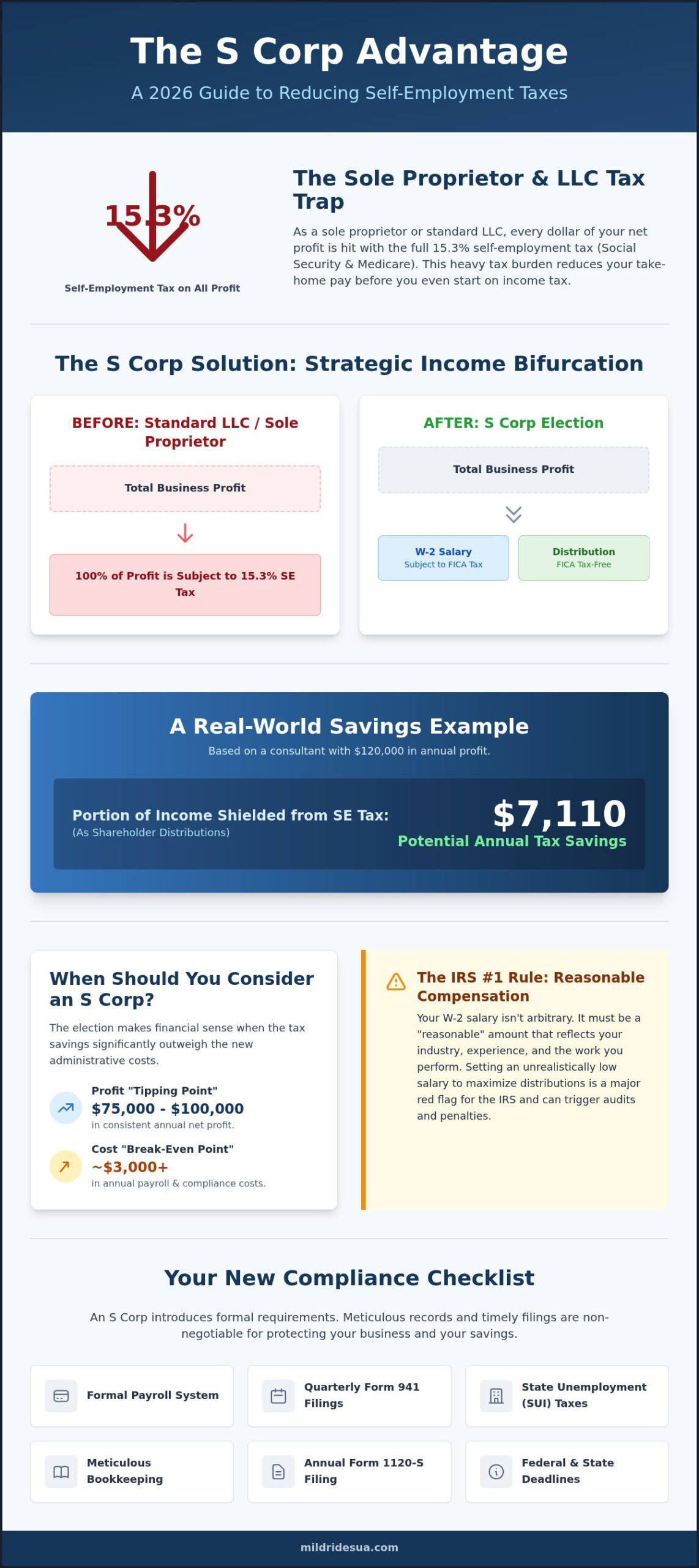
A consultant generating $120,000 in profit could potentially keep an additional $7,110 every year simply by restructuring how their income is classified. It’s exhausting to watch 15.3% of your revenue vanish into self-employment taxes before you even address your standard income tax obligations. You’ve likely felt the frustration of these heavy FICA bills, yet the anxiety surrounding an S Corp election for self employment tax often keeps business owners stuck in a reactive cycle. Many entrepreneurs fear that “reasonable salary” standards or complex payroll compliance might invite unnecessary IRS scrutiny.
This strategic shift is more than a quick fix; it’s a structural evolution that requires professional stewardship. Unlike a standard LLC filing, this election allows you to bifurcate your income between a W-2 salary and shareholder distributions, effectively shielding a portion of your earnings from the full weight of Social Security and Medicare taxes. This 2026 guide provides the clear framework you need to determine if the election is profitable for your specific situation. We will provide a roadmap for compliant implementation and demonstrate how a partnership with Mildrid Esua, CPA, PLLC ensures your growth is protected by vigilant, year-round oversight.
Key Takeaways
- Identify the specific net profit “tipping point” where tax savings outweigh the administrative costs of payroll and professional bookkeeping.
- Navigate the complexities of the “reasonable compensation” standard to protect your business from the most common IRS audit triggers.
- Master the federal and North Carolina filing deadlines to ensure your S Corp election for self employment tax is implemented correctly for 2026.
- Leverage your corporate structure to access advanced retirement planning tools that further reduce your overall tax liability.
The Mechanism of S Corp Election & Self-Employment Tax Savings
Operating as a sole proprietor or a standard LLC often feels like running uphill. Every dollar of net profit you earn is subject to the full 15.3% self-employment tax. This isn’t just a line item; it’s a structural hurdle that limits your capacity to reinvest in your vision. By implementing an S Corp election for self employment tax, you move away from this reactive posture. You transition into a framework where your income is strategically bifurcated. It is a sophisticated way to manage the money trail while ensuring your tax liability reflects your actual role within the company.
Understanding the FICA Savings Framework
The self-employment tax is composed of two distinct parts: 12.4% for Social Security and 2.9% for Medicare. For the 2026 tax year, the Social Security component applies to the first $184,500 of your earnings. An S corporation acts as a pass-through entity, allowing the business to avoid double taxation at the corporate level. The real power of this structure is the “split.” You pay yourself a W-2 salary that is subject to FICA taxes, but any profit beyond that salary is issued as a shareholder distribution. These distributions escape the 15.3% tax net entirely. This isn’t a loophole; it’s a recognized method of rewarding business ownership rather than just labor.
The Strategic Shift: Owner vs. Employee Roles
Adopting this structure forces a healthy shift in perspective. You are no longer just “the business”; you are a dual-role participant acting as both a shareholder and an employee. This distinction provides essential clarity for personal wealth building and reinvestment. Moving beyond the sole proprietor mindset into a model of corporate governance creates a stable foundation for the future. At Mildrid Esua, CPA, PLLC, we view this as “Strategic Architecture.” We work as your vigilant guide to ensure this separation is maintained through rigorous bookkeeping and payroll compliance. This proactive management transforms your financial outlook from a series of seasonal tax surprises into a methodical, growth-oriented journey.
Calculating the Threshold: When Does an S Corp Election Make Financial Sense?
Determining the exact moment to transition from a standard LLC to an S Corp requires a clinical look at your bottom line. While the potential for savings is high, an S Corp election for self employment tax introduces new administrative layers that carry their own costs. The math is simple, but the variables change based on your specific revenue and growth trajectory. You don’t want to implement a complex structure if the overhead consumes your tax alpha. For most professionals, the conversation begins when net profits consistently exceed the $75,000 to $100,000 range.
The Net Profit Analysis
Low revenue businesses often find that the traditional LLC structure is more efficient. If your net profit is $40,000, the few thousand dollars saved in FICA taxes are quickly negated by payroll service fees and increased tax preparation costs. However, as profits climb toward six figures, the “Net Tax Alpha” becomes significant. This is the actual dollar amount you keep after accounting for every new expense. Considering the increased compliance landscape of 2026, the S Corp break-even point typically arrives when potential tax savings exceed approximately $3,000 in additional annual administrative expenses. Engaging a dedicated Accountant & Tax Advisor for Small Businesses ensures your profit analysis accounts for these nuances before you commit to the change.
Administrative and Compliance Overheads
Moving to an S Corp means you can no longer simply “draw” money from your business bank account. You must establish a formal payroll system to pay yourself a salary. This involves mandatory withholdings, quarterly Form 941 filings, and state unemployment insurance (SUI) taxes. The IRS also requires that your salary meets the standard for reasonable compensation, which is a frequent point of contention during audits. Accurate bookkeeping becomes a non-negotiable requirement rather than a luxury. Without a clear money trail, filing the mandatory Form 1120-S becomes a liability. DIY management in this area often leads to costly penalties that far outweigh any initial tax savings. We prioritize vigilant stewardship of these records to ensure your corporate governance remains beyond reproach.
You must also consider the Qualified Business Income (QBI) deduction. While an S Corp saves you 15.3% on distributions, those distributions are the only part of your income that qualifies for the 20% QBI deduction. Your W-2 salary does not. A proactive partner will help you balance these two competing tax benefits to find the precise “sweet spot” for your 2026 filing. For a broader view of how this fits into your overall financial picture, explore our strategic tax planning for businesses guide built specifically for NC entrepreneurs.
The ‘Reasonable Compensation’ Standard: Navigating IRS Scrutiny
The IRS is increasingly utilizing automated systems to flag S Corp returns that report zero or suspiciously low officer salaries. While an S Corp election for self employment tax offers a clear path to reducing FICA liabilities, the IRS requires that you pay yourself “reasonable compensation” for the services you provide. This is not a suggestion; it is a regulatory requirement designed to ensure owners don’t bypass the Social Security system entirely. If your salary is deemed unreasonably low, the IRS can recharacterize your distributions as wages. This leads to back taxes, interest, and significant penalties that can quickly erase your hard-earned savings.
Factors the IRS Uses to Judge Your Salary
The IRS employs a multi-factor test rather than a simple percentage to determine what is reasonable. They evaluate your specific training, experience, and the daily duties you perform within the business. Unlike a passive investor, an active owner-operator contributes high-level management and technical skills that command a specific market rate. We analyze geographic data for the Greensboro and Winston-Salem markets to ensure your pay aligns with local economic realities. For instance, the national median wage for a management consultant in May 2025 was $101,860. If you perform similar high-level work but only pay yourself $30,000, you are creating a high-risk audit profile. The common “60/40” split is a myth. The IRS focuses on facts and circumstances, not arbitrary ratios.
Documenting Your Compensation Strategy
Vigilant stewardship requires more than just picking a number. You need a defensible money trail. We recommend conducting annual salary studies and recording the justification for your pay in corporate board minutes. This documentation provides a proactive defense if the IRS ever inquires about your compensation levels. In years where profits are lower, your salary might need adjustment, but these decisions must be grounded in the company’s financial capacity and documented accordingly. Mildrid Esua, CPA, PLLC acts as your strategic architect in this process. We provide the intellectual rigor needed to benchmark your pay accurately, ensuring you maximize savings without compromising your business’s long-term stability. This methodical approach transforms a potential area of risk into a well-managed component of your corporate governance.
Implementation and Compliance: Moving to S Corp in North Carolina
Execution is the bridge between a theoretical tax strategy and actualized savings. While the benefits of an S Corp election for self employment tax are clear, the window for implementation is remarkably tight. Missing a single deadline can defer your savings by an entire calendar year. This stage of the process requires a vigilant partner who understands that compliance isn’t just about filing forms; it’s about protecting the structural integrity of your business growth. In the Piedmont Triad, this means balancing federal requirements with specific North Carolina Department of Revenue mandates.
The Federal Election Process
To transition your LLC to an S Corp, you must file Form 2553 with the IRS. For calendar-year businesses, the deadline to file for the 2026 tax year is March 16, 2026. This date is critical because the standard March 15 deadline falls on a Sunday. If you miss this 75-day window, you might still qualify for late election relief under Revenue Procedure 2013-30, but this requires demonstrating reasonable cause. It’s far better to establish your corporate “birth date” correctly from the start. We manage this timeline with precision, ensuring your election is accepted so you don’t lose a moment of tax-efficient operation.
North Carolina Specific Requirements
North Carolina generally recognizes federal S Corp status, but the state has its own set of administrative hurdles. You’ll need to file Articles of Incorporation with the Secretary of State, which carries a $125 fee. Beyond the initial setup, NC requires an annual report due by April 15, costing $20 if filed online or $25 by paper. You must also account for the North Carolina franchise tax, which has a minimum payment of $200. For businesses with a tax base over $1 million, the rate is $1.50 per $1,000. While the state’s corporate income tax rate is 2.0% for 2026, it’s scheduled to phase out completely by 2030, making North Carolina an increasingly attractive home for corporate entities.
Local compliance in cities like Greensboro, High Point, and Burlington adds another layer of complexity. You must register for payroll taxes and manage local business privilege licenses where applicable. If you have non-resident shareholders, North Carolina requires specific withholding procedures that can lead to penalties if ignored. Mildrid Esua, CPA, PLLC acts as your strategic architect in these matters, handling the money trail across multiple municipalities. If you’re ready to move beyond reactive tax paying, it’s time to partner with a dedicated S Corp Tax Advisor who can navigate these Piedmont Triad nuances with calm confidence.
Beyond the Election: Integrating S Corp Strategy into Your Growth Plan
Successful entrepreneurs don’t view an S Corp election for self employment tax as a one-time tax hack. Instead, they treat it as the “Strategic Architecture” for long-term wealth accumulation. Once the structural transition is complete, the focus shifts toward maximizing the benefits of corporate governance. This involves more than just lowering your FICA bill. It’s about creating a predictable environment where your personal and business interests are managed with constant attention and high-level expertise.
S Corp as a Foundation for Advanced Tax Planning
Moving your business into a corporate structure opens doors to sophisticated tax-saving vehicles that are often unavailable to sole proprietors. You can utilize corporate fringe benefits, such as health insurance premiums and accountable plans for business expenses, to reduce your overall taxable income effectively. Strategic timing of distributions and annual bonuses also allows for better cash flow management, especially when preparing for future business transitions or a potential sale. A corporate structure provides a level of financial maturity that appeals to investors and lenders alike, positioning your business as a stable, professionally managed entity. North Carolina entrepreneurs across the state, including those seeking a small business accountant Charlotte residents trust for proactive wealth-building strategies, are increasingly recognizing the value of this approach.
Integrating Retirement and Growth
Retirement planning takes on a new dimension within an S Corp framework. While you save on self-employment taxes through distributions, your W-2 salary becomes the basis for contributions to a SEP IRA or a Solo 401(k). It’s a delicate balance. A lower salary reduces your current tax burden but also limits your maximum retirement contribution ceiling. We help you navigate these trade-offs to ensure your current savings don’t compromise your future security. This forward-looking approach ensures that every dollar earned is working toward your long-term trajectory.
The Growth Partner Advantage
The complexity of maintaining an S Corp requires a move from transactional tax prep to a consultative partnership. Without year-round bookkeeping and professional oversight, business owners often fall into the “S Corp Trap” of late payroll filings or undocumented distributions. These errors invite the very IRS scrutiny you sought to avoid. Mildrid Esua, CPA, PLLC provides the steady hand and vigilant stewardship necessary to manage these moving parts. We handle the money trail so you can focus on the operations that drive your success. To ensure your business is built on a stable foundation, schedule a strategy session with Mildrid Esua, CPA, PLLC to optimize your structure.
Securing Your Financial Trajectory for 2026 and Beyond
Transitioning your business structure is a decisive step toward long-term stability. By mastering the “reasonable compensation” standard and navigating the specific North Carolina filing deadlines, you transform your tax liability into a manageable engine for growth. An S Corp election for self employment tax provides the clarity needed to reinvest in your vision while protecting your personal wealth from the full weight of 15.3% FICA burdens. It’s a shift from a reactive, year-end scramble to a proactive, architected financial future.
Unlike traditional, transactional services, we emphasize year-round stewardship. We combine tailored business formation strategies with comprehensive bookkeeping for S Corp compliance, ensuring your money trail remains beyond reproach. Should challenges arise, our expert IRS representation provides the seasoned defense your business deserves. It’s time to move beyond the frustration of high tax bills and embrace a consultative partnership that prioritizes your trajectory. Partner with a Strategic S Corp Advisor in Greensboro today to build a more resilient and profitable foundation for your business.
Frequently Asked Questions
Can an LLC elect to be taxed as an S Corp?
Yes, an LLC can file Form 2553 to be taxed as an S Corp. This allows the business to retain its legal structure as a limited liability company while changing its federal tax classification. It’s a strategic move for owners who want to reduce their overall tax burden through an S Corp election for self employment tax. This election is particularly common for Piedmont Triad businesses that have reached a consistent profit threshold.
What is the deadline for S Corp election in 2026?
The deadline for a calendar-year business to file Form 2553 for the 2026 tax year is March 16, 2026. Usually, the deadline is March 15, but that date falls on a Sunday in 2026. Filing within this 75-day window ensures your S Corp status is effective from the start of the year. Late elections are possible but require demonstrating reasonable cause to the IRS through specific relief procedures.
How much can I save on self-employment tax with an S Corp?
You save 15.3% on every dollar of profit that is distributed as a dividend rather than paid as a W-2 salary. For example, a consultant earning $120,000 in profit who sets a $65,000 salary could save roughly $7,110 in annual taxes. The actual savings depend on balancing your salary against your total net income to maximize tax efficiency. This ensures your growth remains protected through strategic, forward-looking planning.
Does an S Corp election increase my risk of an IRS audit?
While audit rates for S Corporations remain statistically low at less than 0.05%, the IRS uses automated systems to flag specific triggers. The most common trigger is reporting zero or an unreasonably low salary for an active owner. Maintaining rigorous bookkeeping and a defensible compensation strategy significantly reduces this risk. Vigilant stewardship of your corporate records ensures that your tax structure remains a tool for stability, not a liability.
What happens if I don’t pay myself a “reasonable” salary in an S Corp?
The IRS can recharacterize your shareholder distributions as wages if they determine your salary is too low. This leads to immediate liability for back payroll taxes, interest, and penalties. It effectively voids the primary benefit of the S Corp election for self employment tax. We help you avoid this trap by benchmarking your compensation against geographic market data for Greensboro and Winston-Salem to ensure your records are audit-proof.
Do I need a separate bank account for my S Corp?
Yes, you must maintain a dedicated business bank account to preserve the corporate veil and ensure accurate bookkeeping. Commingling personal and business funds is a major compliance risk that can lead to legal and tax complications. A separate account provides the clear money trail required for filing Form 1120-S. This separation is essential for the professional governance model that a sophisticated S Corp structure demands for long-term growth.
Can I revert back to a standard LLC if the S Corp structure doesn’t work?
You can revoke your S Corp status by filing a statement with the IRS, but this decision carries long-term consequences. Once revoked, you generally cannot re-elect S Corp status for five years without specific IRS permission. It’s a significant structural change that requires careful foresight and consultative advice. We analyze your long-term growth trajectory to ensure the election remains profitable and sustainable before recommending any transition back to a standard LLC.
Does North Carolina recognize the federal S Corp election automatically?
North Carolina generally recognizes the federal S Corp election, but you must still comply with state-specific administrative duties. This includes filing an annual report with the Secretary of State and paying the minimum $200 franchise tax. You don’t need a separate state-level election form, but you must register for NC payroll taxes and withholdings. Mildrid Esua, CPA, PLLC manages these Piedmont Triad compliance layers to protect your standing with the Department of Revenue.