


Paying the tax debt is an important step, but confirming the lien’s status matters too. To understand how to get an IRS tax lien removed, distinguish a release from a withdrawal: according to the IRS, it releases a federal tax lien within 30 days after the tax debt is paid in full. A release confirms the debt has been paid; a withdrawal removes the lien notice from public record.
If you’re concerned about borrowing or a pending loan, it helps to understand what a tax lien does and does not do. A lien is a legal claim against property; a levy is the IRS’s seizure of assets to collect unpaid tax. They have different effects and require different responses.
This article explains what a federal tax lien means, how it differs from a levy, and how it may factor into borrowing. You’ll also learn what can happen when you request removal and how to follow up on the request, so you can understand the status and plan your next move with greater clarity.
Key Takeaways
- Identify whether the issue concerns the lien notice, collection action, or a particular property; each may call for a different response.
- Understand how a federal tax lien may factor into a loan or mortgage decision, and which withdrawal pathway could apply.
- If a property needs to be sold, a discharge may address the lien on that specific property. Form 14135 is the application for a certificate of discharge.
- Keep track of the removal request and its outcome so you can decide what follow-up is needed.
- For routine lien matters, the IRS Centralized Lien Operation can help verify a lien, provide a payoff amount, or address a release request at 800-913-6050.
Q5: What is the difference between a tax lien and a tax levy?
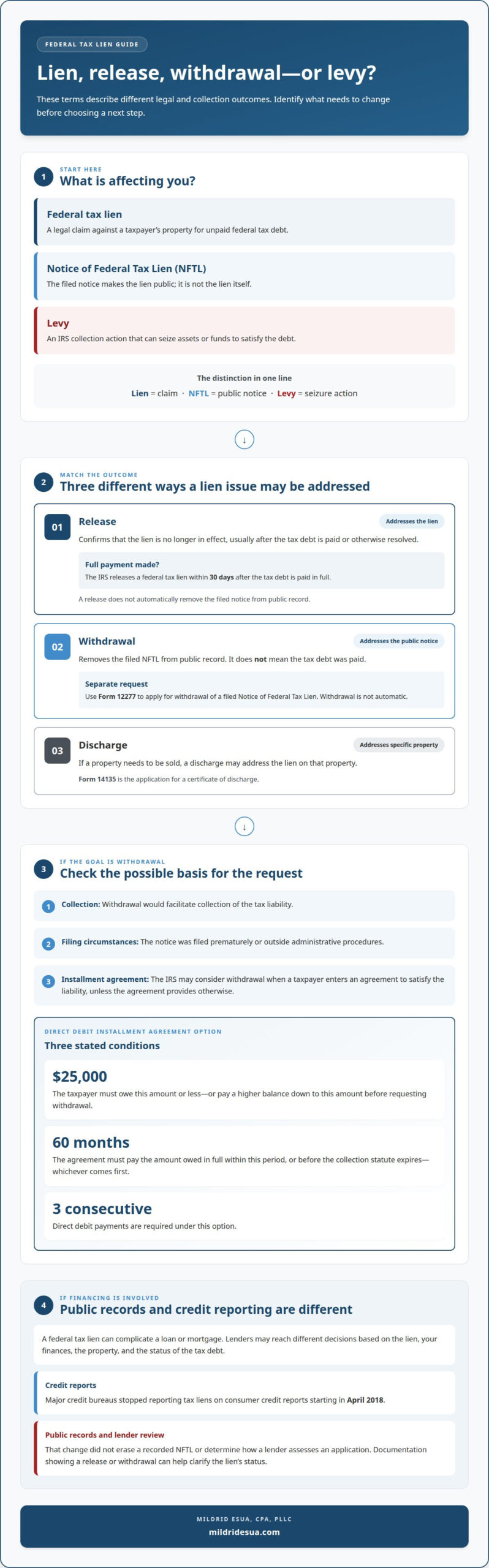
A federal tax lien is a legal claim against a taxpayer’s property for unpaid federal tax debt. A levy is a collection action that can seize assets to satisfy that debt. The lien establishes the government’s claim; the levy takes property or funds. A filed Notice of Federal Tax Lien, or NFTL, is public notice of the lien, not the lien itself. To understand how to get an IRS tax lien removed, first identify which action is affecting you.
Release and withdrawal have different effects. A release confirms that the lien is no longer in effect, usually after the tax debt is paid or otherwise resolved. The Internal Revenue Service releases a federal tax lien within 30 days after the taxpayer pays the tax debt in full. A withdrawal removes the NFTL from public record, but doesn’t mean the tax debt was paid. The IRS may consider withdrawing an NFTL even after the underlying lien has been released, so a release doesn’t automatically remove the notice.
Paying the full tax debt is a direct route to a lien release. Once the debt is settled, the release addresses the lien itself. Removing the public filing is a separate matter: you may request withdrawal after satisfying the liability and obtaining a release if you also meet the filing requirements for the past three years. Eligibility depends on meeting these conditions, not simply on making a payment.
An accepted Offer in Compromise also requires attention to its terms. Acceptance alone isn’t the same as completed payment or a recorded release. Once the taxpayer fulfills the accepted offer and the liability is satisfied, the release process applies to the resolved lien. The taxpayer may then consider whether to separately request withdrawal of the NFTL. Form 12277 is the application for withdrawal of a filed Notice of Federal Tax Lien.
To understand how to get an IRS tax lien removed, match the requested action to the problem: a levy concerns collection from assets, a release addresses the lien, and withdrawal addresses the public notice. For example, after paying the settled amount, you may need to confirm the lien’s release and then pursue withdrawal if you also need the NFTL removed. Keeping these outcomes distinct makes follow-up clearer and avoids assuming that resolving tax debt automatically removes every public filing.
Can A Federal Tax Lien Stop Me From Getting A Loan Or Mortgage?
A federal tax lien can complicate a loan or mortgage because it creates a public claim against your property. Lenders may reach different decisions, considering the lien alongside your finances, the property, and the status of your tax debt. If a transaction is delayed, documentation showing a release or withdrawal can help clarify the lien’s status.
Credit reporting is a separate issue. Major credit bureaus stopped reporting tax liens on consumer credit reports starting in April 2018. That change does not erase a recorded Notice of Federal Tax Lien or determine how a lender assesses your application. A lender may still review relevant public records or ask about tax obligations. Be prepared to explain whether the lien remains active, has been released, or has been withdrawn.
Withdrawal removes the filed Notice of Federal Tax Lien from public record. It can matter when a notice is affecting a financing transaction, but withdrawal is not automatic. Federal law, under IRC § 6323(j), allows withdrawal in specified circumstances. These include when withdrawal would facilitate collection of the tax liability, or when the notice was filed prematurely or outside administrative procedures. The IRS may also consider withdrawal when a taxpayer enters an installment agreement to satisfy the liability, unless the agreement provides otherwise.
The Direct Debit installment agreement option has specific conditions. According to the Internal Revenue Service, the taxpayer must owe $25,000 or less, or pay down a higher balance to $25,000 before requesting withdrawal. The agreement must pay the amount owed in full within 60 months or before the collection statute expires, whichever comes first. The Internal Revenue Service also requires three consecutive direct debit payments under this option.
To request withdrawal of a filed notice, taxpayers use Form 12277. A clear request should identify the NFTL and explain the basis for withdrawal, such as eligibility under the Direct Debit option or how withdrawal may facilitate collection. Include relevant account and agreement details so the request can be assessed against the applicable criteria. If you want the IRS to send a copy of an approved withdrawal to a lender or other creditor, identify that financial institution or creditor specifically.
Interest and continuing payment obligations remain important: withdrawing a notice does not itself settle tax debt. Keep the installment agreement current while the request is considered, and share accurate status records with a lender when needed. For help assessing lien options and preparing an IRS representation strategy, IRS representation for tax lien issues can support a more organized path forward.
How to Check the Status of Your IRS Tax Lien Removal Request?
To verify that a federal tax lien release appears in public records, contact the county recording office where the Notice of Federal Tax Lien was filed. Search its public index using the taxpayer’s name and lien details, or ask how to locate the recorded release. An IRS update and a county record entry are separate status checks.
Keep your records organized while a request is pending. Retain a copy of the application, its submission date, delivery confirmation, and IRS correspondence. Note the tax periods and lien notice details involved. When contacting the IRS, state whether you’re checking on a release, withdrawal, or discharge. Each request concerns a different action, so identifying what you submitted can help clarify the response.
For basic and routine lien matters, taxpayers can contact the IRS Centralized Lien Operation at 800-913-6050. The office handles requests to verify a lien, obtain a payoff amount, or request a lien release. Have your tax account and notice information available during the call. Record the date and the outcome, then compare the IRS response with any county recording entry.
A discharge differs from a release of the entire federal tax lien. It removes the lien’s effect from a specific property, allowing that property to be sold or transferred while the lien may continue to apply elsewhere. The IRS may discharge property to allow a sale when the proceeds go toward paying the tax debt. For example, a homeowner preparing to sell may seek a discharge for that property rather than assume the entire lien is resolved.
To apply for a Certificate of Discharge from Federal Tax Lien, taxpayers use Form 14135. IRS Publication 783 provides application instructions. The request focuses on the specific property and the proposed transaction, including how sale proceeds will address the tax debt. A mortgage lender or closing professional may need to understand the discharge status before a sale can proceed, so keep correspondence and transaction records together.
Track a discharge as a property-specific matter: note when the application was sent, preserve IRS responses, and follow up using the contact details provided for the case. After approval, confirm that the discharge covers the correct property and transaction. If the public record needs updating, ask the county recording office how to locate the recorded document. A discharge can support a sale, but it does not show by itself that all tax debt is satisfied.
What a federal tax lien is and how it differs from a levy
Under 26 U.S. Code § 6321, a federal tax lien may arise after the IRS assesses tax, demands payment, and the taxpayer neglects or refuses to pay. The lien is the government’s legal claim against property; it is not the seizure itself. It can attach to current and future assets, including a house, car, or bank account. A levy is the collection action that seizes assets to satisfy unpaid tax debt.
A filed Notice of Federal Tax Lien puts the government’s claim on the public record. Form 668(Y) is the form identified for a filed notice. The distinction matters: a lien establishes a claim, while a levy takes property or funds. For example, a recorded notice may affect a property transaction even when the IRS has not levied a bank account.
For spouses, first identify whose tax liability and property are involved. A joint return, separate assessment, or jointly held asset may raise different questions. Don’t assume one spouse’s tax debt automatically affects every asset or account in the same way. Gather relevant tax notices, return information, and ownership records before evaluating the lien’s scope. These details help clarify which taxpayer and property the IRS action concerns.
Subordination does not remove a federal tax lien. It changes the lien’s priority relative to another creditor’s claim, which may matter during refinancing or a property transaction. Taxpayers use Form 14134 to apply for a Certificate of Subordination of Federal Tax Lien. IRS Publication 784 explains the application process. For example, a homeowner considering refinancing may need to address lien priority with the proposed lender.
Prevention starts with addressing federal tax obligations before they remain unpaid. File required returns, review IRS notices promptly, and respond to a balance due rather than letting the matter go unattended. Under § 6321, assessment, demand for payment, and neglect or refusal to pay are the stated conditions preceding a federal tax lien. If the balance cannot be paid in full, an installment agreement may address collection, but it doesn’t by itself erase an existing lien.
Keep tax returns, payment records, and IRS correspondence together. If a notice arrives, identify the tax periods and amounts it covers, then determine whether the liability is accurate and what payment or collection response fits. A timely, documented response can help resolve discrepancies and prevent unanswered notices from complicating the record. For complex ownership or creditor issues, consider who owes the tax, what property is affected, and whether a filing or transaction is pending.
Checking the status of a lien removal request
Submitting a request and completing a lien action are different milestones. Track the application type, tax periods, submission date, delivery record, and IRS correspondence in one case file. When following up, specify whether you requested a release, withdrawal, or discharge. That distinction can help the IRS locate the relevant action and prevent a request about one notice from being confused with another.
For basic and routine lien matters, contact the IRS Centralized Lien Operation at 800-913-6050. The office handles lien verification, payoff requests, and release requests. Have the taxpayer’s identifying details and lien notice information ready. Ask whether the request was received, whether the IRS needs additional information, and what action has been taken. Record the call date, the representative’s instructions, and any follow-up needed.
Use the response to establish the request’s actual status. For example, an IRS account balance changing does not by itself show that a certificate has been issued or recorded. If the IRS confirms a release, ask about the Certificate of Release of Federal Tax Lien and its processing. The IRS issues this certificate using Form 668(Z). Keep the certificate and related correspondence with the original notice and payment records.
- Request received: Keep the submission confirmation and note the application type.
- More information needed: Send the requested documents and retain proof of delivery.
- Action completed: Request or retain the certificate or withdrawal documentation that applies.
- Public record follow-up: Contact the county recording office where the Notice of Federal Tax Lien was filed.
If the IRS says a balance remains, ask which tax periods or charges account for it. Compare the explanation with your payment confirmations and IRS notices. A remaining balance can affect whether a release is appropriate, while an accepted withdrawal request concerns removal of the filed notice. Keep these outcomes distinct, especially if a lender, mortgage closing, or property transaction needs evidence of the lien’s status.
When the IRS and county records appear inconsistent, keep both records and follow up with the organization responsible for the pending action. An IRS certificate addresses the federal lien; the county index shows what has been recorded locally. Note the document date and recording details when available. For structured help resolving lien correspondence and follow-up, get support with IRS lien representation.
Mildrid Esua, CPA, PLLC: Tax Planning & Tax Preparation,Bookkeeping IRS Representation small business accounting Tax resolution unfiled tax, tax lien , payroll servies
Mildrid Esua, CPA, PLLC provides IRS representation and tax resolution services for taxpayers dealing with federal tax liens, back taxes, or unfiled returns. Turn to the firm when you need help understanding a lien notice, identifying a suitable resolution path, or managing communication with the IRS.
A release, withdrawal, and discharge are not interchangeable. Tax resolution support helps identify which action fits your circumstances and what documentation the request requires. For small businesses, an accountant and tax advisor can also connect lien matters with broader tax preparation and accounting needs, helping keep records aligned as the issue is addressed.
If you’re ready to discuss your tax lien situation, contact Mildrid Esua, CPA, PLLC.
Move Forward With a Clear Tax Resolution Plan
Your next step in learning how to get an IRS tax lien removed is to connect the tax issue with your broader financial priorities. A pending property sale, borrowing plans, or unresolved returns can affect what needs attention first. Organize the notices, payment records, and correspondence you have, then use them to shape a focused plan for addressing the IRS matter.
Keep the goal practical: understand what action remains, who needs an update, and what documentation supports your next decision. A measured approach can help you move from uncertainty toward a more organized resolution while keeping your longer-term financial stability in view.
If you’d like professional guidance on your circumstances, contact Mildrid Esua, CPA, PLLC to discuss a path forward. With the right support, you can address the issue with greater clarity and make informed decisions about what comes next.
Frequently Asked Questions
What Is a Tax Lien?
A federal tax lien is the government’s legal claim against property when federal tax remains unpaid after assessment and a demand for payment. It can affect assets a taxpayer owns now and acquires later. The lien is distinct from the Notice of Federal Tax Lien, which makes the government’s claim public. For example, a public filing may surface during a property or financing transaction even when no assets have been seized.
Q3: Does paying off a tax lien improve my credit score immediately?
Paying a tax debt doesn’t necessarily create an immediate credit score increase attributable to the lien. Major credit bureaus stopped reporting tax liens on consumer credit reports starting in April 2018, and federal tax liens stopped directly affecting credit scores starting in 2018. A lender may still consider other financial information or public records. So keep proof of payment and the lien’s resolution for a lender that asks about its status.
How Does It Affect Your Property?
A federal tax lien can attach to a taxpayer’s current and future assets, including real estate, a vehicle, or funds in a bank account. A filed notice may also complicate selling or refinancing property because the government’s claim can affect the transaction. For example, a homeowner planning a sale should distinguish a discharge for that property from resolution of the entire tax account. The appropriate action depends on the property and transaction.
Q4: Can a tax lien be removed without paying the full amount owed?
In some circumstances, the filed notice may be withdrawn before the full balance is paid, but withdrawal does not erase the tax debt. One possible route is an eligible Direct Debit installment agreement. The IRS sets specific balance, payment, and repayment-period conditions for this option. A different situation may call for a discharge of a particular property, which addresses that asset rather than removing the lien from all property.
What Documents and Information Are Needed to Remove a Tax Lien?
Gather the Notice of Federal Tax Lien, relevant tax periods, account correspondence, and payment or installment agreement records. Form 12277 is used to apply for withdrawal of a filed notice; Form 14135 applies to a certificate of discharge for specific property. A request should clearly identify the taxpayer, the notice or property at issue, and the reason for the requested action. Keep submission records and IRS replies together.
When Do Federal Tax Liens Expire?
A federal tax lien generally expires when the IRS collection period ends without collection, commonly described as 10 years. That period can be paused by certain events, including bankruptcy, an Offer in Compromise submission, or signing a waiver, which may affect the expiration date. The IRS may also refile a lien for another 10 years in some circumstances. Check the applicable collection period and any tolling events before relying on expiration.
How can I get an IRS tax lien released after paying the tax debt?
After the tax debt is paid in full, confirm that the IRS has processed the account and issued the release. The IRS releases a federal tax lien within 30 days after full payment. The Certificate of Release of Federal Tax Lien uses Form 668(Z). Keep the certificate with payment proof, then check the county record where the Notice of Federal Tax Lien was filed to see whether the release appears there.
How long does the IRS have to release a federal tax lien after payment?
The Internal Revenue Service has 30 days after the taxpayer pays the tax debt in full to release a federal tax lien. Keep payment confirmation and IRS correspondence in case the release needs follow-up. If the county record still shows the notice, contact the county recording office and ask how it indexes release documents. A recorded release and withdrawal are different actions, so confirm which document was issued.


Leave a Reply
Your email is safe with us.