


A CPA doesn’t have to become a permanent part of your team. Freelancers can seek CPA support for a defined tax project or hourly advice, and freelancer CPA services can help with tax preparation, planning, and questions that call for professional judgment. The scope can match the task, from reviewing a specific tax issue to helping organize finances for filing.
It makes sense to want support that fits your workload without adding unnecessary complexity. Accounting software can organize transactions, but it cannot provide personalized tax strategy or compliance guidance. Knowing when to bring in a CPA can help you make clearer decisions about taxes and your freelance finances.
This article explains when CPA support may help, what project-based and hourly services can cover, and how to choose an arrangement that fits your needs. You will also see how bookkeeping, tax planning, and preparation work together, so you can identify a practical next step.
Key Takeaways
- Match the scope of tax support to the complexity of your income, expenses, and business structure.
- Organized records across clients and platforms can make cash flow and project profitability easier to understand.
- Identify which services address your immediate tax needs and which can support more informed financial decisions.
- Assess a CPA’s experience by how well it aligns with the specific tax project and freelance work involved.
- Learn when tax resolution or IRS representation may be a useful next step for unresolved tax issues.
Do freelancers really need an accountant?
Not every freelancer needs ongoing accounting support, but a CPA can help with tax preparation, compliance, and planning. The right level of support depends on your income sources, business structure, records, and the decisions you need to make.
Tax Preparation and Compliance
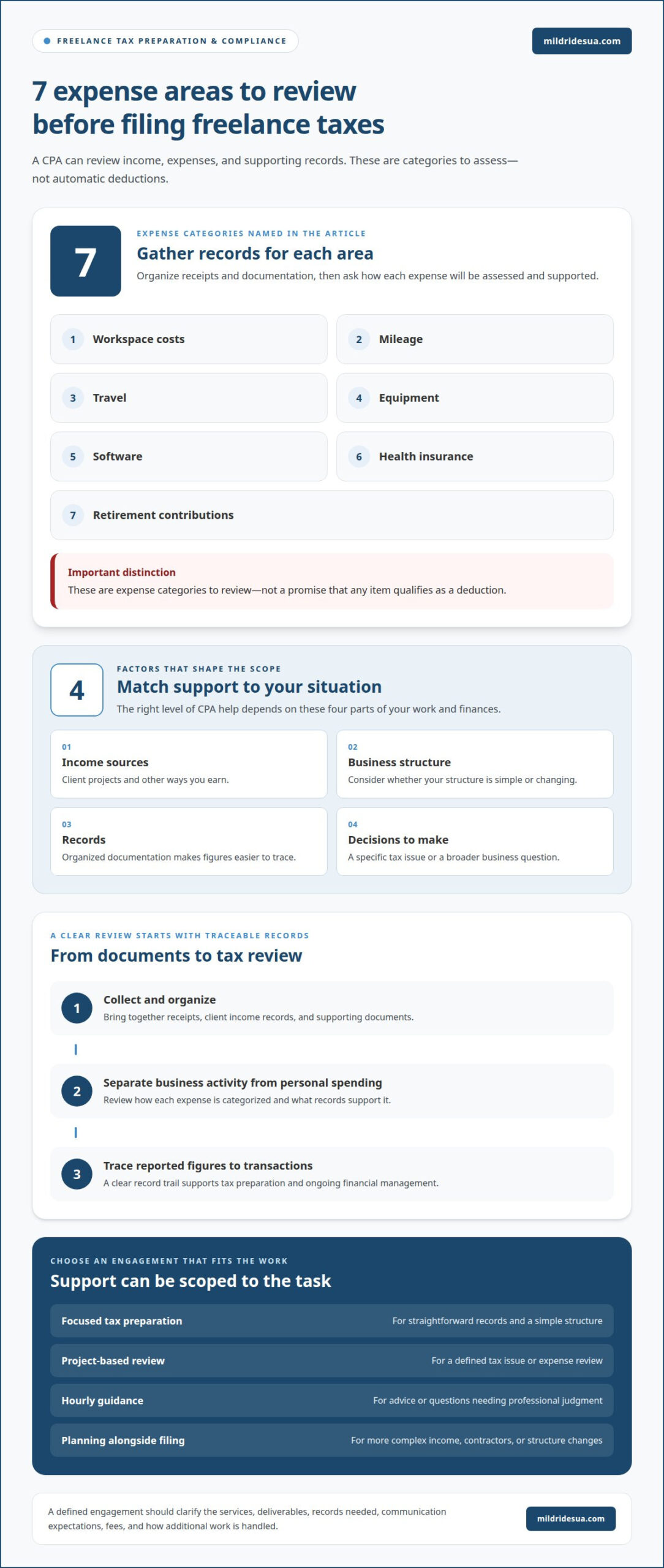
Federal and North Carolina tax preparation involves more than transferring figures from a spreadsheet. A CPA can review income from client projects, business expenses, and supporting records before preparing returns. For example, a freelancer might organize receipts and records for workspace costs, mileage, travel, equipment, software, health insurance, or retirement contributions. These are expense categories to review, not automatic deductions.
Ask how each expense will be assessed and matched to supporting records. A clear process helps distinguish business activity from personal spending and trace reported figures to transactions. It also makes filing part of managing freelance finances, rather than an isolated annual task.
The size and complexity of your business should shape the engagement. A freelancer with one client, straightforward records, and a simple business structure may need focused tax preparation. Someone earning through several platforms, managing contractors, or considering a change in business structure may benefit from tax planning alongside filing. Freelancer CPA services can be hourly or project-based, depending on whether you need a specific review or continuing guidance.
A CPA’s tax expertise is especially useful when paired with practical knowledge of bookkeeping, payroll, and small-business finances. Software can categorize transactions and store receipts, while a CPA can interpret the tax questions those records raise. That distinction matters when income fluctuates or an equipment purchase raises questions about how to record the expense.
Finding and Verifying a Freelance CPA
To find a freelance CPA nearby, seek referrals from independent professionals or local business groups in North Carolina. Verify the CPA’s credential through the relevant state accountancy board, then discuss experience with self-employment income and North Carolina filings. A useful first conversation clarifies whether the professional’s experience fits your income sources, expenses, and business structure.
Before work begins, review an engagement letter describing services, deliverables, records you must provide, communication expectations, and how additional work is handled. It should also explain whether fees are hourly, fixed for a defined project, or arranged another way, and when billing occurs. These terms clarify whether the engagement covers return preparation alone or includes planning and follow-up questions.
Define the project in plain terms. For example, specify whether you need a return prepared, expense records reviewed, or guidance about a business decision. A clear scope helps align the CPA’s qualifications and complementary skills with the work. It also gives both sides a shared understanding of what the agreed service includes.
Financial challenges of managing freelance finances without a CPA
Freelancers often track money across clients, invoices, payment platforms, and business accounts. Without a consistent process, missed transactions can obscure cash flow, project profitability, and tax records.
Bookkeeping and Financial Reporting
Bookkeeping records income and expenses, giving freelancers a clearer view of business activity. For example, a designer can categorize client payments, software subscriptions, equipment purchases, and contractor invoices. Separate categories help show which projects bring in revenue and which costs recur.
Useful reports turn those records into information that supports decisions. An income and expense summary can show whether revenue covers recurring costs, while unpaid invoice tracking highlights delayed payments. Review these reports regularly, not only during tax preparation. The goal is to spot patterns early, such as rising software costs or a client whose payments routinely arrive late.
Fragmented records can make a freelancer’s financial position harder to understand. A payment platform may show deposits, invoices show billed work, and a bank statement shows cash received. These records describe different stages of the same transaction. Matching them helps prevent a deposit from being counted twice or an outstanding invoice from being mistaken for received income.
Financial reporting is only as useful as the bookkeeping behind it. If personal purchases and business expenses share an account, categorization requires extra care. If you use multiple platforms, organize records consistently so each transaction can be traced to its source and purpose. Clear records make it easier to assess cash flow, prepare for tax work, and understand each project’s contribution.
Financial Record Cleanup
Record cleanup brings scattered or inconsistent financial information into an organized system. A practical review can group receipts by expense type, match invoices to deposits, identify duplicate entries, and flag transactions that need clarification. For example, a bank deposit may combine payments from separate clients, requiring invoice records to explain its components.
Start by organizing documents by account and time period, then compare statements with bookkeeping entries. Note unresolved items rather than assigning uncertain expenses to a category without support. This creates a useful trail for later review and reduces confusion when tax preparation begins.
Hiring a freelance CPA involves risks such as unclear responsibilities, missed expectations, or exposure of sensitive financial information. Protect your records by agreeing on the work’s scope in writing, sharing only necessary documents through secure transfer, and limiting account access to what the work requires.
Cleanup can reveal gaps, but it cannot recreate every missing detail. If you lack receipts or cannot identify a transaction, you may need to locate supporting records before the entry can be assessed. A consistent monthly routine helps: reconcile accounts, organize receipts, review unpaid invoices, and record business purchases while details are fresh. Bookkeeping support can help establish and maintain that process.
CPA services and capabilities
A CPA can support a freelancer with a defined tax project or broader financial work. The useful scope depends on the decision at hand, such as preparing a return, planning for changing income, or addressing an IRS notice.
Tax preparation turns income and expense records into completed tax returns. A freelancer receiving client payments through several platforms may need help organizing those figures and assessing potential deductions. Tax planning looks ahead: a CPA can review expected earnings, business costs, and planned purchases to help you understand how choices may affect your taxes.
Bookkeeping and accounting connect day-to-day transactions with business decisions. For example, a consultant can use organized income and expense records to review project profitability, recurring costs, and unpaid invoices. Bookkeeping focuses on recording and organizing transactions; accounting can use those records for tax planning, compliance support, and financial strategy.
Payroll and business structure support may become relevant as a freelance practice changes. If you hire workers, payroll services may be needed. If you are considering a new business structure, you may need guidance on formation or an S corporation election. A well-defined engagement identifies the decision, records involved, and expected work product.
IRS representation and tax resolution address a different need from routine return preparation. If you face back taxes, an unfiled return, or a tax lien, you may need help understanding the issue and managing communication with the IRS. The work depends on the records, notices, filing history, and resolution steps involved.
International tax services can be relevant when freelance work crosses borders. For example, a designer might serve clients in different countries or receive income through an overseas platform. The engagement should identify the countries, income sources, and records involved, so the tax review reflects the actual arrangement rather than assuming every client relationship is alike.
These services can be arranged as hourly advice or a defined project. A freelancer who needs a focused review of one tax question may prefer a limited engagement; recurring planning or bookkeeping needs may call for ongoing support. Freelancer CPA services should have a clear scope, deliverables, and communication process before work begins.
To make the work efficient, organize relevant documents by topic: income records, expense support, prior returns, IRS notices, or payroll information. Then identify the decision you need help with. A focused starting point helps the CPA determine whether tax preparation, planning, representation, or another service best fits your needs.
Choosing a CPA for tax projects
Choose a CPA engagement based on a defined outcome, not a vague promise of help. A freelancer seeking return preparation needs a different scope from someone resolving an IRS notice or planning a business change. Matching the work to the CPA’s expertise and the engagement structure helps keep expectations clear.
Start by writing down the decision or deliverable you need. For example, you might want a review of one tax issue, a prepared return, or ongoing planning as project income changes. Then identify the records involved, such as invoices, expense documentation, prior returns, or tax notices. A concise project brief helps the CPA assess the work and explain its boundaries.
Ask how the CPA’s experience fits your particular freelance activity. A consultant with client income and few expenses may need a different perspective from a creative professional with equipment purchases, platform payments, and subcontractors. If the project involves Illinois filings, confirm the engagement addresses the relevant state work as well as federal tax preparation. Discuss who will handle questions and what happens if the project uncovers a separate issue.
Agree on the engagement structure before work begins. Hourly support can suit consultations or tasks whose scope may change; a project arrangement can fit a specific deliverable, such as preparing a return. The engagement letter should describe responsibilities, expected records, deliverables, communication, billing method, and how additional work is approved. A price depends on the case and is given after a quote request; the scope, record condition, and complexity shape the work involved.
Consider how the CPA will communicate progress. A project involving several records or decisions benefits from agreed checkpoints, while a focused question may need a simpler exchange. Clarify how documents will be shared, who reviews drafts, and how corrections are handled. These details help prevent a limited tax task from becoming an open-ended engagement.
Business scale can also influence the right arrangement. A corporation with annual revenues exceeding $50 million may be better served by hiring a full-time CPA. Freelancers generally need to weigh the complexity of their finances and the continuity of support required. A single filing project may call for defined seasonal assistance, while changing business structure or recurring financial decisions may justify a broader advisory relationship.
Before signing, compare the proposed scope with your original need. If you asked for tax preparation, confirm whether planning, bookkeeping, or IRS representation is included or requires separate authorization. A well-defined project gives both sides a shared basis for completing the work and deciding whether further support is appropriate.
Freelance CPA profiles and expertise
Freelance CPAs bring different professional backgrounds to tax and financial projects. A useful match depends on the work involved, not simply a polished profile. A freelancer seeking tax preparation needs relevant filing expertise; a business owner reviewing a sale may need experience with transactions and financial analysis. Past work can help clarify which questions a professional is equipped to address.
Curtis H Short has led three sell-side M&A transactions. That experience points toward transaction work, where financial records and deal preparation matter. It does not automatically establish a fit for routine freelancer tax preparation. Connect a CPA’s described experience to the task you need, such as reviewing project income, preparing returns, or planning for a business change.
Gavin Doyle has over 20 years of experience in finance. A broad finance background can be relevant when a freelancer needs help interpreting business performance alongside tax questions. For instance, a consultant considering a major equipment purchase may want to understand both its operational role and its place in a larger financial plan. Ask how the professional’s experience relates to the decision being made.
Juba Tsuladze worked on a turnaround of a $50 million hotel business. That work suggests exposure to complex business challenges, but a freelancer’s needs may be much narrower. Someone with inconsistent client payments might need a focused review of cash flow and records instead. Profiles offer context; the engagement conversation should establish the specific work, expected deliverables, and relevant expertise.
Look beyond titles when evaluating a profile. Consider the professional’s stated experience, the types of clients or projects described, and how clearly they explain their role. Then compare those details with your situation. A self-employed designer with platform income, equipment purchases, and subcontractor payments may need different expertise from a writer seeking a single tax-return project.
Freelance CPA services can be scoped around a single project or continuing advice. Before work starts, define the business question, relevant records, and desired outcome. For example, distinguish a request to prepare a return from a request to analyze a business decision. That distinction connects professional experience with the assignment and gives both parties a clear basis for discussing scope.
Use the first discussion to describe your freelance work and the decision you need to make. Invite the CPA to explain how similar experience applies, what the engagement covers, and which records will support the analysis. If tax planning is the priority, explore tax planning support as a next step toward making informed decisions about your freelance finances.
Mildrid Esua, CPA, PLLC: Tax Resolution Services
Mildrid Esua, CPA, PLLC helps freelancers address back taxes, unfiled returns, tax liens, and other tax resolution concerns. Turn to IRS representation when you need support responding to an IRS matter, or tax preparation when outstanding filings need attention. Organized records can clarify the situation and inform the next steps.
For freelancers seeking steadier financial oversight, tax planning, bookkeeping, and small business accounting can support ongoing decisions alongside tax resolution. The appropriate support depends on whether the immediate need involves a notice, missing filings, or broader business finances.
Contact Mildrid Esua, CPA, PLLC to discuss your tax situation and the support you need.
Set up your next tax decision with clarity
Your next step does not need to be a permanent commitment. Start by identifying the decision you want help with, the records it involves, and the outcome you need. That gives a CPA a clear basis for defining a project or hourly engagement, while keeping your freelance business priorities in focus.
Thoughtful freelancer CPA services can support more than a filing task when they connect today’s tax choices with your business’s direction. As your work changes, revisit the scope of support so it continues to match your finances and priorities.
For guidance on the tax issue you’re facing, contact Mildrid Esua, CPA, PLLC to discuss a suitable next step. A clear conversation can help you move forward with greater confidence.
Frequently Asked Questions
Can you hire CPA advisors on an hourly basis or for project-based tasks?
Yes. Hourly advice can suit a focused discussion, such as reviewing an unexpected tax document, while project-based work can address a defined deliverable. Before starting, agree on the task, records needed, communication method, and what falls outside the scope. For example, a return-preparation project may not automatically include a later review of an IRS notice. Written expectations make the engagement easier to manage.
What is a Certified Public Accountant?
A Certified Public Accountant, or CPA, is an accounting professional who holds the CPA credential. For a freelancer, a CPA may help interpret financial records, prepare taxes, or advise on a business decision. The credential alone does not describe a person’s particular expertise. For example, experience with individual tax returns may differ from experience handling small-business accounting or IRS representation, so match the professional’s background to your specific need.
How can you identify the ideal CPA for you?
Choose a CPA whose experience aligns with the work you need and whose engagement terms fit your preferences. Consider whether your situation involves recurring platform income, cross-border clients, an IRS matter, or a planned business change. Then discuss a relevant example from your finances and assess whether the CPA explains the issues clearly. A good fit should also make responsibilities, deliverables, and communication expectations understandable before work begins.
How do I hire CPAs?
Begin by defining the result you need, such as a tax return, advice about a business decision, or help addressing an IRS issue. Gather relevant records and describe your income sources and business structure. Then discuss the CPA’s relevant experience, proposed scope, communication process, and engagement letter. For an online engagement, clarify how documents will be exchanged. Confirm the agreed work in writing before sharing financial records or authorizing additional tasks.
How much does it cost to hire a CPA?
The price depends on the case and is provided after a quote request. Factors include the service requested, the complexity of your finances, the condition of your records, and whether the work covers a defined project or ongoing support. For example, organizing multiple income sources may involve different work from preparing a straightforward return. Ask what the quoted scope includes and how additional work is handled, so the engagement stays clear.
Is it better to hire a full-time or freelance CPA?
A freelance CPA can fit a defined project or advisory need, while a full-time CPA may suit a business requiring continuous in-house support. The scale and complexity of the organization matter. Corporations with annual revenues exceeding $50 million may be better served by hiring a full-time CPA. A freelancer can assess whether independent project support or ongoing staffing better matches the frequency and depth of financial decisions.
Is it safe to hire an online CPA?
Online CPA work can be handled carefully when document access and communication are managed deliberately. Use a secure file-sharing process, protect accounts with strong passwords and multifactor authentication, and share only records relevant to the engagement. For example, a CPA preparing a return may need income documents, but unrelated personal files are not automatically necessary. Confirm who can access submitted records and how finished documents will be returned.
What attributes distinguish quality CPAs from others?
Look for relevant experience, clear explanations, organized work processes, and written engagement terms. A capable CPA should connect advice to your actual records rather than offer generic answers. For instance, when reviewing a proposed equipment purchase, they should explain which financial details affect the analysis. Responsiveness also matters: establish how questions and document requests will be handled, so you can make decisions with a shared understanding of the work.




Leave a Reply
Your email is safe with us.