


What if the real receipt problem isn’t where each slip is, but whether it connects clearly to a business purpose and bookkeeping entry? When receipts are split between email, a wallet, and accounting records, tax-season catch-up can feel like piecing together a story from fragments. Learning how to organize receipts for taxes small business owners collect starts with a routine that captures each purchase and the context behind it.
You don’t need an elaborate filing system to make your records easier to manage. You need a consistent way to capture receipts, record key details, and connect each document to the right expense. This guide explains how to build that routine, choose practical filing methods, and review your records before tax preparation.
With organized receipts, you can make bookkeeping more accurate and give tax preparation a clearer foundation. Mildrid Esua, CPA, PLLC supports small businesses with bookkeeping, tax preparation, and tax planning, helping owners maintain a steadier view of their financial records throughout the year. The firm serves small businesses in Greensboro, High Point, Burlington, Kernersville, Jamestown, Oak Ridge, Summerfield, and Winston-Salem.
Key Takeaways
- Learn how to organize receipts for taxes small business records with a straightforward capture-and-filing workflow.
- Record the details that connect a receipt to its transaction and business purpose.
- Align expense categories with your bookkeeping approach, then match receipts to recorded transactions.
- Use a brief monthly review to spot missing documents and resolve unclear entries before tax season.
- Recognize when repeated gaps or year-end catch-up signal a need for bookkeeping or tax support.
Why Organizing Small-Business Receipts Matters at Tax Time
A dependable receipt system doesn’t need to be complicated. Build it around habits you already have, such as reviewing card transactions or clearing your email. Capture documents as purchases happen instead of reconstructing them at year-end.
An organized receipt record connects an expense to its amount, transaction date, payee, business purpose, and payment context. That context matters because a tax deduction generally reduces taxable income when an expense qualifies under applicable rules. A receipt can support your records, but having one doesn’t by itself establish that a purchase is deductible.
Organized records help substantiate business expenses and make them easier to review during bookkeeping and tax preparation. They also make it easier to investigate a transaction if its purpose or category isn’t immediately clear. Documentation needs can vary by expense and tax rules, so don’t assume one receipt standard applies to every situation.
What Information Should a Business Receipt Record Include?
Keep the vendor, transaction date, amount, description of the items or services, and payment method when available. If the receipt doesn’t explain the business connection, add a brief note, such as “client meeting” or “shipping supplies.” A useful record lets you understand the purchase later without relying on memory.
Some expenses need context beyond a receipt. An invoice may clarify what work a vendor performed; a contract can describe an ongoing arrangement; a mileage log can document business travel; and a bank or card statement can help show how a purchase was paid. Keep relevant supporting documents together or clearly linked to the transaction.
Why Bank Statements Alone May Not Tell the Whole Story
A card statement can show the date, merchant, and amount of a charge, but it may not identify the items purchased or why they were needed for the business. For example, a general retailer’s name may not reveal whether a charge was for office materials, personal goods, or a combination.
Additional documentation can help distinguish business from personal spending and support accurate categorization. Preserve what explains the transaction’s details and purpose, and verify documentation requirements against current tax guidance or with a tax professional. This gives small business owners a practical starting point for organizing receipts and reviewing records with greater clarity.
How to Organize Receipts for Taxes Small Business Owners Collect
A reliable filing process brings paper slips, email invoices, and digital receipts into one searchable system. Keep the method simple enough to follow after a purchase, then connect each file to its bookkeeping transaction so the document is useful later, not merely saved.
A Simple Digital Receipt Filing Structure
Choose one primary digital location and organize it to match your routine. You might create a folder for each tax year, then sort by month or expense category. Use one consistent filename format, such as YYYY-MM-DD_Vendor_Amount_Category. A consistent naming convention makes receipts easier to locate and compare with transaction records.
Avoid including full card numbers, account details, or other sensitive information in filenames. Limit access to the folder to people who need it, and set a recurring backup routine so a device or account problem doesn’t leave you without records. Use a secure location that fits your existing bookkeeping process; no particular app or product is required.
What to Do with Paper Receipts and Email Invoices
Paper and digital records can follow the same filing rules. Set a regular time to photograph or scan paper receipts, check that the image is readable, and save it in the primary location. Keep the original when the document’s nature or applicable requirements make that appropriate. Verify retention rules rather than assuming a digital copy always replaces the paper version.
Save emailed invoices and order confirmations from your inbox into the same system. Apply the same filename format and file them beside related receipts when they document the same transaction. This keeps email from becoming a separate, hard-to-search archive.
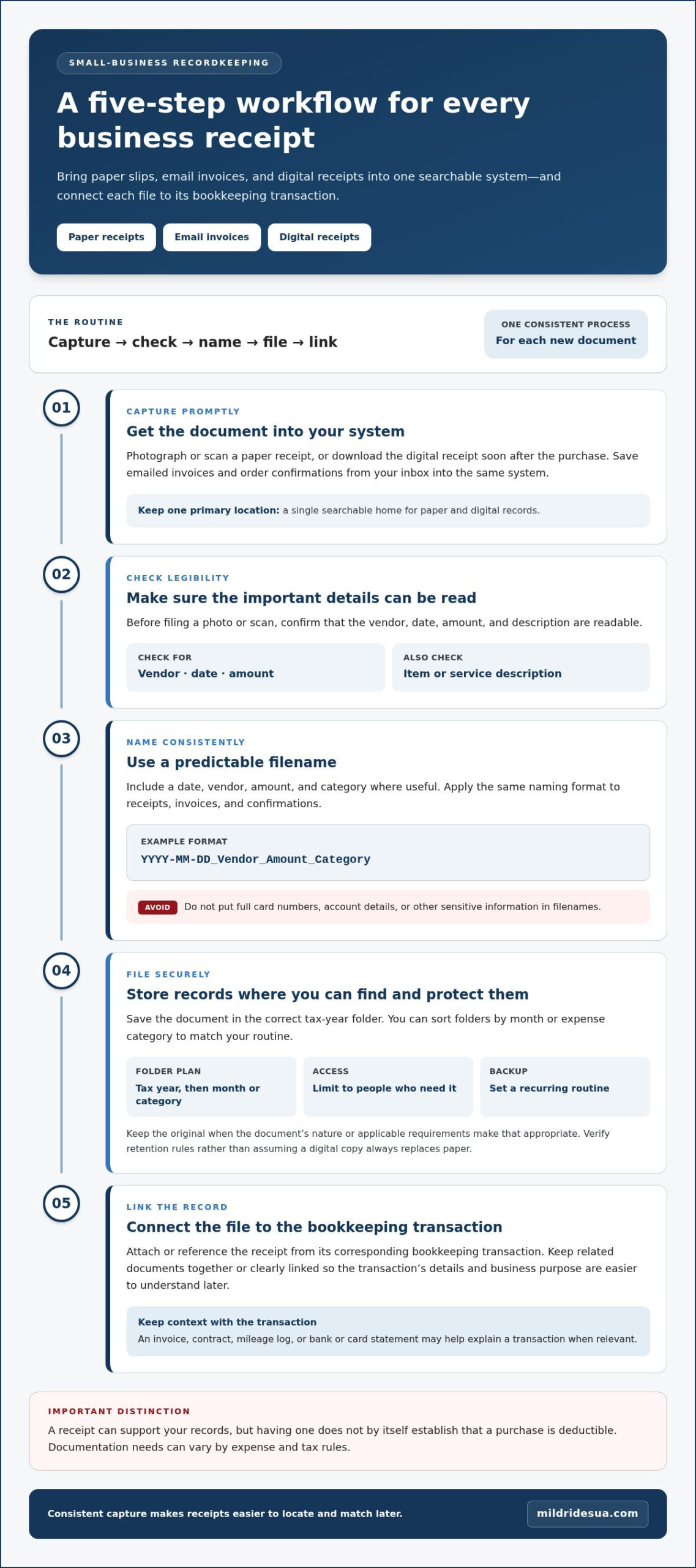
Use this five-step workflow for each new document:
- Capture promptly: Photograph, scan, or download the receipt soon after the purchase.
- Check legibility: Confirm the vendor, date, amount, and description can be read.
- Name consistently: Include a date, vendor, amount, and category where useful, without sensitive account details.
- File securely: Save it in the correct tax-year folder and maintain a backup.
- Link it: Attach or reference the file from the corresponding bookkeeping transaction.
A practical receipt workflow is to capture, name, file, and match every document using the same routine. Mildrid Esua, CPA, PLLC provides small-business bookkeeping support to help keep records connected to transactions.
Categorizing Receipts and Matching Business Transactions
A receipt becomes more useful when it’s connected to the right bookkeeping category and transaction. Keep categories aligned with the system you already use, so your records remain consistent from purchase through tax preparation. Examples might include supplies, travel, software, and professional services. These are organizational labels, not a determination that an expense is deductible.
Choose Expense Categories That Stay Consistent
Start with the categories in your books or accounting system. Avoid creating a separate category for each vendor or minor purchase; a stable structure makes records easier to review and compare. If a transaction doesn’t fit clearly, flag it for follow-up instead of guessing. For questions about tax treatment, refer to current guidance or your business’s tax professional.
Different supporting documents answer different questions:
| Document | What it helps show |
|---|---|
| Receipt | Items or services purchased, amount, date, and vendor |
| Invoice | Charges and details of work or goods billed |
| Bank or card statement | Payment activity and transaction date |
| Mileage log | Travel details recorded for a vehicle trip |
Match Receipts to Card, Bank, and Cash Transactions
On a regular schedule, compare saved receipts with bank, card, and cash activity. Match each document to the corresponding entry, then mark transactions with missing support so they don’t disappear into a pile of unresolved items. A card charge may confirm that payment occurred, while the receipt or invoice explains the purchase.
For cash purchases, record the date, amount, vendor, and business purpose promptly, then keep that note with any available supporting document. Review differences before closing the period. A duplicate charge, refund, or partial receipt may require a note or correction so the books reflect what actually happened.
Some purchases serve both personal and business purposes. Record only the business portion according to the applicable method, and retain the calculation or other support showing how you arrived at that amount. For example, if a shared service is used for both purposes, document the basis for the business share rather than assigning the full cost automatically. The appropriate treatment depends on the expense and relevant tax rules.
For owners learning how to organize receipts for taxes small business records, the goal is a clear trail from document to category to transaction. Consistent matching helps you identify gaps and gives bookkeeping and tax preparation a more reliable foundation.
A Monthly Receipt Review Checklist for Small Businesses
A short month-end review can keep receipt records current and make bookkeeping and tax preparation more manageable. Missing documents are often easier to track down while the vendor, purchase, or business purpose is still familiar. Set a recurring time to review the month’s activity instead of leaving every question for year-end.
A Repeatable Month-End Receipt Checklist
Work through the same steps each month. The aim is to close gaps and flag questions, not to force an uncertain classification or tax conclusion.
- Capture: Save paper receipts, email invoices, and other supporting documents in your primary filing location.
- Categorize: Assign each transaction to a consistent bookkeeping category, and flag items that need review.
- Match: Attach or cross-reference suitable documentation to each recorded expense.
- Investigate gaps: Review missing receipts, uncategorized entries, refunds, and possible duplicate transactions. Note unresolved items and who will follow up.
- Back up: Save a dated copy of the updated records using your established backup routine.
Keep business and personal purchases distinct in your records. If a purchase includes both, document the business portion and retain the calculation or other support for how you determined it. For an employee or owner reimbursement, record the business expense and reimbursement clearly so the records show what was paid and how it was settled.
A consistent monthly process can bring financial activity into view before tax deadlines approach. Mildrid Esua, CPA, PLLC provides monthly bookkeeping for small businesses. Organized receipt records can also inform planning conversations alongside strategic tax planning for NC entrepreneurs.
How Long Should Small Businesses Keep Receipts?
There isn’t one retention period that applies to every business record and circumstance. Federal record-retention periods can vary based on the document and tax situation; payroll, employment, state, and legal records may also have separate requirements. Verify current IRS guidance and any other applicable requirements before setting a destruction schedule. Until you’ve confirmed the rules that apply, avoid treating a general timeframe as universal.
Building a routine is a practical first step in organizing the receipts small business owners need to maintain throughout the year. Regular review keeps documentation connected to the books and gives unresolved items a clear place for follow-up.
When Receipt Organization Calls for Bookkeeping or Tax Support
A receipt system should make financial activity easier to understand, not create another source of uncertainty. Repeated missing documents, transactions that stay unresolved from month to month, or a major year-end scramble are signs that your current process may need attention. These patterns can make it harder to see what a transaction was for and leave important questions until tax preparation is underway.
What Organized Receipts Help a Bookkeeper or CPA Review
Clear documentation gives a bookkeeper or CPA context for reviewing expenses, reconciling transactions, and following up on purchases that aren’t easy to classify. A receipt connected to its bookkeeping entry can help clarify what was purchased, when it occurred, and how it relates to business activity. If a detail is unclear, a note or related invoice can give the reviewer a useful starting point.
Maintained records can also reduce avoidable back-and-forth during tax preparation. Rather than searching across inboxes and devices for missing paperwork, you can provide a more organized record for review. Documentation supports professional analysis, but it doesn’t guarantee a particular tax treatment or result. Questions about classification or tax rules still require appropriate review.
Build a More Consistent Small-Business Recordkeeping Routine
Choose one primary way to capture receipts, use a consistent filing structure, and schedule regular reviews. If the routine repeatedly breaks down, a bookkeeping professional can help bring transactions and supporting documents into a more orderly process. Mildrid Esua, CPA, PLLC provides small-business bookkeeping and tax preparation, supporting owners who want to maintain organized records throughout the year.
That consistency can be useful beyond filing season. A clearer view of income and expenses gives you a stronger basis for discussing business decisions and planning ahead. The firm’s business tax planning and preparation supports a year-round approach, alongside small-business bookkeeping.
Key takeaway: Organized receipts support informed review and business decisions throughout the year, not only tax filing. A manageable routine, paired with bookkeeping or tax support when needed, can help keep your records connected and easier to understand.
Make Your Receipt System Work All Year
A manageable routine can turn receipt filing from a tax-season scramble into a steady part of running your business. Capture receipts promptly, keep them in one consistent location, and connect each document to its bookkeeping transaction. A monthly review helps you spot missing information while details are still fresh.
That’s the practical foundation of how to organize receipts for taxes small business owners can maintain: preserve the context behind each expense, use consistent categories, and keep records ready for review. Organized documentation supports more than tax filing. It can help you understand business activity and prepare for informed bookkeeping and planning conversations throughout the year.
Mildrid Esua, CPA, PLLC provides bookkeeping for small businesses, along with tax preparation and planning. A consistent system can make records easier to review and help prepare for tax needs.
Start with one simple habit and build from there. Consistency can make your records clearer and easier to manage throughout the year.
Frequently Asked Questions
What is the easiest way to organize receipts for small-business taxes?
A simple routine is to save each receipt in one secure digital location, use consistent filenames, and link it to the matching bookkeeping transaction. A practical answer to “how to organize receipts for taxes small business” owners can follow is to capture, categorize, match, and review documents regularly. Choose folders that fit your bookkeeping habits, such as tax year and month, and set a recurring time to check for missing records.
Do small businesses need to keep every receipt for taxes?
Not necessarily every paper slip, but you should keep records that adequately support business expenses and explain their amount, timing, payee, and purpose. The documentation needed can vary by expense and applicable tax rules, so don’t assume the same receipt requirement applies to every transaction. Keep relevant invoices, statements, logs, or other supporting records with the expense, and verify current IRS guidance for situations where requirements are unclear.
Can I use digital copies of business receipts for taxes?
Yes. The IRS accepts electronic records when they’re legible, accurate, and can be retrieved and reproduced. Scan or photograph paper receipts clearly, check that key details are readable, and store files in a secure location with a backup. Use a consistent naming method and connect the digital copy to its bookkeeping transaction. Keep paper originals when the document’s nature or applicable rules make retaining them appropriate.
How should I organize receipts in QuickBooks or bookkeeping software?
Use the receipt-capture or document-attachment features available in your software to associate each receipt with the corresponding transaction. Apply categories that match the business’s existing chart of accounts rather than creating a new category for each vendor. Review uncategorized entries and confirm that dates and amounts align. If a transaction has no matching document, flag it for follow-up instead of treating the statement entry as a complete explanation.
Are bank statements enough to prove small-business expenses?
A bank or card statement helps show that a payment occurred, but it may not explain what you bought or why it was for the business. A merchant name and charge amount alone can leave important context unclear. Keep a receipt, invoice, or other relevant supporting document when appropriate, and add a business-purpose note if the document doesn’t make that connection evident. Documentation needs depend on the expense and applicable tax rules.
How long should a small business keep tax receipts?
Retention periods vary by record type and tax circumstances. IRS guidance generally calls for keeping records supporting a filed return for at least three years after filing, while some situations call for longer periods. Employment tax records generally require four years; certain claims may require seven. Records related to fraudulent or unfiled returns may need to be kept indefinitely. Verify current IRS guidance and separate state, payroll, or legal requirements before discarding records.
What should I do if I lost a business receipt?
First, ask the vendor for a duplicate receipt or invoice, then check email confirmations and order histories. Keep related records, such as a bank or card statement, and write a dated note describing the purchase and its business purpose while you still remember the details. These records may help explain the transaction, but they don’t guarantee it meets every substantiation rule. Ask your tax professional how to handle the specific expense.
Should I organize receipts monthly or once a year?
Reviewing receipts monthly is usually more manageable than waiting until tax season. Capture documents as purchases occur, then use a month-end review to categorize transactions, match supporting records, investigate gaps, and back up files. Prompt follow-up makes details easier to recall. Mildrid Esua, CPA, PLLC provides bookkeeping and tax preparation for small businesses, including owners in Greensboro, High Point, Burlington, Kernersville, Jamestown, Oak Ridge, Summerfield, and Winston-Salem who want support maintaining organized records throughout the year.




Leave a Reply
Your email is safe with us.