


When transactions are uncategorized, accounts unreconciled, or statements, receipts, and invoices are missing, it can be hard to see current cash flow or know where tax filings stand. The pressure to clear the backlog quickly is understandable, but a data-entry sprint can leave important gaps unresolved. Catch up bookkeeping for businesses works best as a controlled reconstruction, not a rush through old transactions.
This practical 2026 guide shows you how to assess the backlog, gather and organize source documents, rebuild and reconcile records, and review the results. You’ll also learn how organized books can support tax preparation and business decisions, and how to establish a repeatable monthly process so the backlog doesn’t return. With bookkeeping connected to small-business accounting and tax planning, the goal is more than closing out old months: it’s restoring clarity you can use going forward.
Key Takeaways
- Use warning signs such as unclear balances, delayed reports, and unreconciled accounts to assess the backlog and set priorities.
- Approach catch up bookkeeping for businesses as a structured reconstruction: define the periods, gather records, categorize transactions, reconcile accounts, and review results.
- Handle missing paperwork by distinguishing verified transactions from estimates, unresolved items, and questions that need your follow-up.
- Prepare statements, receipts, account access, and open questions in an organized checklist, while keeping business and personal activity distinguishable.
- Turn reconciled opening balances into a repeatable monthly routine for reviewing accounts, reports, payroll records, and outstanding questions.
Catch-Up Bookkeeping for Businesses: Recognize the Backlog and Set Priorities
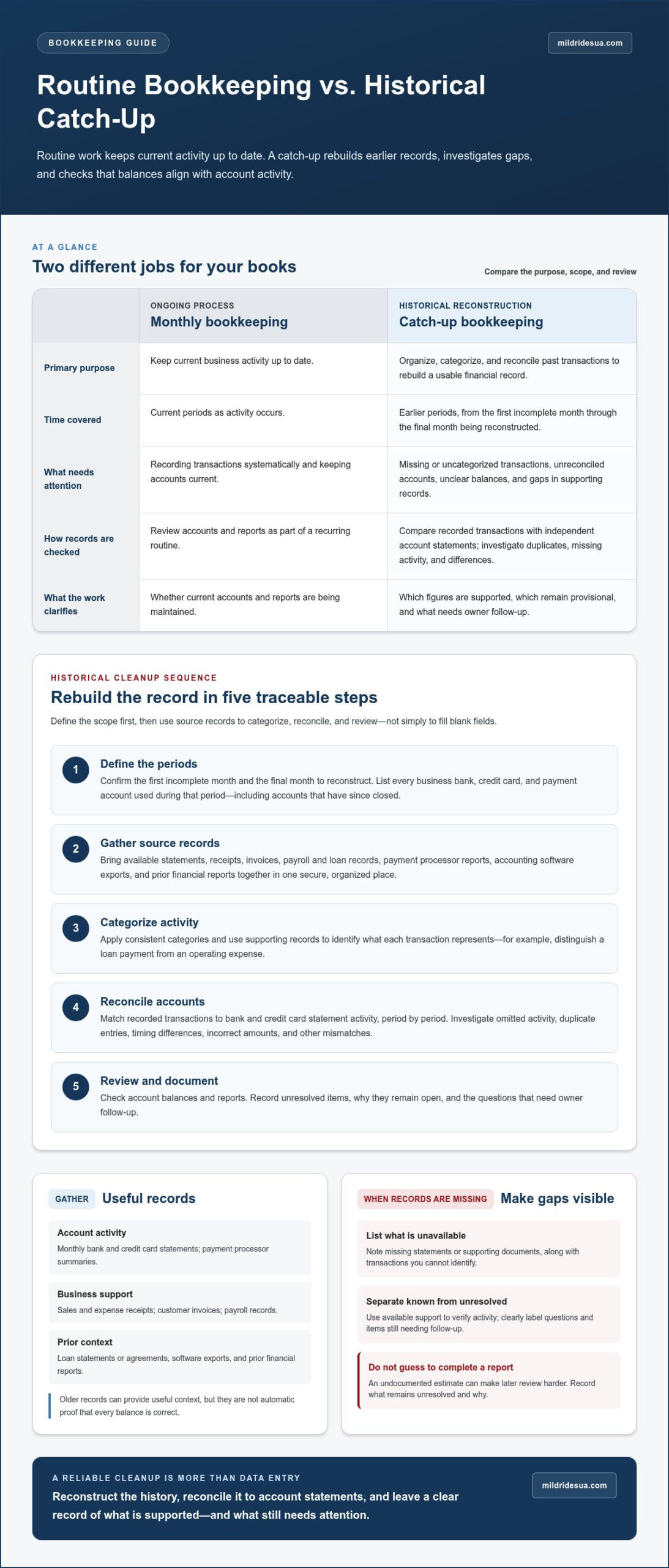
Catch-up bookkeeping is the process of organizing, categorizing, and reconciling past business transactions to rebuild a usable financial record. Routine monthly bookkeeping keeps current activity up to date. Historical cleanup works through earlier periods and investigates gaps or discrepancies. The basic role of bookkeeping is to record financial transactions systematically; catch-up work also verifies that the historical record aligns with available account activity.
If reports are delayed, account balances are unclear, or tax records are incomplete, the problem may be more than a few late entries. Unreconciled bank or credit card accounts make it difficult to know whether recorded balances reflect actual activity. Outdated reports can conceal current cash flow and profitability, making decisions about spending, hiring, or tax preparation less dependable.
For a visual overview of the process, watch this video:
How do you know your business books need catching up?
Look for missing monthly reconciliations, transactions sitting uncategorized, unexplained differences between your books and account statements, or reports that stop before the current period. A few late entries may fit into regular bookkeeping. A cleanup is different when multiple periods need review or balances must be traced to supporting records. There’s no universal month-count threshold; the condition of the records and the decisions they need to support matter more.
What should an owner establish before cleanup begins?
Start by identifying the earliest period you believe is incomplete. Then list every business bank account, credit card, and payment account used during that period, including accounts that have since closed. This defines the scope and helps prevent activity from being overlooked.
Next, separate urgent filing or reporting deadlines from preferences such as receiving updated monthly reports. Gather available statements, receipts, invoices, payroll records, and prior bookkeeping files in one secure, organized place. Note missing documents and open questions rather than guessing. This gives catch up bookkeeping for businesses a defined starting point and directs attention to the records that matter most.
How Catch-Up Bookkeeping Reconstructs and Reconciles Business Records
Reliable cleanup follows a traceable sequence, not a rush to fill blank fields. Bank and credit card statements show activity in the accounts, while receipts, invoices, payroll records, loan documents, and payment processor reports help explain what each transaction represents. A small business bookkeeping guide can provide a broader overview of bookkeeping practices, but historical reconstruction also requires documenting gaps and investigating mismatches.
Reconciliation compares recorded transactions with independent account statements. Matching activity this way can reveal duplicate entries, missing transactions, and differences to resolve before relying on financial reports.
Which records help rebuild the books?
Gather monthly bank and credit card statements, sales and expense receipts, customer invoices, payroll records, loan statements or agreements, and payment processor summaries. Accounting software exports and prior financial reports can help establish opening balances and show how accounts were previously categorized. Treat older records as useful context, not automatic proof that every balance is correct.
Keep a list of statements or supporting documents you can’t locate, along with questions about transactions you can’t identify. Don’t estimate an amount just to make a report appear complete. A documented open item can be investigated; an undocumented assumption can make later review harder.
How are transactions matched and unresolved items handled?
Once the cleanup periods and records are assembled, work through the following sequence:
- 1. Define the periods. Confirm the first incomplete month and the final month to reconstruct.
- 2. Gather source records. Collect statements, receipts, invoices, payroll and loan records, processor reports, and available software exports.
- 3. Categorize activity. Apply consistent categories and use supporting records to distinguish, for example, a loan payment from an operating expense.
- 4. Reconcile accounts. Match recorded transactions to statement activity, period by period, and investigate differences.
- 5. Review results. Check account balances and reports, then document unresolved items and questions requiring owner follow-up.
A transaction in a bank feed may still need an invoice or receipt to clarify its business purpose. If a statement balance doesn’t agree with the books, check for omitted activity, duplicate entries, timing differences, or incorrect amounts. Record what remains unresolved and why; don’t treat an unexplained difference as settled simply because the period is old.
After historical records are reconstructed, a consistent review routine helps keep accounts current. Explore monthly bookkeeping for small businesses as the next step toward maintaining reconciled records and dependable reports.
What Accurate Catch-Up Bookkeeping Can, and Cannot, Resolve
A completed cleanup should make clear which figures are supported, which remain provisional, and what needs the owner’s attention. Missing paperwork creates follow-up work, but it doesn’t automatically make a cleanup impossible. Bank statements, payment records, and other available evidence may help reconstruct activity. Document gaps rather than hiding them behind unsupported assumptions.
Reliable reports depend on reconciled accounts and documented exceptions. A report can be organized and useful without every open question being resolved, as long as its limitations are visible.
| Finding | What it means | Next step |
|---|---|---|
| Reconciled record | Recorded activity agrees with the available account statement or supporting source. | Use it as a verified part of the financial picture. |
| Estimate | An amount is based on an assumption rather than complete supporting evidence. | Label it clearly and identify what could verify or revise it. |
| Missing evidence | A transaction appears in an account, but a receipt, invoice, or other detail is unavailable. | Record the gap and seek supporting documentation or an explanation. |
| Owner follow-up | The transaction’s business purpose or treatment needs the owner’s clarification. | Keep the question open until the owner provides context. |
How does catch-up bookkeeping support tax preparation?
Organized income and expense records give a tax preparer a clearer foundation for reviewing business activity and identifying questions that need attention. They don’t, on their own, determine a particular tax result or constitute a filed return. Bookkeeping organizes what happened; tax preparation and filing involve separate review and decisions. For a forward-looking perspective, see strategic tax planning for businesses.
What if records reveal unfiled returns or an IRS concern?
Separate the bookkeeping task from resolving a tax notice, liability, or unfiled return. Reconstructed, documented books can clarify the financial history for professional review, but cleanup alone doesn’t resolve an IRS matter or determine how it should be addressed. If catch up bookkeeping for businesses brings an IRS issue into view, treat it as a distinct next step and explore IRS tax resolution services.
A Practical Catch-Up Bookkeeping Checklist for North Carolina Businesses
A well-prepared records package makes cleanup more orderly and reduces avoidable back-and-forth. For small businesses in Greensboro, High Point, Burlington, Kernersville, Jamestown, Oak Ridge, Summerfield, and Winston-Salem, use this sequence to define the review and surface gaps before reconstruction begins.
What should you gather before a bookkeeping review?
- Set the period. Write down the earliest month that may be incomplete and the final month to review. Note urgent filing or reporting needs separately from preferred report dates.
- Collect financial records. Gather bank and credit card statements, receipts, invoices, payroll summaries, accounting files or exports, and prior financial reports. Include records for accounts that have since closed.
- Map changes and unusual activity. Note changes in bookkeeping systems, new or closed accounts, loans, transfers, owner contributions, reimbursements, and transactions that may need explanation.
- Track missing items. Create a simple list with the account, period, transaction amount if known, missing record or question, and follow-up status. This makes gaps visible instead of letting them disappear into the cleanup.
How can owners protect the accuracy of the cleanup?
Provide context for ambiguous activity. A transfer between accounts, for example, isn’t necessarily income or an expense; an owner contribution or reimbursement also needs clear identification. Keep business and personal activity distinguishable during review, and flag mixed transactions for explanation rather than assigning a business category without support.
Review exception lists promptly. If a receipt is missing or a transaction’s purpose is unclear, share what you know and keep the item marked as unresolved until it’s supported. Don’t present an unsupported estimate as a confirmed fact. Secure account access and share only the records and permissions needed for the bookkeeping review.
North Carolina tax records may form part of the documentation to organize, but a bookkeeping checklist isn’t legal or tax advice. Keep relevant state tax notices, payment records, and prior filings with the other financial documents. Verify current requirements that apply to your business rather than relying on assumptions about deadlines or obligations.
Preparing these details gives catch up bookkeeping for businesses a clearer scope and supports a more dependable handoff from historical cleanup to ongoing accounting. Mildrid Esua, CPA, PLLC provides bookkeeping support alongside small-business accounting and tax preparation. Learn more about small-business bookkeeping support.
From Catch-Up Bookkeeping to Ongoing Small-Business Accounting
Once historical activity has been reviewed, reconciled opening balances and documented exceptions give monthly bookkeeping a sound starting point. Carry forward what’s been verified, keep unresolved questions visible, and prevent new activity from accumulating into another backlog. Catch up bookkeeping for businesses is most valuable when it leads to a consistent process for maintaining reliable records.
What changes after the historical records are organized?
A regular close cycle keeps new transactions categorized and accounts reconciled as statements become available. A practical review can include:
- Checking bank and credit card reconciliations for differences that need follow-up.
- Reviewing financial reports for unusual balances, changes, or gaps in information.
- Comparing payroll records with the entries reflected in the books.
- Following up on open owner questions and carrying forward documented exceptions until they’re resolved.
With current records, owners can review cash flow and business performance for a defined period rather than relying on reports that lag behind activity. That visibility can support more informed operational decisions. It also creates a more orderly foundation for tax preparation, though bookkeeping alone doesn’t guarantee a particular tax outcome.
How can a CPA-led accounting relationship support the next stage?
For a small business, bookkeeping is connected to more than recording transactions. Mildrid Esua, CPA, PLLC provides bookkeeping alongside small-business accounting, tax preparation and planning, and payroll services. Connecting organized financial records with tax preparation and business planning can help address questions as a business’s needs change.
Rather than treating cleanup as a one-time data-entry task, establish a routine for reconciliations, reports, payroll records, and unresolved questions. This creates continuity between historical review and ongoing financial oversight for businesses in Greensboro, High Point, Burlington, Kernersville, Jamestown, Oak Ridge, Summerfield, and Winston-Salem.
If you’re ready to move from a bookkeeping backlog toward a dependable monthly process, discuss your business bookkeeping needs.
Turn Rebuilt Books Into a Stronger Financial Routine
Overdue books can be restored through a careful process: define the periods to review, use available records to reconstruct activity, and reconcile accounts before relying on reports. Keep estimates, missing evidence, and owner follow-up questions clearly documented. This helps distinguish verified financial information from items that still need attention.
The value of catch up bookkeeping for businesses extends beyond closing out old transactions. Reconciled opening balances create a practical foundation for consistent monthly reviews, useful cash flow and performance reports, and better-organized information for tax preparation. The next step is maintaining that clarity with a repeatable process.
Mildrid Esua, CPA, PLLC offers bookkeeping alongside small-business accounting and tax services. For businesses in Greensboro, High Point, Burlington, Kernersville, Jamestown, Oak Ridge, Summerfield, and Winston-Salem, that connection can support a transition from historical cleanup to ongoing financial management. Discuss your business bookkeeping needs and identify a practical next step for your records.
Frequently Asked Questions
What is catch-up bookkeeping for a business?
Catch-up bookkeeping organizes, categorizes, and reconciles past business transactions so the records provide a more reliable view of financial activity. It differs from routine monthly bookkeeping because it reviews historical periods, checks entries against available statements and supporting documents, and identifies unresolved questions. The result should distinguish verified balances from missing evidence or estimates, giving owners a clearer starting point for business decisions and tax preparation.
How far back can a business catch up its bookkeeping?
A business can work back through any period for which records need reconstruction, but there’s no universal cutoff. The scope depends on how far back the books are incomplete, what source documents remain available, and whether earlier balances or filings need review. Start by identifying the earliest uncertain period and any urgent reporting needs. A clear timeline helps define the work without assuming every business’s backlog is the same.
What records do I need for catch-up bookkeeping?
Gather bank and credit card statements, receipts, invoices, payroll summaries, loan records, payment processor reports, accounting software files, and prior financial reports. Include records for closed accounts or periods when you changed bookkeeping systems. Complete documentation makes it easier to investigate transactions and reconcile balances. Keep a separate list of missing records and unanswered questions rather than treating unverified amounts as confirmed.
Can a bookkeeper catch up my books if I am missing receipts?
Yes, missing receipts don’t automatically prevent a cleanup, but they can leave transactions requiring investigation or owner follow-up. Bank statements, invoices, processor records, and other available documentation may help explain activity. Keep unsupported amounts or uncertain business purposes clearly identified instead of guessing. The books can show what’s verified and what remains unresolved, helping you understand which gaps need more evidence before relying on related reports.
How long does catch-up bookkeeping take?
The timeline depends on the number of periods involved, transaction volume, account complexity, condition of existing records, and how quickly missing documents or owner answers become available. A short backlog with complete statements may move differently from a multi-period reconstruction involving closed accounts or unclear balances. Define the periods and gather available records first. That gives the review a practical scope, though it doesn’t establish a universal completion time.
Does catching up bookkeeping automatically file overdue tax returns?
No. Catch-up bookkeeping organizes and reconciles financial records, but it doesn’t automatically prepare or file overdue tax returns. Organized books may support tax preparation by clarifying income, expenses, and open questions for review. Filing decisions and IRS concerns are separate matters. If cleanup brings an unfiled return or tax notice to light, identify it as a distinct next step and address it through tax preparation or tax resolution support.
How do I keep my business books from falling behind again?
Set a recurring monthly routine to categorize activity, reconcile bank and credit card accounts, review reports, check payroll records, and follow up on open questions. Keep statements and receipts organized as they arrive, and document unusual transactions such as owner contributions or transfers. For small businesses in Greensboro, High Point, Burlington, Kernersville, Jamestown, Oak Ridge, Summerfield, and Winston-Salem, consistent bookkeeping can help keep financial information current for ongoing accounting, business decisions, and tax preparation.




Leave a Reply
Your email is safe with us.