

What if your largest annual expense wasn’t a mandatory loss, but a strategic asset you could reinvest into your next expansion? Many Greensboro and High Point entrepreneurs feel they’re working harder only to be penalized with higher liabilities and the constant anxiety of a potential IRS audit. It’s frustrating to watch your growth capital disappear into self-employment taxes because of outdated entity structures. Unlike the traditional approach of looking backward at tax time, strategic tax planning for businesses allows you to act as an architect of your own financial future. We believe that vigilant stewardship of your resources is the only way to ensure long-term stability.
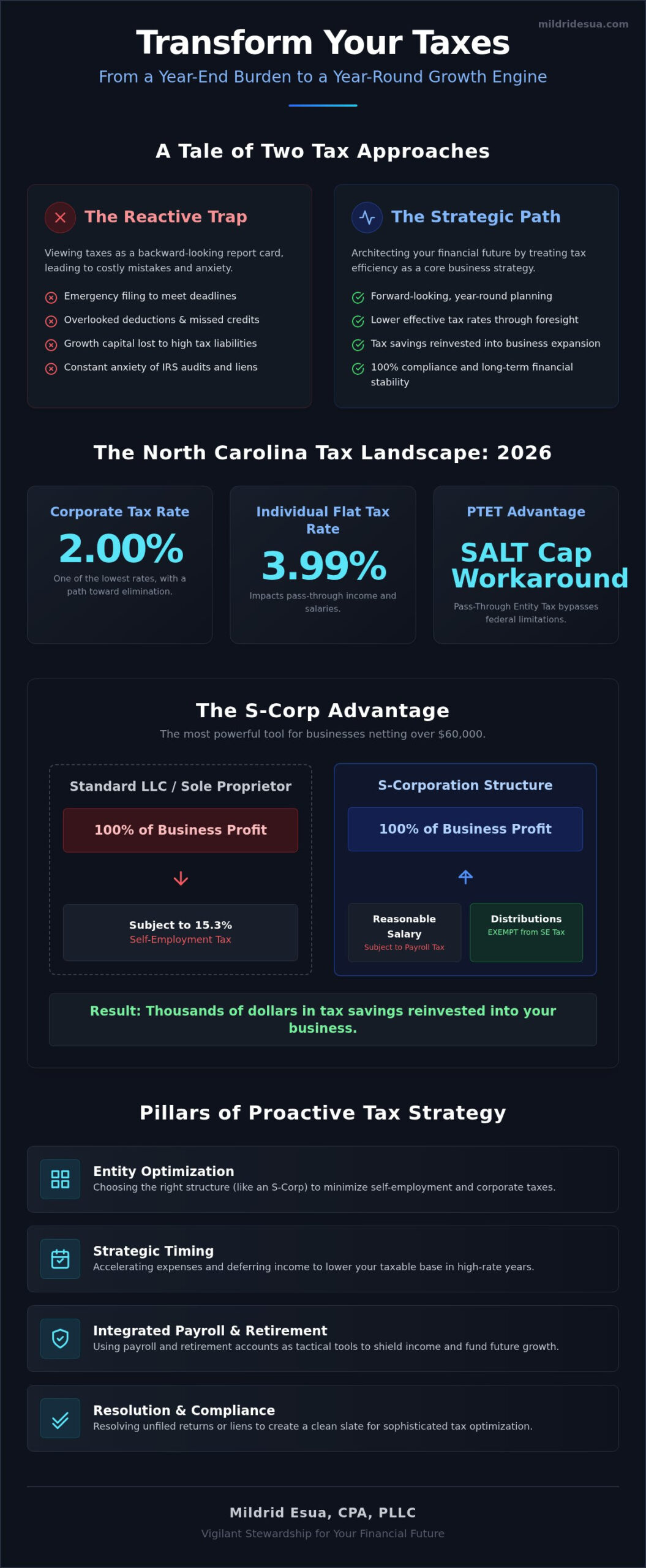
You’ve likely felt the weight of unresolved back taxes or the confusion of S-Corp elections, but these challenges don’t have to define your 2026 fiscal year. This guide promises to transform your tax obligations from a year-end burden into a year-round growth engine using expert North Carolina insights. We’ll explore how the 2.00% corporate tax rate and the 3.99% individual flat tax impact your bottom line. You’ll learn exactly how to lower your effective tax rate, maintain 100% compliance to avoid liens, and use your tax savings to fuel your business’s next chapter.
Key Takeaways
- Move beyond reactive filing by adopting a forward-looking architecture that treats tax efficiency as a year-round growth strategy.
- Implement strategic tax planning for businesses by optimizing entity selection and timing revenue recognition to lower your 2026 effective tax rate.
- Navigate North Carolina’s unique landscape by utilizing the Pass-Through Entity Tax (PTET) to bypass federal SALT caps and access local credits.
- Transition payroll and retirement planning from clerical tasks into tactical tools that protect your income and fund your business’s future expansion.
- Secure your financial stability by resolving unfiled returns or liens, ensuring a clean slate for sophisticated tax optimization.
The Foundation of Tax Efficiency: Why Strategic Planning Trumps Reactive Filing
Most Greensboro entrepreneurs view their tax return as a final report card, a static document that looks backward at the previous year’s performance. Real strategic tax planning for businesses is fundamentally different; it’s a forward-looking architecture designed to shape your financial future rather than just recording your past. Unlike a traditional tax preparer who only appears in April, a “Vigilant Guide” maintains constant attention on your operations. This proactive methodology creates “Tax Alpha,” which represents the tangible value added through expert structural decisions and timing rather than mere compliance. By treating The Foundation of Tax Efficiency as a year-round priority, you transform your relationship with the IRS from one of anxiety to one of strategic intent.
The Reactive Trap: The High Cost of Waiting Until April
Waiting until the year ends to consider your tax position is a costly mistake. When you fall into the reactive trap, you’re forced into “emergency filing,” where the primary goal is simply meeting a deadline. This haste often leads to overlooked deductions and missed credits that require foresight to claim. You can’t build a sophisticated future strategy while burdened by unresolved issues. A critical part of our stewardship involves clearing the path first. If you’re dealing with unfiled returns or tax liens, those must be resolved before proactive optimization can begin. Without a clean slate, even the most brilliant strategy remains fragile and vulnerable to IRS intervention.
The Growth Partner Mindset: Integrating Taxes into Business Strategy
Integrating tax considerations into your daily business strategy changes how you approach every major decision. In 2026, tax planning should inform your capital expenditures, equipment leases, and even your hiring timeline. For example, knowing the impact of the 3.99% flat tax rate in North Carolina allows you to project cash flow with higher precision. This level of insight requires more than just an annual meeting; it demands the real-time data provided by professional bookkeeping. We define tax stewardship as the continuous protection of business assets through informed, deliberate action. When your financial records are maintained with a growth partner’s eye, you’re always prepared to pivot or reinvest without the fear of an unexpected tax bill.
Core Strategies for 2026: Deductions, Deferrals, and Entity Optimization
The 2026 legislative landscape presents a unique set of opportunities for Greensboro entrepreneurs who prioritize foresight over reaction. As North Carolina continues its methodical path toward eliminating corporate income tax, the rate for 2026 sits at 2.00%, while the individual flat tax rate is 3.99%. Mastering strategic tax planning for businesses in this environment requires a deep understanding of Core Strategies for 2026, particularly regarding the timing of revenue recognition. By accelerating necessary capital expenses into the current year while deferring specific income streams, you can effectively lower your taxable base during years with higher relative rates. This isn’t about evasion; it’s about the sophisticated architecture of your financial timeline.
S-Corp Election: The Most Powerful Tool for Small Business Owners
For many local businesses netting over $60,000, the transition from a standard LLC to an S-Corp remains one of the most effective ways to preserve capital. Unlike a sole proprietorship where every dollar of profit is subject to the 15.3% self-employment tax, an S-Corp allows you to bifurcate your income into a reasonable salary and shareholder distributions. Only the salary portion attracts payroll taxes, which can save thousands of dollars that are better used for business expansion. Managing this transition requires a steady hand to ensure compliance with IRS salary standards, which is why S-Corp optimization is a cornerstone of our advisory partnership. We ensure your salary is defensible while maximizing the distributions that remain exempt from self-employment levies.
International Tax Planning & FIRPTA Stewardship
Greensboro’s growing economy increasingly attracts international investment, bringing complex requirements like FIRPTA into play. Foreign investors often face a 15% withholding trap on the gross sales price of U.S. real property, a significant blow to liquidity. We act as a vigilant guide in these transactions, helping clients secure a FIRPTA Certificate of Withholding to reduce or eliminate this requirement based on actual tax liability. Beyond real estate, cross-border planning for 2026 involves navigating the intersection of NC’s low-tax environment and federal international reporting standards. Proper stewardship ensures that global operations don’t lead to local complications. By addressing these international nuances early, you protect your global interests from redundant taxation and ensure long-term stability.
Navigating North Carolina Specifics: SALT Cap Workarounds and Local Incentives
North Carolina’s tax environment is intentionally designed to reward growth, but capturing these benefits requires more than just knowing the rates. While the state’s move toward a 2.00% corporate tax rate in 2026 signals a business-friendly trajectory, the real advantages lie in the technical nuances of the state code. Effective strategic tax planning for businesses in the Piedmont Triad means looking beyond federal returns to leverage state-level elections that competitors often overlook. This is where we act as your Strategic Architect, building a framework that shields your income from unnecessary erosion while ensuring you remain a compliant, respected entity in the Greensboro business community.
The NC PTET Election: A Game-Changer for High-Income Owners
The federal State and Local Tax (SALT) deduction cap remains a significant hurdle for high-earning business owners, even with the 2026 increase to $40,400. North Carolina’s Pass-Through Entity Tax (PTET) election offers a sophisticated workaround by allowing the business to pay state income tax at the entity level. This means the tax paid becomes a deductible business expense on your federal return, effectively bypassing the individual $10,000 or $40,400 limit. To qualify for this election, your entity must be a partnership or an S-Corporation where all owners are qualifying individuals, estates, or trusts. This strategy illustrates why essential tips for corporate tax efficiency must always include state-specific maneuvers that align with your broader federal goals.
Regional Compliance: From Burlington to Kernersville
Operating across Greensboro, Winston-Salem, and High Point introduces layers of local complexity that you can’t ignore. Each municipality has distinct expectations for business privilege licenses and property tax filings that require constant attention. Unlike a distant firm, we understand the Winston-Salem business climate and how it differs from the manufacturing-heavy landscape of High Point. Your compliance needs change as you grow, and we provide the vigilant stewardship needed to manage these multi-city obligations. Consider these regional factors for 2026:
- Greensboro Startups: Focus on R&D credits and local grants that support innovation.
- High Point Manufacturers: Prioritize accurate property tax valuations for heavy machinery and inventory.
- Piedmont Triad Service Providers: Ensure multi-jurisdiction nexus compliance to avoid unexpected local audits.
Maintaining compliance in every jurisdiction where you operate isn’t just about avoiding penalties. It’s about building a reputation for stability and foresight that supports your long-term growth trajectory. By integrating local incentives into your strategic tax planning for businesses, you ensure that every dollar saved is a dollar that can be reinvested into your local operations.
Integrating Payroll and Retirement: Building a Year-Round Tax Shield
Many Greensboro entrepreneurs mistake payroll for a mere clerical obligation, yet it’s actually one of the most potent levers in strategic tax planning for businesses. When managed with foresight, your payroll structure becomes a tactical tool that directly influences your Qualified Business Income (QBI) deduction. This 20% deduction is a significant benefit, but it’s often limited by the amount of W-2 wages your business pays. We don’t just process checks; we architect a compensation strategy that balances your personal income needs with the technical requirements of the tax code. It’s a delicate balance. This synergy between payroll and tax efficiency is only possible when supported by meticulous, real-time bookkeeping that provides a clear view of your profit margins throughout the year.
Strategic Payroll: Managing the S-Corp Salary-to-Distribution Ratio
Finding the “sweet spot” for owner compensation is an exercise in vigilant stewardship. Unlike generic payroll software that applies a one-size-fits-all percentage, we analyze your specific industry benchmarks to determine a “reasonable salary” that stands up to IRS scrutiny. In 2026, staying mindful of payroll tax limits is essential for high-earning NC business owners who want to avoid unnecessary tax leakage. By carefully calibrating your salary-to-distribution ratio, you can significantly reduce your self-employment tax burden while maintaining full compliance. This proactive management prevents the common year-end surprises that plague businesses relying on reactive, automated systems. If you’re ready to optimize your compensation structure, our integrated payroll and tax services provide the steady hand you need to navigate these complexities.
Retirement as a Tax Shelter: Selecting the Right Plan
Retirement planning in 2026 offers more than just a path to future stability; it’s an immediate shield against high taxable income. For the solo entrepreneur or the small firm in High Point, the choice between a SEP IRA, a Solo 401(k), or a SIMPLE IRA depends entirely on your headcount and growth trajectory. For 2026, the maximum employee contribution to a 401(k) has increased to $24,500, with an additional $8,000 catch-up for those aged 50 and over. Those between 60 and 63 can contribute even more, with a catch-up limit of $11,250. Advanced strategies like the “Mega Backdoor Roth” can allow successful owners to move even larger sums into tax-advantaged environments. We help you evaluate these options not as isolated products, but as integral components of your broader wealth-protection strategy. This level of customization ensures that your retirement plan serves your current tax goals as much as your long-term legacy.
The Mildrid Esua Advantage: Resolving the Past to Protect the Future
Future growth is impossible when it’s anchored by past burdens. Many Greensboro entrepreneurs find that their vision for expansion is clouded by the weight of unfiled returns or the looming threat of an IRS audit. True strategic tax planning for businesses cannot exist in a vacuum; it requires a foundation of absolute compliance. We act as your Strategic Architect, first identifying and dismantling the obstacles that prevent you from moving forward. By resolving historical complexities, we clear the path for the sophisticated, forward-looking strategies that define our partnership. This transition from a defensive posture to a proactive growth mindset is the most significant shift a business owner can make.
IRS Representation: Your Shield Against Liens and Levies
Facing the IRS alone is a risk that established North Carolina businesses simply don’t need to take. When you’re dealing with tax liens or back taxes, the situation requires a vigilant guide who understands the technical nuances of IRS representation. We step into the gap, acting as your professional advocate to negotiate resolutions and remove the barriers to your liquidity. Resolving these past issues isn’t just a clerical task; it’s the critical first step in unlocking your ability to use the “Tax Alpha” strategies discussed earlier. Professional tax resolution provides the profound psychological and financial relief necessary to focus entirely on your business’s future trajectory.
Continuous Engagement: The Roadmap to 2026 Success
Unlike the traditional model of annual contact, the Mildrid Esua, CPA, PLLC approach is built on the philosophy of continuous engagement. We don’t wait for the tax year to end to evaluate your position; we conduct quarterly reviews and make proactive adjustments as your business evolves. This steady hand ensures that your payroll ratios, retirement contributions, and PTET elections remain perfectly aligned with your 2026 goals. We begin every new partnership with a comprehensive tax diagnostic to identify immediate opportunities for savings and compliance. This roadmap transforms your tax obligations into a predictable, manageable component of your business architecture. If you’re ready to secure your financial legacy, Schedule your strategic tax planning consultation in Greensboro today!
Securing Your Financial Legacy Through Proactive Stewardship
The transition from reactive filing to year-round financial architecture is the defining factor for North Carolina businesses seeking long-term stability. By leveraging the NC PTET election to bypass SALT caps and optimizing your entity structure through S-Corp elections, you transform tax liabilities into reinvestment capital. Strategic tax planning for businesses isn’t a seasonal task; it’s a continuous commitment to protecting your hard-earned assets from unnecessary erosion. Whether you’re navigating the complexities of FIRPTA withholding or resolving historical IRS liens, your path to growth requires a steady hand and expert foresight.
Mildrid Esua, CPA, PLLC serves as your vigilant guide, providing the intellectual depth needed to manage international tax obligations and aggressive IRS representation. We specialize in clearing the slate of the past so you can build a robust, compliant future. Don’t let the complexity of 2026 tax regulations hinder your momentum. Partner with Greensboro’s Strategic Tax Architect-Contact Mildrid Esua, CPA, PLLC to begin your journey toward informed decision-making and sustainable growth. It’s time to trade uncertainty for the calm confidence of a truly managed financial future.
Frequently Asked Questions
What is the difference between tax preparation and strategic tax planning?
Tax preparation is a backward-looking compliance task, while strategic tax planning is a forward-looking architectural process. Unlike preparation, which merely records past events to satisfy the IRS, strategic tax planning for businesses proactively shapes future transactions to minimize liability and maximize cash flow. It’s the difference between reporting a loss and preventing one through deliberate structural decisions made well before the tax deadline.
How does an S-Corp election help me save on self-employment taxes in North Carolina?
An S-Corp election allows Greensboro business owners to reduce their 15.3% self-employment tax burden by reclassifying a portion of their income as shareholder distributions. Since only the “reasonable salary” portion is subject to payroll taxes, the distributions remain exempt from Social Security and Medicare levies. This strategy is particularly effective for businesses netting over $60,000, allowing owners to reinvest those tax savings directly back into their company’s growth.
Can I still do tax planning if I have unfiled tax returns or an IRS lien?
You can begin the planning process, but resolving unfiled returns and tax liens is the mandatory first step to achieving a clean financial slate. Proactive strategies require a stable foundation; you can’t effectively architect a future shield while the IRS is actively pursuing past-due obligations. We specialize in IRS representation to settle these historical issues, ensuring your business is compliant before we implement sophisticated optimization techniques for the years ahead.
What is the North Carolina Pass-Through Entity Tax (PTET) election?
The North Carolina Pass-Through Entity Tax (PTET) is a voluntary election that allows S-Corps and partnerships to pay state income tax at the entity level. This serves as a vital workaround to the federal $40,400 SALT deduction cap for 2026, as the state tax paid becomes a deductible business expense that reduces federal taxable income. It’s a sophisticated tool that directly benefits high-income owners by lowering their overall effective tax rate.
How much can a small business owner save with a proactive tax strategy?
Savings vary based on revenue and structure, but proactive planning often results in a permanent reduction of the effective tax rate by several percentage points. By integrating strategic tax planning for businesses, owners frequently identify thousands in recurring savings through entity optimization and the timing of capital expenditures. These saved funds act as interest-free capital that can be used for hiring, equipment upgrades, or expanding operations across the Piedmont Triad.
What are the most common tax deductions for Greensboro small businesses in 2026?
Common 2026 deductions include Section 179 equipment expensing, qualified business income (QBI) deductions, and home office expenses for remote-hybrid models. Local entrepreneurs should also look at the 1.0% SUI rate for new employers and specific North Carolina credits for research and development. We ensure every eligible expense is captured through vigilant bookkeeping, protecting your margins from the 3.99% flat individual tax rate and the 2.00% corporate rate.
Do I need a local NC CPA if my business operates entirely online?
A local North Carolina CPA is essential because online businesses still create a physical “nexus” and specific state-level filing obligations. Even if your customers are global, your business formation, payroll taxes, and NC PTET eligibility are governed by North Carolina law. Having a local advisor who understands the Greensboro and High Point regulatory climate ensures your online entity doesn’t face offline penalties from the North Carolina Department of Revenue.
How often should I meet with my tax advisor for strategic planning?
We recommend meeting at least quarterly to review your financial trajectory and adjust your tax shield in real time. Annual meetings are reactive and often result in missed opportunities for income deferral or accelerated deductions. Continuous engagement allows us to serve as a vigilant guide, ensuring that your bookkeeping, payroll, and retirement contributions remain perfectly aligned with changing tax laws and your evolving business goals throughout the year.